Facts are friends
The 100 days
In the last 100 days, Anthropic entered three vertical markets in deliberate sequence.
Design in April. Figma fell 7% in a single afternoon.
Legal in February, expanded substantially in May. Thomson Reuters fell 18%. RELX fell 14%.
Small business tools on 13 May - targeting the payroll, invoicing, HR and marketing software that small businesses run on.
Each entry followed the same pattern. The capabilities already existed inside Claude. What changed was not the model. It was the packaging. Anthropic took what Claude could already do and wrapped it in vertical-specific tooling, workflow connectors and direct integrations with the software those markets already depend on.
This was not opportunistic. It was systematic. What looks like a series of competitive product launches is something else entirely.
Competition or utility?
There is a distinction between a competitive product and a utility.
One competes within a market. The other changes the infrastructure beneath it.
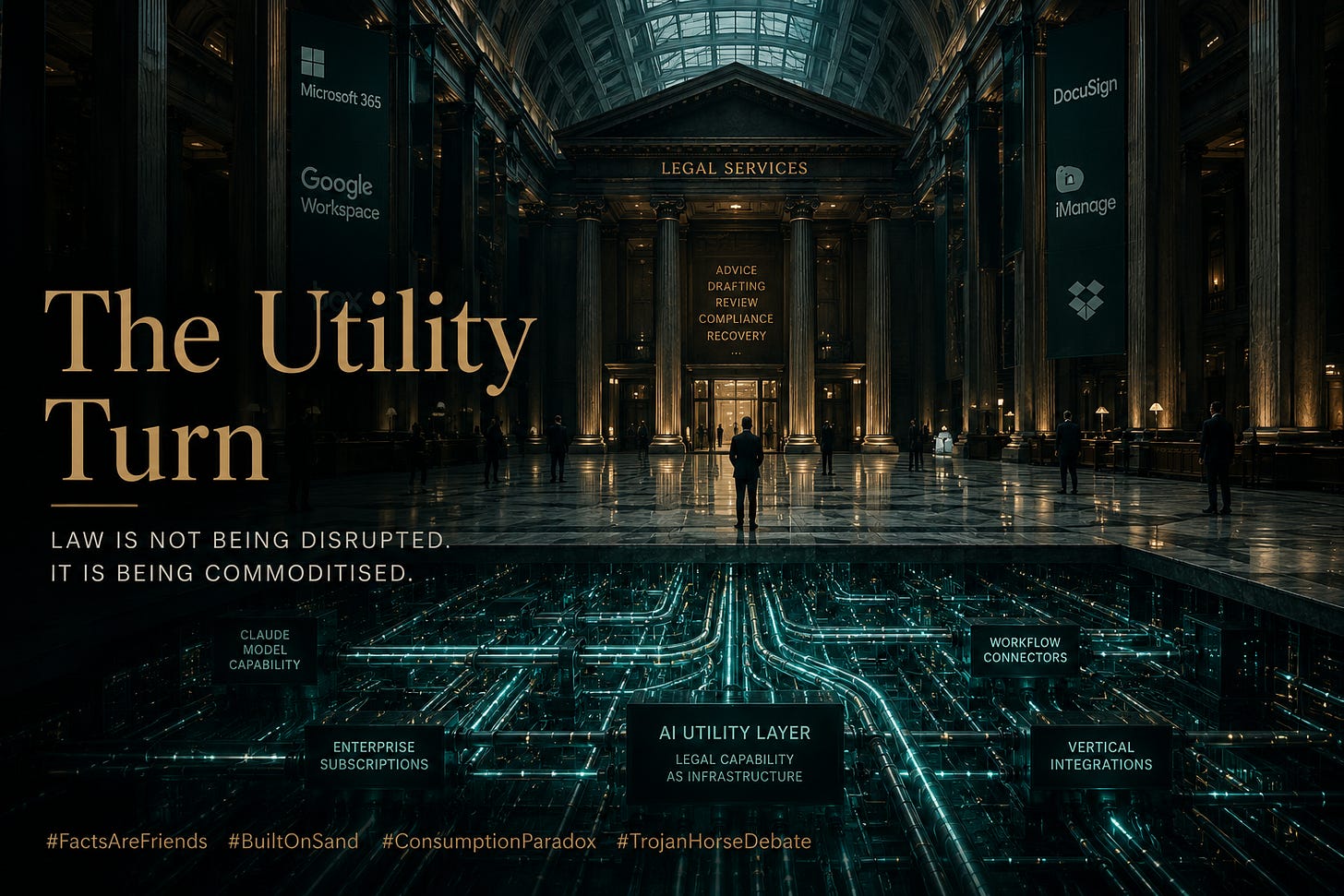
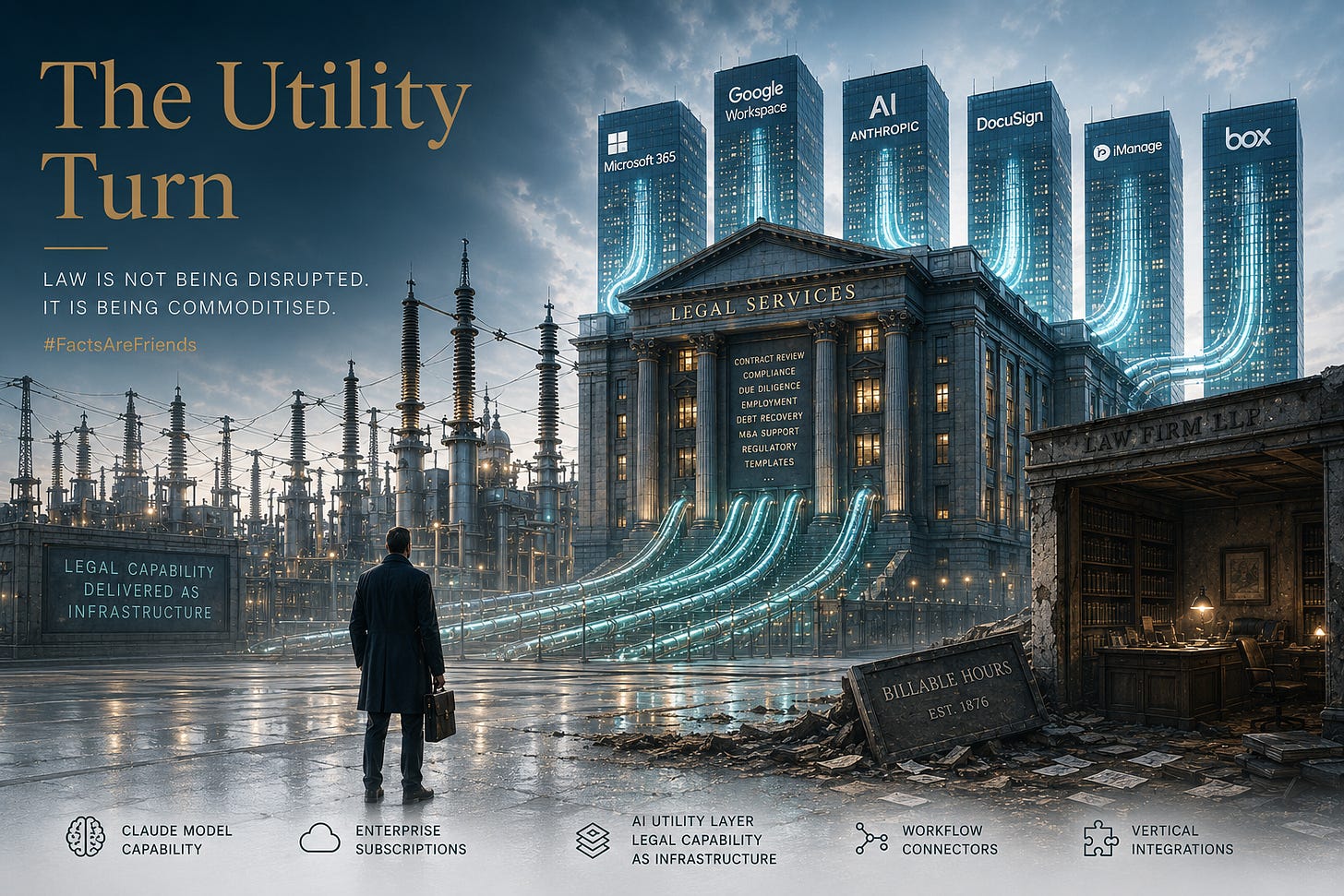
When electricity became a utility, manufacturers did not face a more efficient generator. They faced the grid. The question was no longer how to generate power more cheaply. It was whether to have a generator at all. For most the answer was no - go grid.
Anthropic is not building legal tools that compete with Harvey, Legora or law firms. It is building infrastructure that makes legal capability a function of the enterprise subscription that clients already hold. Microsoft 365. DocuSign. Google Workspace. Box. iManage. The legal work happens inside the tools clients already use. It is sold as part of the token subscription.
No procurement decision. No instruction placed. No lawyer called.
That is the Consumption Paradox at scale. (For the full argument, see The Consumption Paradox, February 2026.)
This is the dissolution of legal services as a separately purchased category. The demand is consumed before it reaches the profession.
The law firm becomes the distribution channel for a product the client no longer needs to buy separately.
And after the corporate market is addressed, the consumer market follows. Massive untapped demand, which was too costly for humans to address, now becomes routine for the bots.
We used to buy mobile, phone and broadband separately, now we often buy them as a bundle. Our AI subscription will offer so much more than a ChatBot …
The revenue tells the story
Anthropic’s revenue signals the story. $9 billion run rate in January 2025. $30 billion by April 2026. In four months. That revenue came from somewhere. Revenue that was previously distributed across hundreds of specialist SaaS companies and professional service firms is being absorbed into a single subscription.
Thomson Reuters and RELX did not get a decade of warning. They got a Monday morning.
What this means for law firms
The Built on Sand series argued that the valuations of Harvey and Legora cannot survive the foundation models entering their market directly. That argument was about legal tech companies.
The utility argument takes the next step. For now it is about law firms.
If legal capability is infrastructure - bundled into enterprise software at subscription cost - the demand for external legal instruction on routine matters does not compress gradually. It disappears at source.
Routine legal work is at immediate risk. Debt recovery, as Garfield has already demonstrated at scale. Standard contract review. Employment handbook drafting. M&A closing checklists. Regulatory compliance templates. Each is now a Claude plugin, or will be. The capabilities are already inside the model. The packaging is the only remaining step.
Yesterday I was asked to review a shareholders’ agreement created by Clio. Technically excellent - some commercial questions, but that is as it should be.
Today GenieAI amazes me by creating a settlement agreement.
The world is changing, fast. Complex legal work may not be threatened immediately .
Judgment, accountability, irreducible complexity - the matters where being wrong has catastrophic consequences - survive. For now. But the boundary between routine and complex moves with every model update. What required specialist advice 18 months ago is a plugin today. Today’s specialist today will be tomorrow’s commodity.
The question for every law firm is the same question every vertical SaaS founder is now asking. Which of my activities cannot be replicated? And which are latent AI capability waiting to be packaged?
The messaging
Throughout this transition, the companies driving it have been careful to reassure the legal profession. AI augments lawyers, not replaces them. The tools serve lawyers. The horses are being settled.
Some of those companies do not even sell to lawyers. They sell to the businesses that might otherwise instruct lawyers. Yet they make the reassuring argument anyway - because the ecosystem requires it. You can see examples by following my LinkedIn comments.
The Trojan Horse does not need to announce its intentions. It needs only to be welcomed inside the walls. If it is settled and groomed, so much the better. The reassurance is not an accident. It is the mechanism.
By the time the reassurance is no longer necessary, it will no longer be relevant.
What comes next
Legal was entered in February and expanded in May. Perhaps healthcare is next? Any business with billing and complex records. Real estate. Construction. In each case the pattern is the same: latent capability, deliberate packaging, market entry. The sequence does not stop at legal.
Some firms are already choosing which side of this transition to be on. The ones building for the utility environment - finding the work the utility cannot reach, owning the relationships it cannot replicate, operating at the complexity level it cannot yet address - will navigate it. The ones waiting for the reassurance to prove accurate will not have long to wait.
The capabilities are already inside the model. Waiting.
Good Enough is moving up the food chain. In legal, we can see the PacMan like trail as the ghosts of the old world are dodged.
Quentin Solt is a senior commercial solicitor, co-founder of Eurovestech and a strategic adviser on legal technology and AI. He writes on Substack at FactsAreFriends.
#FactsAreFriends #BuiltOnSand #ConsumptionParadox #TrojanHorseDebate #LegalAI