 Facts are friends

Harvey and Legora have raised hundreds of millions at billion-dollar valuations. Both promise AI “purpose-built for legal professionals“. The pitch: models trained on legal data, workflows for law firms, compliance baked in.
The legal profession, long resistant to technological change, appears to be embracing AI with unprecedented enthusiasm. Legal AI startups have collectively raised over $2.4 billion globally in 2025 alone. Europe has built an ecosystem of eight well-funded startups totalling $512 million. Clio recently completed the largest M&A transaction in legal tech history - a $1 billion acquisition of vLex at a $5 billion valuation.
The momentum feels unstoppable. But momentum and value are not the same thing.
Strip away the marketing and two troubling questions emerge. First: what exactly do these platforms offer that cannot be replicated by foundational models with decent prompting, proper context and appropriate guardrails? Second - and more troubling - are law firms paying to accelerate their own obsolescence?
This essay examines whether legal AI platforms possess defensible competitive moats - or whether their valuations are built on sand. It also explores who the real losers will be. My conclusion: while many investors will lose money when only one or two platforms survive, lawyers themselves may be the biggest losers of all. As I see it, lawyers are paying for Trojan Horses to be delivered into their citadels.
The Valuation Problem
The numbers deserve scrutiny.
Harvey’s $8 billion valuation on $100 million ARR represents an 80x revenue multiple. Legora’s $1.8 billion on $23 million ARR is 78x. These are extraordinary figures by any measure.
Compare this to typical legal tech companies, which trade at 5-7x revenue in the private market. Even accounting for premiums for high retention, network effects and switching costs, sector leaders rarely exceed 10-15x. The highest-performing B2B SaaS companies with net revenue retention above 130% might command 15-20x in exceptional circumstances.
80x is not exceptional. It is unprecedented.
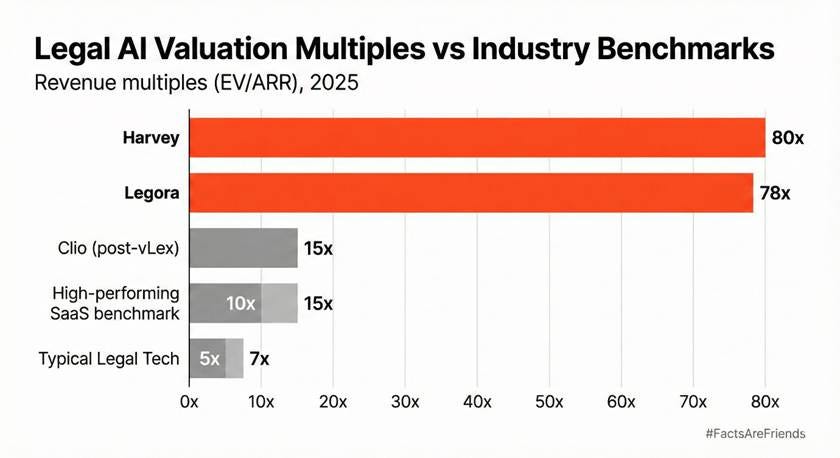
To justify an 80x multiple, investors must believe one of two things: either these companies will achieve exponential revenue growth that compounds for years or they possess structural advantages so profound that premium valuations are warranted regardless of current financials. There is another explanation, but that is less flattering to those funding.
The growth story has some support. Legora’s ARR grew from $4 million to $23 million within a year - nearly 6x growth - and is projected to reach $40 million by year end. Harvey reportedly serves 28% of the Am Law 100 and has 235 clients across 42 countries, including 8 of the 10 highest-grossing US law firms. These are impressive metrics.
But growth alone does not justify 80x. The structural advantage argument requires closer examination.
The Renewal Reckoning
There is a question that cuts deeper than multiples: how much of this revenue is durable?
At a recent LegalTech Connect panel in New York, industry insiders identified the core issue. As one participant observed: most of this explosive growth hasn’t gone through a single renewal cycle.
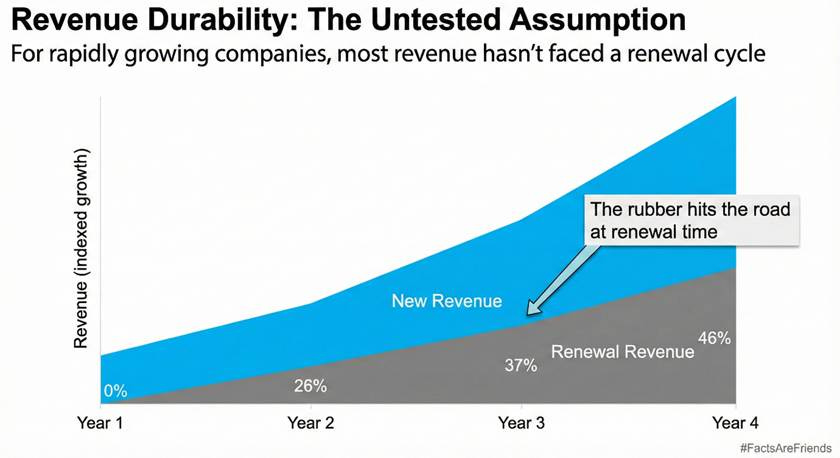
The arithmetic is sobering. For a company doubling annually, renewals as a percentage of revenue follow a predictable pattern:
Year 1: 0%
Year 2: 26%
Year 3: 37%
Year 4: 46%
Harvey and Legora are still in the early years of this curve. The revenue that supports their valuations is largely first-year subscriptions. We know the growth side of the equation. We do not yet know the retention side.
At 80x multiples, even modest churn could crater the investment thesis.
Andreessen Horowitz coined the term “AI tourist” to describe this phenomenon. When companies bring on masses of new users rapidly, distinguishing genuine long-term adopters from experimental users becomes difficult. There is growing discussion - both privately and on platforms like Reddit - about actual adoption rates within firms that purchased these tools. Some of the tech platforms are commissioning reports to demonstrate how lawyer love and rely on them. But they are missing a point they love the logic and efficiency the tech offers, but those benefits may be delivered by any number of tech solutions.
The buyer-user disconnect compounds this uncertainty. Chief Technology Officers and managing partners make purchasing decisions based on demos. Lawyers across the coal face determine whether, and how, the tool actually gets used daily. One does not necessarily predict the other. And associates may use the tool provided by the firm, but prefer the technology they use at home. As the home interface starts to satisfy the security and compliance that regulators demand, the must have benefits of the Legal Tech platforms start to diminish. That is a big risk for these platforms.
As one industry observer noted: “There is a huge surface level adoption of AI by firms who intuitively know that there is something valuable there. However the failure rate for AI implementation is HUGE! It takes more than entering into an expensive contract with a vendor and a couple of seminars to get staff to change their workflow”.
The first wave of renewals may not yet reveal whether we are looking at sticky enterprise software or expensive pilots that firms can live without. Even if they prove sticky for a year or two, how are they defensible against the fast-developing foundational models on which many of them are built?
It is only if investors see continued growth without churn that they will be able to justify the current valuations as visionary. If the numbers do not stack up, they will be revealed as delusional.
Tomorrow … why the Legal AI platforms are a Trojan Horse