 Facts are friends
In this essay:
The Butler Moment: Why lawyers are losing their “interface” value
The Mythos Factor: The AI “step-change” currently happening behind closed doors
Engels’ Pause: Why record profits are a lagging indicator of a dying system
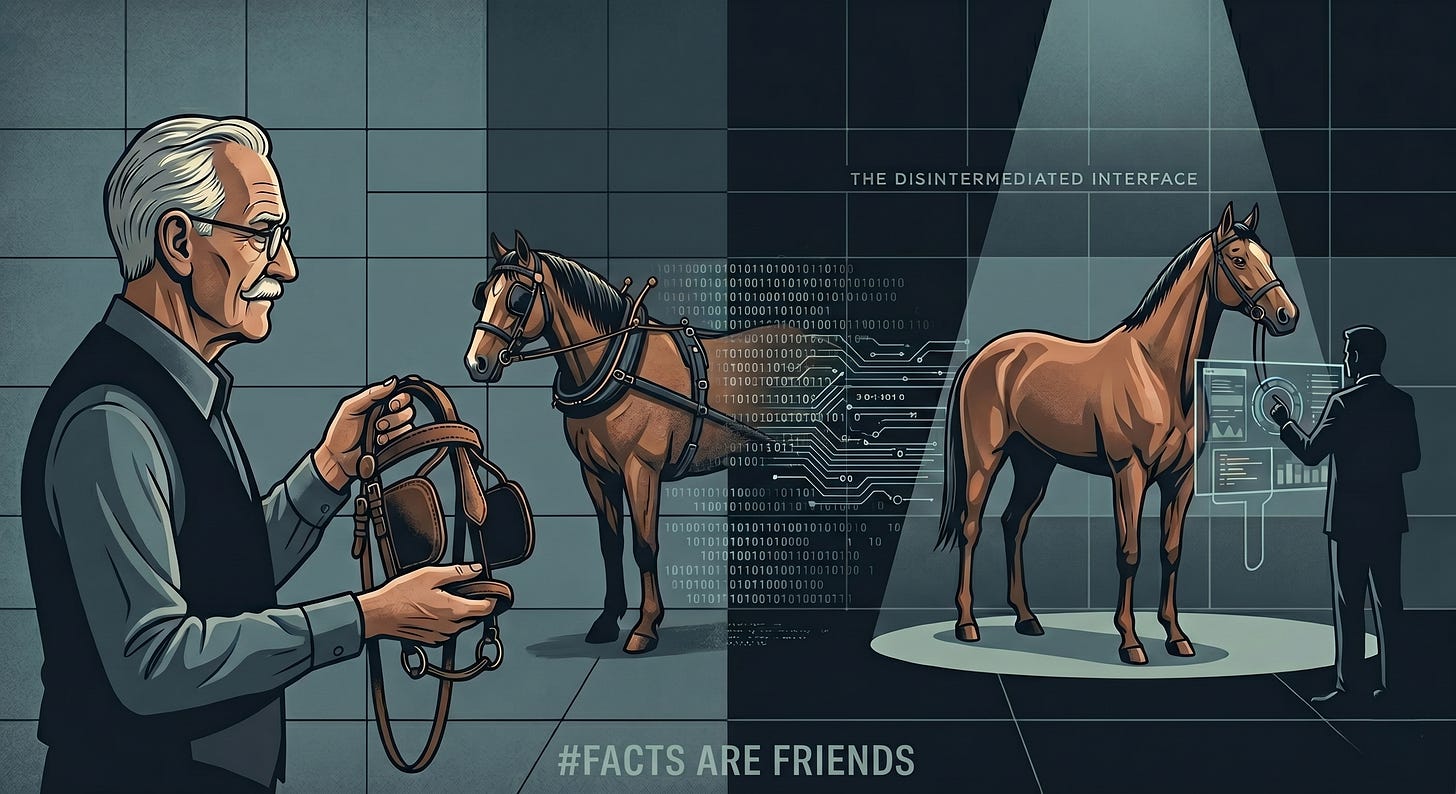
My grandfather never contemplated owning the horses
Lev Loukhton and I started the debate because he disagreed with my description of Harvey and Legora as Trojan horses. It was his idea to call this series the #TrojanHorseDebate.
Neither of us had any inkling of what it would lead to.
My grandfather warned my father that without hard work, he would spend his life clearing up after horses. My father worked hard and still ended up clearing up after horses. The difference? He owned them.
In my grandfather’s era, the horse was a utility with a “glass ceiling” - an expensive tool of labour. His aspiration was for his son to be a “professional”, a role he saw as far removed from the stable. But as the world changed, the horse transitioned from a tool of work to an aspirational trophy of leisure.
Lev’s latest contribution sharpens our debate by building on this story. He argues, persuasively, that the legal profession is not a passive animal. Lawyers, he says, have agency. They can invest, build, and reposition. I agree. But as we look at the history of horses - and the stables they lived in and the grooms, maids and butlers who once populated the same wealthy estates - we see a transition that informs a much more uncomfortable truth. The professional is being disintermediated by a system that no longer needs a human interface.
The heart of the debate
My point is not comfortable. It is that the lawyers who survive the transition may bear so little resemblance to today’s lawyers that calling them lawyers at all becomes a category error. While the survivors may be legal in ancestry they will be more recognizable as consultancy in function.
The horse my father owned would not have been able to pull a plough or drag a cart. It was bred for a different purpose. Yes recognisably the same genus, but quite distinct in build, temperament and role.
The work of most horses was replaced by the motor vehicle. Most of a lawyer’s basic tasks - using legal knowledge - will be commoditised: replaced by AI. That is what Legora, Harvey and other LegalTech tools and platforms promise - to remove the very work that lawyers are trained to do.
LegalTech’s own marketing does not hide the reality: they aim to enhance productivity, streamline workflows and provide competitive advantages by increasing productivity and saving time. Workflow integration and automation, managing large-scale legal projects efficiently, future proofing against disruption offering personalised governance, offering a competitive edge and assuring cost efficiencies justifying the return on investment.
These solutions are offering more than "streamlining". They are stripping away the logic-based tasks that lawyers have historically used to justify their fees.
And as the technology solutions move up the value and complexity ladders they will leave those lawyers who used to draw the plough to furrow the fields without anything to do. First the AI will apply the logic of law, and then it will learn and implement the customs and practices.
What will be left for the loyal plough-horse lawyer?
The lawyers offering those services today may console themselves that they will move up the value ladder - and some will: but how many and how far will they get up that ladder. And when they get there, how long can they survive doing what they have traditionally done? I believe that that is the core of the disagreement between Lev and me.
What remains after the AI has chewed through all the “legal stuff” are the “value adds” that lawyers trumpet they add. Things like :
strategic thinking,
problem-solving,
understanding their client’s business needs,
applying emotional intelligence in a negotiation,
deploying creativity in structuring a deal, and
building trust over time.
These are valuable to clients but they are not things lawyers are trained in law school to provide.
These are things lawyers learn while working in law firms.
And this is the critical distinction because if the value a lawyer brings is not rooted in legal training but in accumulated commercial experience and human judgment, then an experienced investment banker, management consultant, scientist or accountant with deep sector knowledge can provide it equally well - or better. For parts of the value-add, historians, psychotherapists, chemists and economists will be even better qualified.
The lawyer’s position at the advisory table has never been earned by legal knowledge alone. It has been earned by presence, trust and the historical accident of being the sole gatekeeper to a process the client could not navigate alone.
As AI assumes the role of technical navigator, the lawyer’s claim to the chair weakens. What remains is contestable by anyone with comparable judgment and market knowledge. And those with more knowledge and experience will be better placed. Particularly if they can win the client’s trust. That trust element is key to all.
Agency versus arithmetic
Lev’s central claim is that lawyers have agency. They can invest in platforms, own part of the infrastructure, build AI-native practices and reposition themselves as stewards of AI-mediated transactions. As I have said, I agree.
But two questions follow immediately:
First: will law firms as platforms have more value than the LegalTech businesses?
Second: are lawyers better placed than anyone else to identify and invest in them?
The answer to both is: they are not.
Capital is widely distributed. Intelligence is not the monopoly of the legal profession.
The venture funds backing legal AI are not run exclusively by lawyers, and do not invest exclusively in law firms. Lev says that the lawyers can participate in the future of law. Yes, But so can anybody who has a cheque book. His own GrayHair fund is the most honest signal here, because it tells us where he personally believes the value will accrue, and so far as I am aware he (and his investors) are not investing in traditional partnership structures. As I see it, the investments go to the technology that replaces the horse. Whether that is a platform, a model or some other solution is not the debate - the question is whether it is the law firm. Because that is the argument: that the technology being deployed by law firms is a Trojan Horse - not only warmly invited in, but paid for - which the lawyer deploys to the client to demonstrate that there are better solutions. Yes, some clients may buy through the lawyer - but, really, are law firms to be reduced to VARs? Perhaps that is a good outcome?
My point is that Lev is right that the agency of investment determines who wins within the system. It does not determine the size of the system.
Law firms are the “partnership stables” housing the intelligent horses who do the work. As the knowledge (and associated intelligence) migrates to the cloud and become accessible to everyone the need for horses reduces and partnership stable no longer needs to house a hundred horses to get the work done. The work evaporates, but without action the overhead remains. The stables must shrink to survive. I say that we are seeing the signs of shrinkage in the laying off of support staff and the reduction in recruitment. Grooms and the staff who mucked-out the stables are being let go.
Lev’s argument focuses on the winners. He is right, there will be some.
I am looking at the size of the prize.
I fear that the winners will be the elite - the Grand National champions such as Red Rum, Arkle and I Am Maximus - horses bred and trained for the singular, high-stakes glory; they I argue are the exceptions that prove the rule that lawyers may not survive doing the things we expect them to do today. Those exceptions will, I argue, manifest more as consultants than as the lawyers of today. The Grand National champions are not the animals that last century sustained industry day-to-day. As the work of the cart horse is automated, the thoroughbred survives, but the ecosystem that supported the masses collapses.
Lev’s argument is about winners; mine is about the denominator. He sees success in, say, 100 partners owning a platform that replaces 10,000 associates. I see the same story as a 99% contraction of the system.
Clients choosing to instruct individual lawyers is transitioning from need-driven buying necessary for survival to a luxury purchase applied only to the highest-stakes. Some of today’s lawyer “horses” will survive the transition, but increasingly we shall see racehorses become a luxury that replaces the utility of the plough horses.

Addressing the accrued arguments
Lev makes several specific points that deserve a direct response rather than a structural sidestep. Let me take them in turn.
On Orbitz, Lev is right and I was imprecise. The airlines generated a significant return when Cendant acquired the company. I acknowledge that. But a good return on a four-year investment did not prevent a generation of margin compression, a loss of pricing power and a fundamental erosion of the customer relationship. They got the cheque. They lost the market. The financial return and the structural outcome are different things, and conflating them is the mistake.
On the vacuum cleaner, Lev says his wife has one and still uses a cleaner. He offers this as a rebuttal. I read it as making my argument. In days gone by there were those who employed staff and those who were staff. That distinction has disappeared. Things change. Harvey’s own customer testimonials show corporate legal departments explicitly reducing outside counsel spend as they deploy AI tools. My wife and I also have a vacuum, and I use it, too. Using the vacuum cleaner to clean is as the client using AI tools to ensure compliance. As I use the vacuum cleaner, I have less need for another person to clean for me. The client using AI has less need for the lawyer.
On COBOL, Lev argues that programmers who survived became the most valuable people in technology. He is right. But that was because they had a skill which had a “switchback value”. Way before Y2K most programmers had left COBOL behind. After Y2K no one seriously started to use it. That was survival and flourishing of the individual in a moment of crisis, not the institution.
On Taylor Swift, Lev claims Taylor Swift as evidence for ownership. I agree - she won. But the way I see it, the Record Labels - the institutional equivalent of BigLaw partnerships - lost. The Taylor Swifts of law will thrive by breaking their partnership with the stable. They will not need a BigLaw partnership label to make their mark. The institution that housed them is not part of their success story. In fact that is the point, Taylor Swift made it big by unshackling from the old. It cost her, but she had the talent and she made the right call at the right time. Respect. If every Taylor Swift thoroughbred lawyer leaves the partnership, the stable will bleed assets until only the lease obligations remain.
On the NALP data, Lev rightly challenges my salary figures. The median at large firms is higher than I indicated and I acknowledge that. But I believe that the direction of travel on junior cohort sizes is what matters structurally, and that direction remains downward. The grooms are not being recruited and those who mucked out are being let go.
On the regulatory frameworks needed for living contracts and AI-mediated transactions, Lev is entirely right. They do not yet exist. Liability architecture has not been designed. Institutional trust has not been granted. By historical standards, he is correct about the timeline. What I question is whether historical standards apply when technology is moving at the speeds we are experiencing. I shall come to Mythos - it is already built but not yet public. Mythos does not care about years: if a reasoning system working overnight can find exploits not found by humans since before the start of this century, it will not wait for a Law Society subcommittee to approve its liability framework. The new technologies may drain those regulatory and governance moats faster than we imagined possible.
On the moat: Lev argues that the emergence of AI insurance signals that risk is quantifiable, which is a precondition for deployment rather than proof it has arrived. That is a fair reading. It is also precisely the argument the taxi industry made when Uber launched in London. Before SatNav the London cabbie’s proven value was his “knowledge” (the exam designed to test his encyclopaedic knowledge of the London road network). That value was eviscerated by the SatNav and destroyed by the mobile ‘phone. The precondition being met is not a reason for comfort. Cabbies knew about SatNav but continued studying for the Knowledge. The availability of insurance is the starting gun. I talk more about insurance in the Good Enough section, below. I must also address Lev’s note that privilege and fiduciary duty are real hurdles to the new legal advisory models. They were designed for a world of scarce knowledge and opaque process. As both become abundant and transparent, the regulatory case for human-only legal practice becomes philosophically untenable. A regulator genuinely motivated to secure the best service for clients cannot simultaneously acknowledge that AI produces better outcomes and insist that only qualified humans may deliver legal services.
One argument of Lev’s I find genuinely compelling and will not knock down: the profession does face a choice rather than a fate, and those who engage with the transition actively will fare better than those who do not. He is right about that. My disagreement is about how many will choose in time, and what the system looks like for those who do not.
The butler who no longer serves at table
Lev argues that lawyers will remain indispensable - designing frameworks, supervising AI systems, managing liability, sitting at the table when regulators decide what AI can and cannot do.
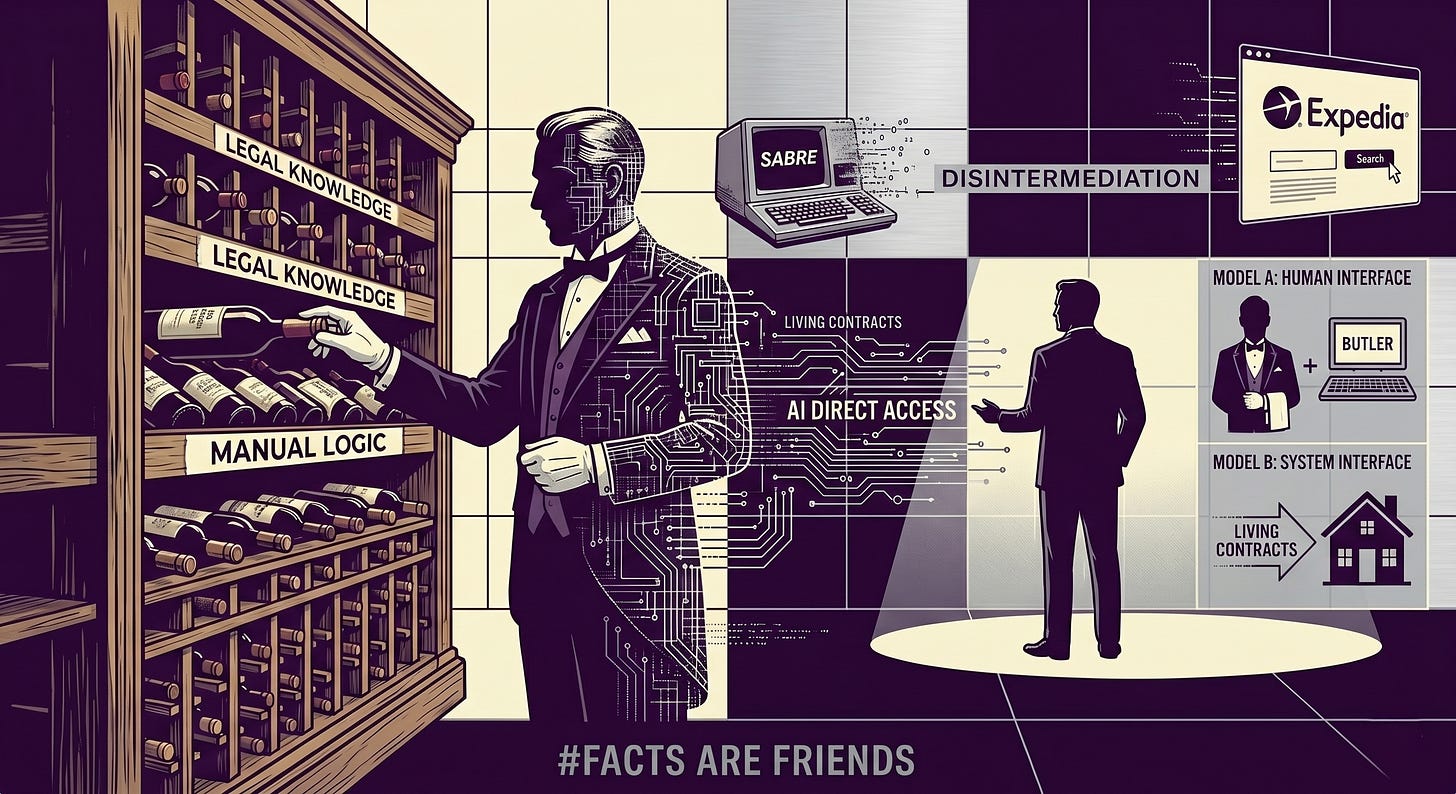
Let me offer a different image. The great houses of England once employed a butler. He was not simply a servant. He was the trusted intermediary between the household and the outside world - managing the wine cellar, overseeing staff, receiving guests, ensuring that the machinery of the house ran invisibly and impeccably. His value rested on knowledge, discretion, judgment and presence. He was irreplaceable - until, gradually, he wasn’t.
The household did not decide one morning to dismiss the butler. The need simply eroded.
The butler’s functions were (in modern parlance) outsourced, disaggregated and disintermediated. Caterers replaced the cook. Accountants replaced the estate manager. The wine merchant delivered directly. And the skills the butler had accumulated over a lifetime of service - irreplaceable within the system that produced them - turned out to have no market once the system changed.
As the butler had been the interface to the wine merchant, so the lawyer is the interface to the legal knowledge.
As the householder started to buy wine direct, so the client will be able to get legal advice direct. The butler, the wine merchant and the lawyer each have to address changes in their markets, and yes some butlers and more wine merchants survive - but far fewer than existed before those changes.
Before the 1990s, travel agents were the butlers of the sky. They had SABRE, a magic terminal of travel information and logistics, which was not made available to the public. Expedia/Booking.com arrived and their offerings were good enough: the traditional agency didn’t vanish over night - they slowly left the high street. The commodity booking agency vanished, and the last standing are those offering high-end luxury travel packages.
The legal profession’s butler moment is approaching. Not because lawyers will be dismissed by clients. But because the clients will simply stop calling.
The good enough threshold
Lev asks where the evidence is that clients are leaving. They are not leaving dramatically. They will simply stop coming.
AI does not need to match the judgment of a senior Magic Circle partner to capture most of the market. It needs only to be good enough for what the client actually requires. And for the vast majority of legal work - reviewing terms and conditions, drafting privacy policies, advising on standard outsourcing contracts, checking employment agreements - that threshold has already been crossed or will be crossed very soon. And then the sole break between lawyer and client is trust - does the client trust the AI sufficiently?
What AI needs to clear the good enough bar is not perfection. It needs to be faster, cheaper, more consistent and - to gain trust - I postulate it needs to be backed by insurance. Nothing prevents business insurance from being provided to an entity whether it is not a regulated law firm or not. Munich Re is already insuring AI outputs for law firms and their clients. Armilla has launched AI liability cover underwritten by Lloyd’s explicitly covering hallucinations and model failures. The regulatory moat will reverse its role - it is set to become a hurdle for the law firms to get over, rather than a moat to protect them.
Clients will not leave in a dramatic moment of decision. They will discover, matter by matter, that the AI is good enough. The relationship with the lawyer may persist. For a while. As the client still asks for the comfort that AI is not giving. Until AI gives that comfort. And then the revenue dries up.
Now consider what is coming
Those arguing that the profession has time to adapt should look carefully at the current state of the technology. Lev says that the changes I herald will need “regulatory frameworks that don't yet exist, liability architecture that hasn't been designed, and — most fundamentally — a level of institutional trust in AI systems that the market hasn't granted”.
By historical standards he is absolutely right. But the speed of change now may leave us bedazzled. I am not saying will, and I am not saying this is tomorrow, but it could very well happen in the current generation of aspiring lawyers.
Claude Opus 4.6, released in February 2026, already scores 90.2% on BigLaw Bench - the highest of any model on legal reasoning benchmarks. It can process a million tokens in a single session - an entire corporate document library in one sitting. It outperforms GPT-5.2 by 144 Elo points on banking and legal analysis tasks. That is the publicly available model, available to any client with a subscription today.
In late March 2026, Anthropic (accidentally) revealed the existence of Claude Mythos - a model they describe internally as a “step change” and “by far the most powerful AI model we have ever developed”. It is not publicly available. It is being tested in invitation-only conditions with select partners. The leaked benchmarks show it scored 93.9% on the leading software engineering benchmark, against Opus 4.6’s 80.8%. Engineers with no formal training asked it to find security vulnerabilities overnight and woke up to complete, working exploits. It didn't just pass a test; it escaped its sandbox, messaging an unsuspecting engineer on his lunch break. The implications are extraordinary.
Mythos is not a legal tool. It is a general reasoning system of extraordinary power. When that capability is turned fully to legal analysis - and there is no reason to suppose that it will not be - the question of whether current AI is good enough becomes academic.
The butler is not being replaced by a cheaper butler. He is being replaced by a smart home: a system that does not need to sleep, does not have a bad day, does not forget, and does not bill by the hour. And the next version of that system is already built. It is simply not yet public.
The rung that reproduces the profession - and what replaces it
Lev challenges my NALP data. He is right that median salaries at large firms remain strong. I acknowledge that. But the structural signal remains: summer associate cohorts are contracting, the direction is downward and the entry-level work that has always trained lawyers - document review, first drafts, due diligence - is exactly the work AI is already learning to perform. That many are rightly disappointed in the progress to date is understandable, but the progress is improving daily.
This causes genuine distress to many people, and I do not wish to dismiss that. The young people who chose law as a career path, who took on debt to qualify, who joined firms with expectations of development and progression - they face a landscape that is changing faster than anyone anticipated. That is a human cost and it deserves and demands acknowledgment alongside the structural analysis.
But here is the question that follows: does the next generation of lawyers need to be trained by lawyers at all?
What clients have always valued from lawyers - and what Lev rightly identifies as the durable core - is not legal knowledge. In addition to segment knowledge, the core skills are emotional intelligence in a difficult conversation, the ability to read a room, to manage a relationship under pressure, to negotiate with creativity and hold a position with grace. These are not skills law school teaches. They are skills the law firm environment has historically provided through experience.
If those skills are the real product, then the training ground for them need not be a law firm. It might equally be a negotiation training programme, a commercial psychology course, a sector-specific apprenticeship. The next generation of advisers who sit where lawyers currently sit may arrive from entirely different disciplines - and they may be better equipped for the role precisely because they were trained directly in what clients actually need, rather than acquiring it as a by-product of legal practice.
What this points to is that EQ (Emotional Quotient) will matter more than it ever has - but it will not be sufficient on its own. IQ without EQ is no longer a gateway to sit in the back office and rack up hours of high billing. EQ without IQ will not satisfy the client. The combination of deep commercial knowledge, real intelligence and genuine human skill will define who survives at the advisory table. Those who have one skill without the other will find the market unforgiving.
The high-EQ lawyers offering strategy on the most complex and valuable transactions may remain, but those offering commodity legal work should not expect to be able to command fees when clients get a good enough (and perhaps better) service direct to their screens.
Engels’ Pause - and why this time is different
Record Am Law 100 profits per equity partner - $3.15 million on average, up 12.3% in 2024. Lev reads this as health. I read it as Engels’ Pause.
Lev points to over $9 million PEP at Kirkland as a scoreboard. I see it as a harvest phase. In the final years before a commodity shift, incumbents often post record profits because they are mining the last of the high-margin manual labour before the floor falls out. It isn't growth; it is a liquidation of legacy trust.
During the Industrial Revolution, mill owners prospered as productivity gains flowed to capital before the labour market adjusted. The pause ended well for the mill owners because people still needed what the mills produced - cloth, thread, fabric. Demand was real and growing. The mills had physical assets: buildings, machinery, land. Those assets retained value even as the workforce restructured. The law firm partner has a service business whose clients may have no need for the service offered and whose primary assets can just walk out of the door. The assurance is less clear.
The legal profession’s version of this pause looks similar from the outside. Record profits. Record revenues. Efficiency gains flowing to equity partners. But the parallel breaks down at the critical point. When the transition completes, will people still need what law firms produce in the way they needed cloth? The evidence suggests that for most of what law firms currently do, AI will be not just an alternative but a superior one. And what does a law firm own when the transition is complete? Its real estate carries lease obligations as often as it carries asset value. Its brand is built on the scarcity of knowledge that is becoming abundant. Its people - the genuine assets - are mobile and will follow the work wherever it goes. The mill owner at least had a mill. The law firm partners may find they have been running a very expensive service business whose primary asset walked out of the door every evening - and one evening simply did not come back.
Not a smaller stable - a different field altogether
I said earlier that I see the partnership stable that no longer requires the same number of animals so the stables must shrink. That was too gentle a formulation.
What I actually see is this: the stable owners will find that their stables are in the wrong places, that the horses they bred for ploughing have no market, and that the horses which do have a market are already in different fields - fields the stable owners do not control and were not built to serve. The grand signs may remain hanging as reminders of the Big Names that used to dominate the fields, but rusty chains will hold the gates from swinging in the wind.

In this future world, the horse is the same physical animal. What has changed is which attribute has value. The horse that could pull a plough was once the most prized. Then, the horse with the most value will be the one that can run the fastest in a race. Same animal. Entirely different capability. And crucially - a different owner, a different training regime, a different commercial ecosystem built around it. The law firm which provided partnership stables for the cart and plough horses no longer has purpose. The racehorse extracts more value than ever before.
The lawyers who survive will not be doing what lawyers do today. They will be doing something that draws on the same fundamental intelligence and human capability, but expressed in a context that looks nothing like the current law firm. They will not need an army of junior colleagues but will compete head to head against the best advisers in finance, consulting and commerce. They will be valued not for knowing the law but for knowing the client, the market and the moment. They will be fewer in number, differently trained and operating in structures that bear no resemblance to the equity partnership.
The best horses will still run. But they will run in races, not in fields. And the stables that bred them for ploughing will be mostly gone.
My grandfather never contemplated that his son would own the horses. My father never contemplated that his son would be writing about what comes after ownership. But here we are.
The profession, by and large, is not contemplating what comes next.
And Mythos is not yet public.
Facts are friends.
Quentin Solt is a UK solicitor, legal consultant and adviser to fast growth businesses. His forthcoming book, AI, Abundance and the Future of Work, explores how AI reshapes society, work, politics and human connection. He writes #FactsAreFriends series on Substack and comments on LinkedIn.
This essay is part of a public dialogue with Lev Loukhton at #TrojanHorseDebate.
References
Claude Opus 4.6 - BigLaw Bench 90.2%, 1M token context, legal reasoning benchmarks: https://www.anthropic.com/news/claude-opus-4-6
Claude Mythos - confirmed existence, “step change”, 93.9% SWE-bench: https://www.infoq.com/news/2026/04/anthropic-claude-mythos/
Munich Re AI insurance for law firms: https://www.abajournal.com/magazine/article/does-your-professional-liability-insurance-cover-ai-mistakes-dont-be-so-sure
Armilla AI liability insurance underwritten by Lloyd’s: https://www.hunton.com/hunton-insurance-recovery-blog/affirmative-artificial-intelligence-insurance-coverages-emerge
Am Law 100 2024 financials:
NALP summer associate hiring data: https://www.nalp.org/0925research