 Facts are friends
This is the second essay in a series examining the structural disruption of the legal data industry. The first essay, The Data Giants’ Dilemma, examined whether Thomson Reuters and RELX would defend the subscription portal or become embedded verification infrastructure. The Claude for Legal launch in May 2026 confirmed that both have, at least in part, chosen the infrastructure path. This essay asks the harder question: on what commercial terms does that infrastructure get packaged, priced and distributed - and whether the market they are pivoting toward is as large as they need it to be.
TL;DR
Thomson Reuters and RELX have made the infrastructure pivot. Both are now embedded as MCP connectors in Claude for Legal. LexisNexis has integrated Claude’s plugin suite directly into Lexis+ with Protégé. The paywall stays. The data moat stays. But the interface is now Claude, not Westlaw - and not the lawyer.
The next development will be more disruptive still. Legal data will eventually be packaged as a bundled token - included in the AI subscription that Anthropic or another foundational model sells as a utility to the end customer. Like the old mobile plan with texts bundled in as standard, it will be enough for most small businesses to handle routine legal requirements without instructing a lawyer at all.
The economics of that model raise a question neither Anthropic nor the data giants have yet answered publicly: who pays for the commodity bundle?
But beneath that commercial question lies a deeper and more unsettling one. The token bundle model assumes clients will want verified legal data in whatever form it is packaged. What if, in sufficient numbers, they do not? What if the Good Enough threshold is lower than anyone has modelled - not good enough to bypass the lawyer, but good enough to bypass the verification layer entirely?
If that risk materialises, the giants are not simply disrupted. They are irrelevant. And by the time they recognise it, they may find - like Gulliver waking on the shore of Lilliput - that thousands of small actors have been quietly tying them to the ground while they slept.
The window to move freely is narrowing. It has not yet closed.
The pivot confirmed
In The Data Giants’ Dilemma I argued that Thomson Reuters and RELX faced a binary choice: defend the law firm subscription portal and shrink alongside a contracting profession, or become the verification infrastructure embedded inside AI-native legal workflows. The infrastructure pivot, I argued, was the only path that did not lead to managed decline.
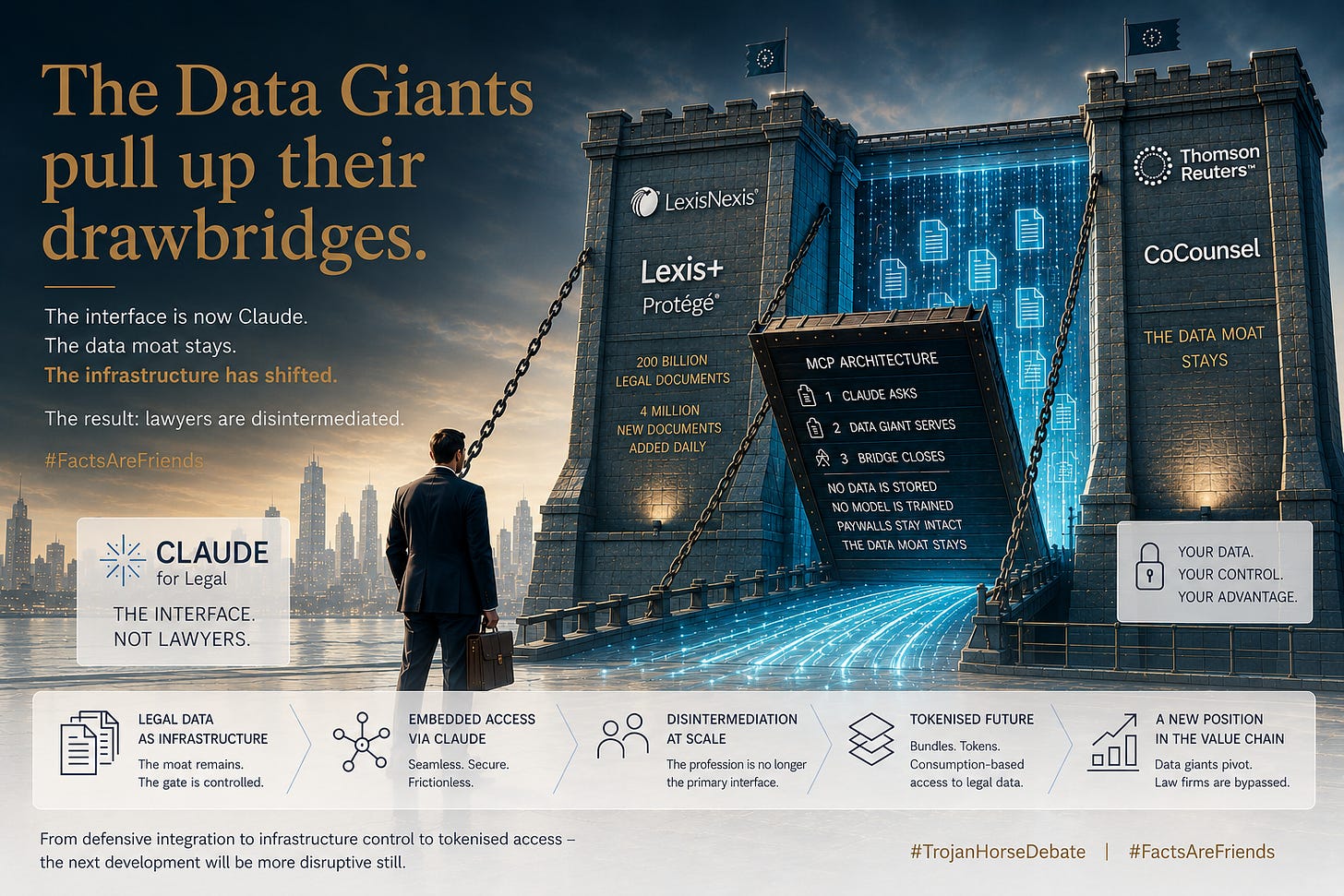
On 12 May 2026, Anthropic launched Claude for Legal - more than 20 Model Context Protocol connectors wiring Claude into the software that law firms and legal departments already run on, and 12 practice-area plugins providing pre-configured workflows for corporate, litigation, privacy and other disciplines. Among the MCP connectors: LexisNexis and Thomson Reuters.
The following day, LexisNexis announced the integration of Anthropic’s Claude legal plugin suite into Lexis+ with Protégé, grounded in its repository of 200 billion legal documents with four million new documents added daily.
The pivot the first essay recommended is now a live deployment.
The MCP architecture matters and is worth understanding clearly. When a lawyer asks Claude a legal research question, Claude does not bypass TR or RELX. It asks them. The data giant drops its drawbridge and serves up the result. The bridge then closes. No data is stored in Claude’s training corpus. No models are trained on the firm’s private queries. The paywall is not breached. The data moat stays.
But the interface is now Claude. Not Westlaw. Not CoCounsel. And - increasingly - not the lawyer.
This is not a defensive move. It is the infrastructure pivot made visible. And it raises the question that the first essay left open: now that the pivot has been made, what is the commercial model that captures the value?
The mobile minute moment
In the early 2000s, mobile networks shifted from per-minute billing to bundled minutes. You paid a monthly fee. The fee included a bundle of calls and texts as standard. Most users did not use them all. The network charged for the bundle regardless.
That single commercial model change transformed consumer behaviour more profoundly than any technology change of the decade. Voice calls were commoditised overnight. The networks that had built the infrastructure found themselves charging less per unit of use, but reaching far more customers, far more consistently. The per-minute premium disappeared. The monthly subscription became universal.
Legal data is approaching its mobile minute moment.
The per-seat subscription model - in which law firms pay for lawyer headcount access to Westlaw and LexisNexis - is the per-minute billing of the legal data industry. It is priced for professional intermediaries who use the product intensively and pass the cost through to clients. It is not priced for end customers who need occasional, targeted, verified legal intelligence without a law firm in the loop.
The bundled token model changes that. It puts verified legal data access inside the AI subscription that millions of businesses already pay for. It reaches markets that the per-seat model never served. And it raises the fundamental question of who sets the terms of the bundle - and who captures its value.
The token bundle model explained
The model works as follows.
Anthropic - or whichever foundational model platform achieves sufficient scale in the legal market - sells a Claude for Legal subscription. Bundled into that subscription is a standard allocation of legal data queries: tokens that allow the user to access TR or RELX primary law, citator infrastructure and regulatory content via MCP connector.
For most small businesses handling routine commercial matters, the standard bundle is sufficient. The NDA, the straightforward commercial agreement, the employment contract, the basic regulatory check - all of these can be handled within the bundle without additional cost. The verification layer travels with the query. The citator confirms the authority. The answer is professionally grounded.
When the user needs more - a complex cross-jurisdictional transaction, a contested regulatory interpretation, a high-stakes litigation research task - additional tokens are available. The volume-based pricing makes individual top-up tokens cheap. The commercial risk of the complex matter justifies the additional spend.
The result is a legal data distribution model that reaches millions of businesses that the per-seat subscription model never touched. The small manufacturing company in the Midlands that currently relies on its general manager’s legal instinct when reviewing a supplier contract. The technology startup that signs agreements without legal review because it cannot afford a law firm. The sole trader who has never heard of Westlaw.
For all of them, the bundled token provides something that previously did not exist at an accessible price point: verified, citator-grade legal intelligence, available inside the AI workflow they are already using, at a cost that feels proportionate to the commercial stakes involved.
This is the Good Enough thesis applied to distribution. The bundle does not need to be as comprehensive as a full Westlaw subscription. It needs to be sufficiently good, sufficiently verified and sufficiently cheap to be chosen over the alternative - which, in most cases, is no verified legal data at all.
The economics: who pays for the bundle?
This is the question that has not yet been answered publicly - and I believe that it is the most consequential commercial decision in the legal data market since the internet made case law searchable.
There are two plausible models, with a third hybrid option that is commercially the most sophisticated and politically the hardest to negotiate.
Model one: Anthropic pays
In this model, Anthropic treats the legal data bundle as a customer acquisition cost and a product differentiator. It subsidises the commodity tokens - paying TR and RELX a licensing fee per token consumed, at a rate that makes the bundle economically viable for the data giants but cheap enough to be included in the standard Claude for Legal subscription.
The logic is the mobile handset model. Networks gave away expensive handsets to win subscribers. Anthropic gives away verified legal data access to win professional users. The cost of the bundle is absorbed against the long-term value of locking in the legal market at scale.
For TR and RELX, this model provides a reliable, high-volume licensing revenue stream from a single counterparty. The per-token rate is lower than the per-seat subscription rate. The volume is vastly higher. The net effect on revenue depends entirely on how many of those tokens would have generated subscription revenue through the traditional model - and how many represent genuinely new demand that the subscription model never reached.
Model two: TR and RELX pay
In this model, the data giants treat the token bundle as a market development investment. They provide a commodity allocation of tokens at cost - or below cost - in exchange for putting verified legal data in front of millions of end users who have never previously had access to it.
The bet is twofold. First, that exposure to verified legal data at the commodity level creates demand for higher-tier products when the stakes are sufficient. The business that uses its standard token bundle for routine contracts will, when it faces a genuinely complex matter, convert to a professional subscription or instruct a law firm that already pays for one.
Second, that the data giants can build a direct relationship with the end customer - bypassing the law firm entirely - and use that relationship to upsell products and services that the traditional model could never offer.
This is the direct-to-consumer strategy the first essay identified as the most aggressive form of the infrastructure pivot. The token bundle is the mechanism that makes it economically viable.
Model three: the co-investment hedge
The most commercially sophisticated option is a joint investment model in which Anthropic and the data giants share the cost of the commodity bundle and share the data on conversion rates and usage patterns.
Anthropic gets the differentiated legal product. TR and RELX get market development at scale and the usage intelligence that allows them to optimise the upsell pathway. Both parties share the risk of a model that neither has previously operated.
This is the hardest to negotiate, requiring data-sharing arrangements that neither party will agree to without significant contractual protection. It is also, in the long run, the most strategically coherent - because it aligns the incentives of the platform and the data provider around the same outcome: maximum adoption of verified legal intelligence at the base, maximum conversion to premium products at the top.
I will argue that this is the better way forward: each party seeking to deal on a transparent basis to build a sustainable commercial relationship.
The disintermediation pathway
At what point does bundled token access result in the “Good Enough” threshold - the point at which the instruction to the lawyer is never made because the client has already found the answer (or, at least, accepted guidance that was “Good Enough”, where the lawyers’ indemnity policy, regulatory protections, delays, foibles and costs no longer outweigh the sheer relief of getting “advice” that appears sufficient o get on with the real job in hand)?
The Good Enough thesis, which I set out in the Consumption Paradox essay in February 2026, holds that AI makes legal services cheaper to deliver while simultaneously destroying the demand that pays for them. The two effects do not cancel out. They compound.
The token bundle is the mechanism by which that compounding accelerates for routine commercial legal work. Not because the bundle is as good as a law firm. But because it is good enough, available immediately, grounded in verified data and priced at a fraction of the cost of professional advice.
For standard documents, basic employment contracts, routine lease renewals and straightforward commercial terms, the bundle will be sufficient for the majority of SME users within two to three years. The instruction to the lawyer is not made. The Westlaw subscription is not opened. The Consumption Paradox compounds.
For complex, high-stakes or novel matters - cross-jurisdictional transactions, contested regulatory interpretation, significant litigation - the bundle is insufficient and professional advice remains essential. But those matters represent a shrinking proportion of the total volume of legal work undertaken by businesses in the economy.
The pyramid hollows from the base upward. The routine work disappears into the bundle. The complex work remains. But there is less complex work than there used to be, because many of the commercial decisions that previously generated complex legal questions are now being made more straightforwardly by businesses that have adequate verified intelligence at their disposal.
The law firm’s customer channel does not collapse overnight. It compresses, fragments and migrates. Some demand disappears. Some migrates to cheaper providers. Some internalises. Some shifts upstream to the genuinely complex matters where human judgement remains essential.
TR and RELX are better positioned in that world than they are in the world of defended subscription portals. But they are not positioned perfectly. Because the token bundle creates a pathway for disintermediation that reaches not just law firms but the data giants themselves.
The verification layer as the last moat
Even in a fully commoditised token economy, not all tokens are equal.
The token that carries Shepard’s verification - that confirms the legal authority underpinning the answer remains good law, that tracks its subsequent treatment, that flags if it has been overruled or distinguished since the AI was trained - is worth more than the token that provides information without context and assurance.
This may be a mechanism by which TR and RELX preserve price differentiation within a commoditised distribution model. The commodity bundle carries basic legal intelligence. The premium token carries verified, citator-grade intelligence. The difference between the two is not the answer. It is the professional defensibility of the answer.
As I argued in the first essay, the value in legal AI is shifting from producing answers to proving they are correct. Generation - drafting, summarising, researching - is commoditising rapidly. Verification - is this right, current, binding and applicable - remains scarce.
The data giants hold the verification infrastructure. Shepard’s Citations. KeyCite. Apparently four million new documents added to the LexisNexis repository daily (let’s not spend too long considering how many of these have real value: sufficient to say that some do and in the age of Big Data, more will be seen as better). The live feed of legal reality, updated continuously, telling you not just what the law says but whether it still says it.
No foundational model can replicate that infrastructure overnight. No open-source platform can substitute it. No AI trained on data with a cut-off date can offer the same assurance. The verification layer is the last moat - and it is a real one.
The strategic question is whether TR and RELX gate the verification layer appropriately within the token model. The commodity bundle should carry basic legal intelligence without citator verification. The premium token - the top-up, the complex matter query, the high-stakes research task - should carry the full verification infrastructure.
If they allow the verification layer to commoditise into the standard bundle, they have surrendered their last durable advantage. If they gate it intelligently, they have the basis of a pricing model that survives the transition from subscription to token economy.
The law tells you what is permitted. The verification layer tells you whether it still does.
What this means for law firms
Law firms are the transmission channel through which the disruption reaches the data giants. As the token bundle reduces the volume of legal work that flows through law firms, the per-seat subscription base that generates TR and RELX revenue contracts.
But the law firm’s deeper problem is the one I examined in the first essay and have been arguing across the #TrojanHorseDebate since March 2026. It is not the loss of the research function. It is the loss of the embedded judgement that the research function built.
Lawyers claim judgement as their irreplaceable value layer - the capacity to understand the characters, the deal drivers, the history and the dynamics of a transaction. That claim is not wrong. But it is not innate. It is acquired through immersion. Through being at the table from the very beginning of the transaction. Through absorbing context that is never written down.
If AI handles the mechanics sufficiently well that lawyers are only invited in when judgement is required, they will arrive without the embedded context that made their judgement valuable. They will need to be briefed. And others can be briefed equally well.
Nothing in law school prepares a lawyer to provide that service without the transactional immersion that AI is now beginning to displace. The profession’s deeper dilemma - what the law firm looks like in 2030, what skills it employs, what training it requires - is the subject of the next essay in this series.
For now, the observation is simpler. Law firms that survive the token economy will be those that provide what the token cannot: the relationship capital, the commercial instinct, the ability to read the room at speed. The question is whether those skills can be maintained when the transactional immersion that built them has been automated away.
The unexpected risk: do clients actually care enough?
The token bundle model rests on an assumption that needs to be challenged. It assumes clients will want verified legal data in whatever form it is packaged. It assumes the Good Enough threshold is the point at which AI-generated legal output is sufficient for the client’s purpose and also the point at which clients will seek verification before proceeding.
That assumption may be wrong.
Imagine the client who drafts her own privacy policy using an AI tool embedded in Word. My first essay identified her as the canonical example of the Consumption Paradox. She does not find a cheaper lawyer. She finds she does not need one. But the token bundle model assumes she will at least seek verified legal data as part of that self-service process - that she will consume a token, query the citator, confirm the authority.
What if she does not? What if the AI output feels sufficiently confident, the commercial stakes feel sufficiently manageable and the cost of even a bundled token query feels like one step too many?
Some clients will use the bundle eagerly. They are the ones for whom the Good Enough thesis clearly applies - who understand they need some verification but do not want to pay full subscription rates or law firm fees to get it.
But others will go further. They will decide that the commercial risk of proceeding without verification is acceptable, that their counterparty is in the same position and that the contract is a framework for a commercial relationship rather than a legal instrument requiring professional-grade authentication. They will settle agreements on the basis of AI-generated output alone - no token consumed, no citator queried, no verification sought.
How many will fall into that second category? Nobody knows. The legal market has never operated in a world where AI-generated commercial agreements were available at zero marginal cost. There is no historical data on how many SME clients, given a genuinely accessible and affordable verification option, would choose not to use it. There are only models - and those models are built by people who assume legal verification will always be sought because it has always been sought.
The darker version of the Consumption Paradox runs like this. It is not merely that the instruction to the lawyer is never made. It is that the verification is never sought either. If that happens at scale - if a significant proportion of the SME market that the token bundle is designed to reach decides that verified legal intelligence is a cost they choose not to incur - then the commercial model that TR and RELX are pivoting toward does not generate the volume they need.
The market does not migrate to the bundle. It bypasses the bundle entirely. And the Consumption Paradox compounds in a direction that nobody in this market is yet modelling.
Might the take-up of verified legal data ultimately be lower in the AI age than it is today? Not impossible. The clients who currently generate demand for Westlaw and LexisNexis do so because they instruct lawyers who then instruct Westlaw and LexisNexis on their behalf. Remove the lawyer from the loop, and you remove the professional obligation that drove the verification search. The end client, operating without professional advice, may simply not know - or not care - whether the authority they are relying on remains good law.
This is the risk that neither the data giants nor the foundational model platforms have yet publicly addressed. And if it materialises even partially, the infrastructure pivot - however correct in direction - may not deliver the commercial outcome that justifies it.
Do the giants still have a choice? The Gulliver problem
There is a famous image from Gulliver’s Travels - Jonathan Swift’s 1726 satire - in which a man wakes to find himself unable to move. He is not a giant. He is a perfectly ordinary man among the tiny Lilliputians. He has not been overwhelmed by a single powerful adversary. He has been tied to the ground by thousands of small actors while he slept: each thread trivial, each knot easy to dismiss, but together forming bonds he cannot break without a deliberate and coordinated effort he is no longer well placed to make.
TR and RELX are not Gulliver. But the image is instructive.
Each individual constraint on their freedom of movement was easy to dismiss when it arrived. A Harvey partnership here. An open-source clone there. A government Open Justice API making primary law machine-readable. A foundational model integrating legal capability with every iteration. A client drafting a service level agreement in Word. Each thread was thin. Each was explicable. Each was manageable in isolation.
But the threads have accumulated.
The token bundle model may be the right strategic response to the infrastructure pivot challenge. But it must be negotiated, developed and deployed against a backdrop of increasing constraint. The terms on which Anthropic will accept TR and RELX as data partners are not the terms those companies would have commanded five years ago - when there was no Claude for Legal, no Harvey, no Mike OSS, no Legora acquiring Qura to build its own legal research capability. The leverage has shifted.
The volume economics of the token model are set by platforms that do not need TR and RELX in the way that lawyers once did. Lawyers had professional obligations that drove them to the citator regardless of cost. End customers using AI tools have no such obligations. They will use the verification layer if it is convenient, affordable and clearly valuable. They will bypass it if any of those conditions is not met.
The regulatory framework that might otherwise protect the verification layer - that requires professional-grade authentication for legal advice given in a professional context - is not keeping pace with the market that is forming around it. Nobody has yet determined at what point a bundled token query that delivers a legal answer constitutes the unauthorised practice of law. Until that question is resolved, the regulatory protection that the data giants might otherwise rely on to enforce the value of verification is uncertain at best.
The question - do the giants still have a choice? - has a qualified answer. They still have choices. The infrastructure pivot is real. The token bundle model is viable. The verification layer is genuinely defensible.
But the range of choices available to them is narrowing with every thread that is added. The moment they try to move decisively - to negotiate the bundle terms that maximise their long-term position, to gate the verification layer at a price that preserves its premium, to develop the direct-to-consumer relationship that bypasses the law firm - they may find that the threads have already shortened their reach.
Gulliver eventually escaped. But it took effort, time and a willingness to acknowledge the seriousness of a constraint that had seemed, thread by thread, beneath notice.
The data giants are not yet on the ground. But they are waking up later than they should have done.
The regulatory question: a sleeping issue nobody is discussing
Bundled legal data access raises a question that has received no serious public attention. At what point does a token bundle that delivers a legal answer to an end customer constitute the unauthorised practice of law?
The regulatory framework governing legal practice was built for a world in which legal advice was delivered by qualified professionals who bore personal liability for its accuracy. It has not kept pace with a world in which verified legal intelligence travels inside a consumer subscription at the point of an AI query.
If a client uses a bundled token to access Shepard’s verification and the citator confirms the authority she is relying on, is that legal advice? If the answer turns out to be wrong - if the citator missed a recent development, if the query was framed imprecisely, if the authority applied in her jurisdiction but not in the counterparty’s - who bears the liability?
Not the lawyer. There is no lawyer.
Not Anthropic. Its terms of service almost certainly disclaim liability for legal outcomes.
Not TR or RELX. Their data is provided to enable professional research, not to substitute for professional advice.
The liability falls on nobody - or on the client herself, who made a commercial decision without adequate professional guidance.
Regulators in both the UK and US are beginning to ask these questions. The Courts and Tribunals Bill in the UK has already opened the debate about AI in legal proceedings. The ABA in the US is reviewing its guidance on AI-assisted legal research. But neither jurisdiction has yet addressed the specific question of whether bundled token access to verified legal data, delivered through a consumer AI subscription to an unprepresented business client, constitutes a regulated legal service.
Until they do, the regulatory protection that might otherwise enforce the value of verification - that makes citator-grade intelligence a professional requirement rather than an optional consumer product - remains uncertain. That uncertainty is a thread. And it is being tied while the giants sleep.
The conclusion: the utility and the question nobody is asking
Legal data is becoming a utility. The Claude for Legal launch confirmed it. The MCP connector architecture operationalised it. The token bundle model - when it arrives, and it will - will complete the transition.
Utilities are essential, ubiquitous and cheap. The companies that own utility infrastructure earn reliable returns on the infrastructure itself, not on the advice layer above it. TR and RELX are becoming utility providers. The question is whether they price themselves as utilities - volume, thin margin, universal access - or try to preserve premium pricing on infrastructure that the market is treating as a commodity.
The verification layer is the answer to that question. It is the one element of what TR and RELX own that cannot be commoditised at pace - the live feed of legal reality, the citator infrastructure, the institutional credibility that no startup can replicate. Gate it intelligently within the token model, and they have the basis of a pricing structure that survives the transition. Surrender it into the commodity bundle, and they have become the passive data feed the first essay warned against.
But beneath both of those strategic questions lies the one that nobody in this market is yet asking publicly. What if the market for verified legal data is smaller in the AI age than it is today?
Not because the product is beaten. Not because a competitor does it better or cheaper. But because the clients who previously generated that demand - mediated through law firms that had professional obligations to verify - now operate in a world where that professional obligation is no longer in the loop, and where the direct commercial calculus of verification versus convenience does not, in sufficient numbers, favour verification.
If that risk materialises even partially, the infrastructure pivot - however correct in direction - delivers less than it promises. The token bundle model reaches a market that chooses, in significant numbers, not to consume. The Consumption Paradox has a final, darker form: not just that the instruction to the lawyer is never made, not just that the verification is bypassed in favour of the cheaper AI output, but that even the free or near-free verification bundle goes unconsumed.
The threads are being tied. The choice is still available. But the window in which the data giants can move freely - and on terms they set rather than terms they accept - is not indefinitely open.
It never was.
And they were warned.
Quentin Solt is a senior UK commercial solicitor with over four decades of experience in corporate finance, M&A and technology-led businesses. He publishes at #FactsAreFriends on LinkedIn and Substack. This essay is the second in a series on the structural disruption of the legal data industry.
With thanks to colleagues whose challenge and insight improved this analysis.
Sources and further reading
The first essay in this series
The Data Giants’ Dilemma - Quentin Solt, Substack, May 2026 https://open.substack.com/pub/factsarefriends/p/the-data-giants-dilemma
Author’s related work
The Consumption Paradox - Quentin Solt, Substack, February 2026 https://open.substack.com/pub/factsarefriends/p/the-consumption-paradox
The Factory and the Platform - #TrojanHorseDebate, Quentin Solt, Substack, March 2026 https://open.substack.com/pub/factsarefriends/p/the-factory-and-the-platform-why-building-the-right-business-may-be-building-the-wrong-business-the-trojanhorsedebate
The Claude for Legal launch
Claude for Legal launches, may reshape the legal tech world - Artificial Lawyer, May 2026 https://www.artificiallawyer.com/2026/05/12/claude-for-legal-launches-may-reshape-the-legal-tech-world
LexisNexis integrates Claude legal plugin suite into Lexis+ with Protégé, May 2026 https://www.globenewswire.com/news-release/2026/05/13/3293955/0/en/lexisnexis-expands-lexis-with-protege-by-integrating-anthropics-claude-legal-plugin-suite
Claude for Legal: Anthropic’s 20+ connectors and 12 practice-area plugins explained https://chatforest.com/guides/claude-connectors-legal/
Financial foundations
Thomson Reuters full year 2025 results - Legal Professionals segment https://ir.thomsonreuters.com/news-releases/news-release-details/thomson-reuters-reports-fourth-quarter-and-full-year-2025
RELX 2025 market segments report - LexisNexis Legal and Professional division https://www.relx.com/~/media/Files/R/RELX-Group/documents/reports/annual-reports/2025-ar-sections/relx-2025-market-segments.pdf
Market context
Investors fear AI will undercut LexisNexis - Business Insider, March 2026 https://www.businessinsider.com/lexisnexis-exec-says-investors-ai-fears-are-misguided-2026-3
Strategic moves referenced
LexisNexis and Harvey strategic alliance, June 2025 https://www.lexisnexis.com/community/pressroom/b/news/posts/lexisnexis-and-harvey-announce-strategic-alliance
LexisNexis and Luminance strategic alliance - enterprise contract workflows https://www.lexisnexis.com/community/pressroom/b/news/posts/lexisnexis-and-luminance-announce-strategic-alliance
RELX proposed acquisition of Doctrine, April 2026 https://www.lexisnexis.com/community/pressroom/b/news/posts/relx-group-enters-into-agreement-to-acquire-french-legaltech-company-doctrine
Harvey and Ironclad strategic partnership, August 2025 https://ironcladapp.com/resources/articles/ironclad-harvey-partnership
Thomson Reuters and Microsoft partnership - Westlaw and Practical Law into Microsoft 365 https://www.thomsonreuters.com/en-us/posts/innovation/thomson-reuters-and-microsoft-revolutionizing-professional-workflow
Wolters Kluwer acquisition of Libra Technology, November 2025 https://www.wolterskluwer.com/en/news/wolters-kluwer-to-acquire-legal-ai-assistant-software-provider-libra-technology-gmbh
Open-source legal AI
Mike OSS - open-source legal AI platform built by Will Chen, May 2026 https://mikeoss.com
Lavern the Agentic ‘Law Firm’ Has Arrived – Artificial Lawyer, May 2026
https://www.artificiallawyer.com/2026/05/20/lavern-the-agentic-law-firm-has-arrived/
Open Justice and public domain
UK Find Case Law service - National Archives https://caselaw.nationalarchives.gov.uk
US federal court data - CourtListener https://www.courtlistener.com