 Facts are friends
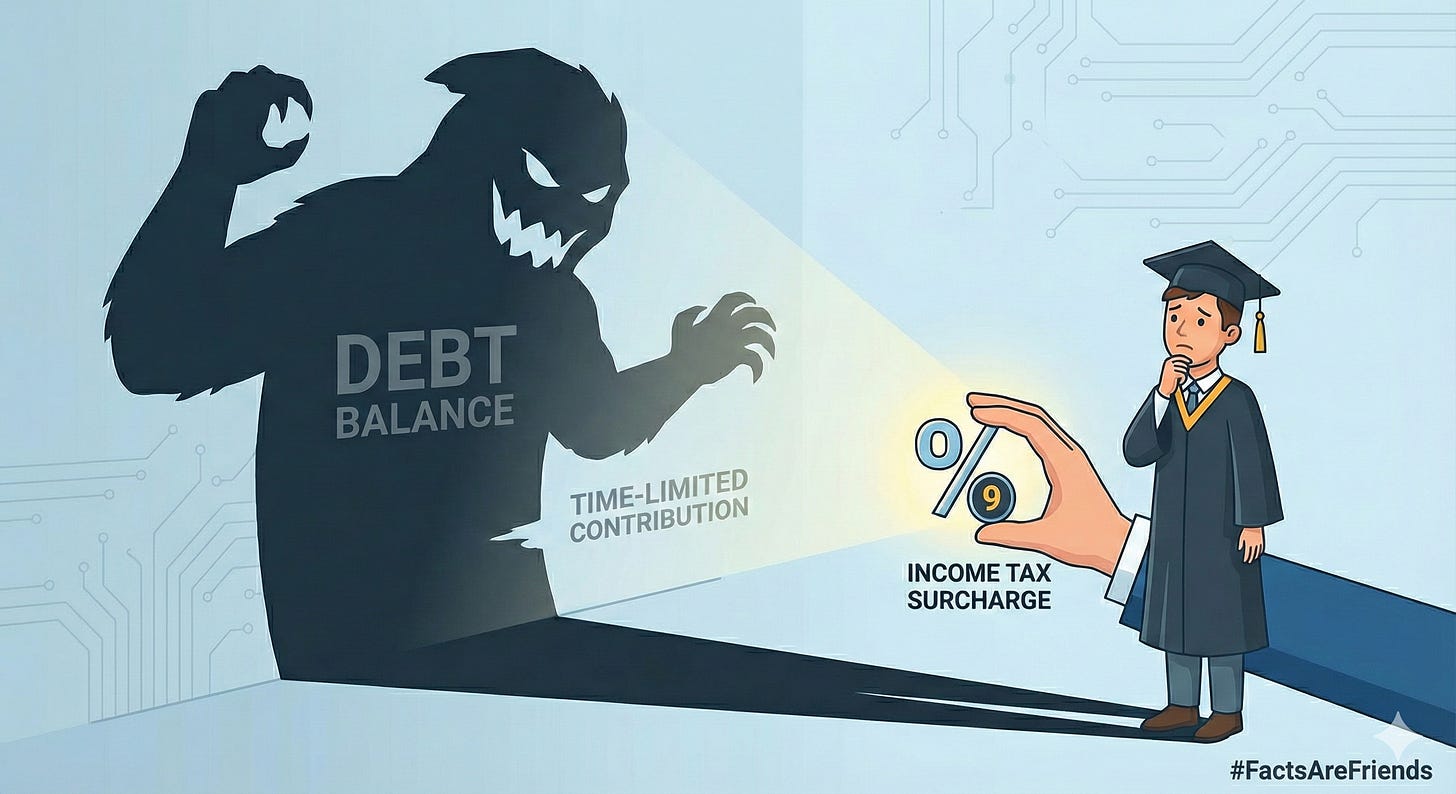
Abstract:
For over a decade, a generation of UK graduates has been sold a financial product which I believe would have been deemed unconscionable by the courts if it had been offered by a commercial bank. We call it a “student loan” but for the vast majority of graduate “borrowers” the balance on their statement is a mathematical fiction and - aside from the very real trauma it rightly induces - a real world irrelevance.
For most of those graduates, the balance on their student loan statement is a number that will never be collected. The system they entered at 18 does not function as a conventional personal debt. It functions as a time-limited income tax - running for up to 40 years, and written off automatically at the end, regardless of what remains.
This essay sets out how the repayment rules actually work, why the language of debt shapes financial decisions in ways that cause real harm, and what a more honest framing would look like. It draws on marginal tax rate analysis, mortgage affordability modelling and salary trajectory data to show that for the majority of graduates - particularly those in teaching, nursing, social work and the wider public sector - the rational financial response to a student loan is almost never early repayment.
The terminology is factually misleading. Young people navigating consequential financial decisions deserve language that matches the mechanics they are actually living with. The conclusion may be that the entire system is not fit for purpose - that is for you to conclude, having considered the evidence.
It is time to stop talking about “loans” and start telling the truth about the structural deception of the graduate levy.
I seek to demonstrate why the rational financial choice for most families is that they should never repay this debt early. My journey of discovery concluded that the rising degree apprenticeship may now offer a far more lucrative path to the middle class.
One last point. Do not allow the vocal critics of the Government distract you about the rate of interest: unless you are going to pay the debt off, the interest rate discussion is sleight of hand. It asks you to focus on something that will never affect you simply because you will never pay the loan off anyway, whatever the interest rate. Having the Government “listen to the arguments” and reduce the interest rates would be a hollow, pyrrhic victory. Graduates deserve more. Our country deserves more.
NOTE: I am not an economist or tax specialist, and this is not advice
The loan that isn’t: how the student debt system became a structural deception
My wife and I hate being in debt. Always have. It is probably a symptom of what we call our Protestant ethic: if you owe money, you clear it. So when the subject of our daughter’s student loan came up recently, our instinct was straightforward. Encourage her to pay it off. It is what you do with a debt.
Having entered university in 2019, she holds a “Plan 2” loan - the standard arrangement for anyone who started university in England between 2012 and 2023. Like most graduates, the loan sat as an overwhelming weight - a five-figure sum contracted at the age of eighteen, before she had ever signed a lease, managed a budget let alone understood compound interest. When her employer awarded her a bonus that pushed her over the repayment threshold, nearly an extra 10% disappeared in what she described, accurately, as tax.
We ran the numbers every possible way. Consulted the official guidance, modelled different salary trajectories and compared the cost of early repayment against alternative uses of the same capital. The answer was always the same. Unless she was going to be an ultra-high-flyer (one of the few who may actually clear the principal before the interest balloons or the 30-year clock runs out) there was no benefit to repaying the loan early. None. At an average salary, the money was better in her hands than in the Government’s. The financial logic simply said “no”.
That realisation led me back to the rhetoric that sold this system in the first place. Tony Blair called it:
“a fair contribution on the basis of ability to pay”
He insisted the package was “highly progressive”.
David Cameron defended the £9,000 fee hike by stating that:
“it’s right that successful graduates pay their share”.
Nick Clegg promised that a quarter of graduates - those on the lowest incomes -
“will pay less overall than they do at present”.
The marketing was clear: this was a success tax. The student loan was sold as a graduate premium, paid by those who reaped the financial rewards of their degree, from the proceeds of that benefit. The reality is different, in ways that matter enormously for an entire generation now navigating their financial lives under a fundamental misunderstanding of what they actually signed.
The student loan is becoming a 9% surcharge on any graduate working full time.
It is regressive penalising those least able to afford it. If the student loan had been sold by a bank, it would be unlawful.
It is becoming a fiscal drag on the economy. It penalises those society most wants to incentivise (teachers and medical staff), and rewards those who are well paid without the “benefit” of tertiary education.
The emotional weight of misunderstanding
Most young graduates believe they carry a personal debt that works like a mortgage or a car loan. They see a five-figure balance. They receive annual statements. The language used throughout the system reinforces the idea that this is money they owe, money they must repay, money that marks them as financially behind before they have even started.
The psychological impact is real. The loan balance can be a source of persistent, grinding anxiety - and the news about exorbitant interest rates makes it worse.
Plan 2 loans are charged interest at up to RPI plus 3%. In recent years, with inflation running high, that has meant rates of 7% or more. For a graduate on a modest salary, the effect is soul-destroying. They watch the balance grow year after year, faster than their repayments can reduce it. They pay hundreds or thousands of pounds and still the amount they owe goes up. It feels like running on a treadmill that someone keeps tilting steeper. For many, the balance at the ten-year mark - even after having paid a significant amount - is higher than it was on the day they graduated.
Nate a recent graduate who after a short time in employment is being sponsored to re-enter academia has described this as the "Hope Taper". It is a point where the student stops looking at the balance entirely because the mountain feels unscalable. When the interest outpaces the repayment, it breeds a form of what he describes as "financial nihilism". If the debt is a fiction that only grows, the rational response for many is to simply disengage from long-term financial planning altogether.
A mortgage balance falls over time. A car loan has a visible end point. This student loan balance climbs relentlessly, mocking the repayments being made against it, until - for the majority who will never clear it - it is simply written off after 30 years.
The intervening decades of rising numbers serve no practical purpose but cause very significant stress. I suspect they also encourage a kind of fatalism: I will never pay off my debt, so what does it matter?
Some graduates self-blinker, barely willing to look at their statements. A friend at church told me his son had moved abroad. Another friend’s daughter had decided not to work overtime because the additional tax made it not worth her while. Once I had done the sums, I understood why she had reached that conclusion. Others avoid career risks or further study because they cannot bear the thought of adding to the total.
How it actually works
The system does not work the way most people expect it would. I do not believe any normal undergraduate would anticipate what actually happens. As a solicitor, I am confident that if any commercial lender had structured a product like this, the courts would have torn it apart years ago.
Plan 2 student loans operate as an income-contingent repayment system. That means you repay 9% of everything you earn above an annual threshold - currently £28,470, rising from April 2026 to £29,385.
You do not repay based on the size of your loan. Two graduates earning the same salary make identical monthly repayments whether their debts are £30,000 or £60,000, unless and until one of them repays in full. The system does not care about the balance. It cares about income.
There is a further consequence that rarely gets discussed. Once a loan reaches a certain scale, a graduate on a typical earnings trajectory might rationally conclude there is no reason not to borrow more. If the balance will never be fully repaid, additional borrowing makes no difference to monthly repayments. The number on the statement is, for graduates with normal earning expectations, a fiction that will never be collected in full. The system creates a perverse incentive towards borrowing more, not less.
Thirty years after you graduate, whatever remains is written off automatically, regardless of the figure on the statement.
This means that for most graduates, the nominal loan amount is irrelevant. The system does not distinguish between a £35,000 balance and a £65,000 balance in terms of what you actually pay month to month. Since the majority of graduates will never clear the balance, the number on the annual statement is, in the most literal financial sense, a fiction.
This is not a loan. In any conventional sense this is a time-limited income tax with a misleading name.
The Government estimates that around 25 to 30% of Plan 2 graduates will ever repay their loans in full. That means a large majority will pay a 9% surcharge on a portion of their income for three decades and never clear the balance. If that is not a tax, I do not know what is.
If the system were called a Graduate Contribution System - which is what Australia calls its equivalent under HECS-HELP, and what New Zealand describes its income-contingent scheme as - the emotional weight would be entirely different. The terminology is not cosmetic. It shapes understanding, planning and behaviour. Britain chose a different word, and that choice has consequences.
The wealthy logic - why paying off the loan makes no sense
The most revealing evidence of the system’s internal contradiction is what the mathematics tells those with capital to do.
Assume a graduate has £50,000 in student loan debt and a parent has £50,000 available to help. The conventional wisdom says: pay off the debt. Clear the slate. Start fresh. The mathematics of the system can say something entirely different.
The alternative? Keep the £50,000. Use it as a deposit on a £250,000 property, borrowing £200,000 rather than the full £250,000. The impact is immediate and substantial.
If that £50,000 is used instead as a deposit on the £250,000 property, the graduate borrows £200,000 rather than £250,000. The difference in monthly mortgage payments is typically £300 to £400 per month - £3,600 to £4,800 per year. The larger deposit also secures a meaningfully better interest rate. Lenders treat a 20% deposit far more favourably than a 10% deposit. Over a 25-year mortgage term, the reduction in total interest paid can easily exceed £40,000. I explain this in more detail in the section headed “The mortgage affordability trap”, below.
Meanwhile, student loan repayments on a £35,000 salary remain approximately £585 per year - 9% of the £6,530 earned above the threshold. The mortgage saving is six to eight times larger than the loan repayment. Every year. The saving of paying the debt off is dwarfed by the additional mortgage costs they now face.
The graduate who uses capital to pay off the loan eliminates a modest annual deduction but loses the deposit that determines their housing costs, their mortgage rate and their financial resilience for the next two decades. They have traded certain capital for uncertain credit.
Here is the part that makes the student loan system genuinely perverse: the comparison improves as income rises.
At £50,000, the loan repayment increases to £1,938 per year. The mortgage saving remains constant. The net benefit of keeping the capital is now around £2,000-£3,000 annually. Larger in absolute terms than at a salary of £35,000.
At £60,000, the loan repayment rises to £2,838. The mortgage saving is unchanged. The graduate with the deposit is still £1,500-£2,500 per year better off - and that gap persists for the full mortgage term.
This is the rational financial outcome for almost any graduate who can access capital, at almost any income level, unless they are earning enough to clear the loan within a few years.
There is a further dimension. Student loan repayments stop entirely if a graduate loses their job or reduces their income below the threshold. A mortgage does not pause. By retaining the capital and maintaining the debt, the graduate keeps financial liquidity and shifts repayment risk back to the State. The system actively rewards this behaviour.
The regressive tax asset gap
The regressive consequence is stark. A graduate with capital available can use the student loan as a low-cost, risk-free line of credit while building their asset base. A teacher or nurse with no capital to leverage pays the 9% surcharge for thirty years with no alternative. The system taxes the credential of the worker while subsidising the portfolio of the investor. That is the opposite of what was promised.
I will return to the precise breakpoints - the income levels and career trajectories at which paying off the loan actually becomes the better decision - later in this essay. The short answer is that those breakpoints apply to the top 15 to 20% of graduate earners.
If a bank had done this, the courts would have intervened
The courts have imposed significant fairness and transparency obligations on commercial lenders in recent years.
When banks mis-sold Payment Protection Insurance between 1990 and 2010, they ultimately paid over £50 billion in compensation - not because the product was illegal, but because customers had been unable to give informed consent. The Financial Conduct Authority found that banks had failed to explain terms clearly, had sold policies that were unsuitable and had not provided adequate opportunity for customers to make informed decisions.
When payday lenders charged interest rates of 1,500% to 5,000%, the courts and regulators shut down entire business models. Wonga, QuickQuid and dozens of others collapsed not because their contracts were legally invalid, but because the terms were deemed unconscionable. The FCA imposed a cost cap and required lenders to write off debts where borrowers could not have afforded repayments from the outset. The principle was clear: even if someone signs a contract, if they did not understand the true cost or if the terms are fundamentally unfair, the agreement cannot stand.
The same principle applied to packaged current accounts, to interest rate swaps mis-sold to small businesses and to a succession of other financial products across three decades. In each case, the legal conclusion was the same: informed consent requires clear explanation, prominent warnings and a reasonable opportunity to understand the commitment being made. Complexity is not a defence. The responsibility lies with the lender to ensure the borrower understands.
Now apply that test to the student loan.
If Barclays or NatWest offered this product, consumer protection law would require them to tell every applicant clearly that for the majority of borrowers, this functions as a 9% income tax for 30 years; that the balance will likely grow faster than repayments for many years; and that the figure on the annual statement is, for around 75% of borrowers, a number that will never be collected.
None of that is disclosed. The Government is exempt from the consumer protection regulation it imposes on everyone else.
An eighteen-year-old signs for a principal sum that may reach £60,000 to £70,000. They do so before most of them have managed a budget, understood compound interest or signed any significant financial agreement. They do so while being encouraged by parents, schools, politicians and universities to treat the process as normal - because going to university has been normalised, and taking a student loan is simply what you do.
The contract uses the word “loan” but the mechanics are those of a tax. The balance grows for years - in many cases faster than the repayments being made against it. The terms can be changed retrospectively: the threshold frozen, the write-off period extended, the interest calculation amended by secondary legislation, as has happened repeatedly.
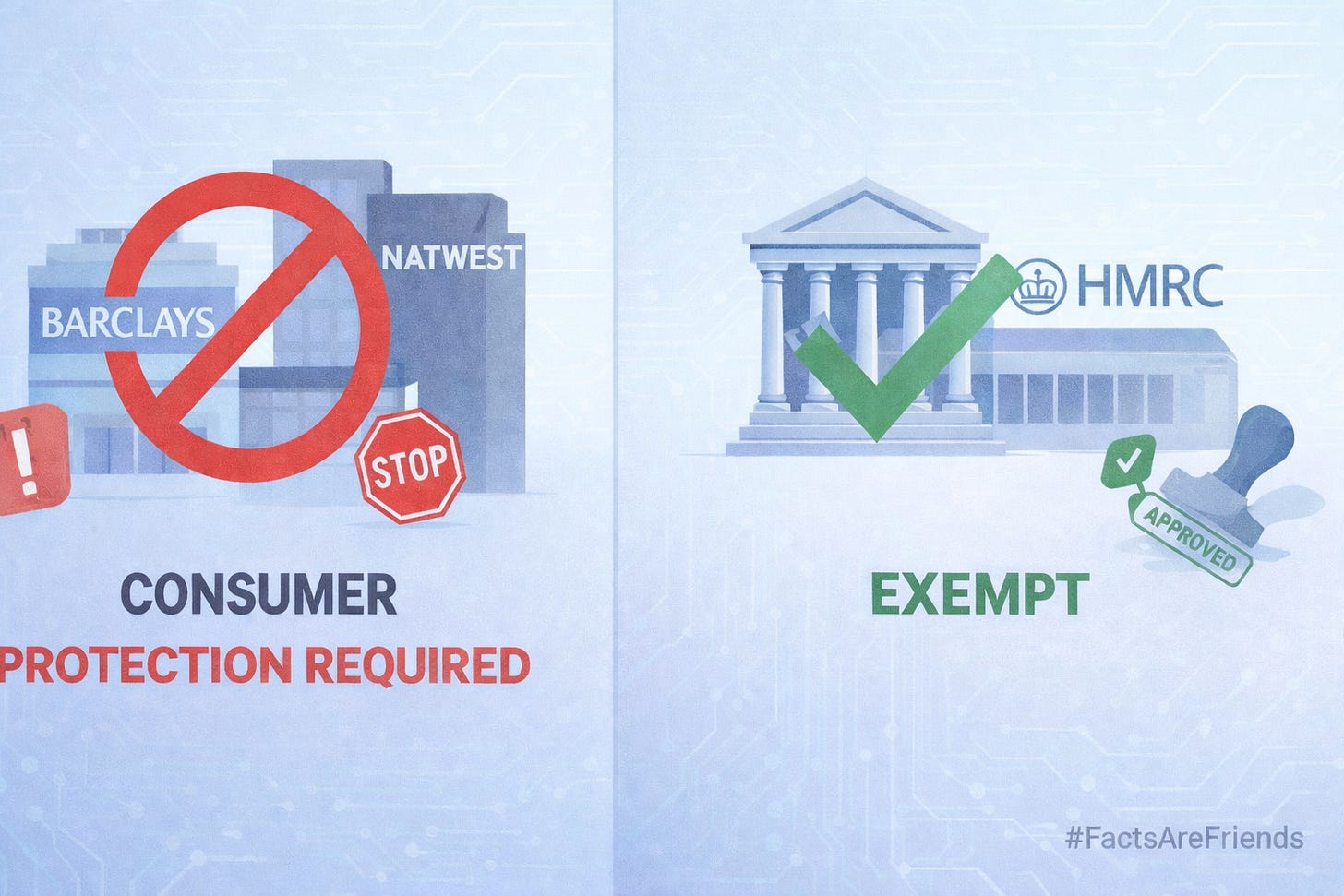
If the student loan had been sold by a bank, it would be unlawful. I am not suggesting the loans are illegal. Parliamentary sovereignty means the Government can structure them however it chooses. But I am suggesting that the student loan, as designed and marketed, is unconscionable - and that a civilised society should not require that standard only of commercial lenders, while exempting itself entirely.
The confusion is a design feature
If the system were called a “Graduate Contribution System” - which is what other countries with income-contingent systems call theirs - the emotional weight would be entirely different.
Australia calls its system HECS-HELP (Higher Education Contribution Scheme). New Zealand calls it a Student Loan Scheme but is explicit that it operates as an income-contingent contribution. The terminology is not cosmetic. It shapes understanding.
Britain does not use that language. It calls this a “loan”, and the framing shapes everything that follows.
The Government estimates that around 56-61% of graduates who started university from 2023 onwards (now on Plan 5, with a lower threshold and a 40-year repayment term) will eventually repay in full. For earlier cohorts on Plan 2, the proportion is far lower - historically estimated at around 25-30%. That means that a majority of Plan 2 graduates will pay a 9% surcharge on a portion of their income for three decades and never clear the balance.
If that is not a tax, I do not know what is.
Who actually pays this tax?
The design becomes more troubling when you understand who bears the burden.
This is not a progressive tax in any conventional sense. It applies only to those who attended university, regardless of how much they earn relative to non-graduates. A graduate earning £35,000 pays the levy. A non-graduate earning £150,000 does not.
Air traffic controllers, train drivers and senior tradespeople can earn between £50,000 and £90,000 without degrees. These are not the super-rich avoiding tax through clever structuring. These are simply people whose career paths did not require higher education - and who therefore escape a levy that falls entirely on their graduate peers.
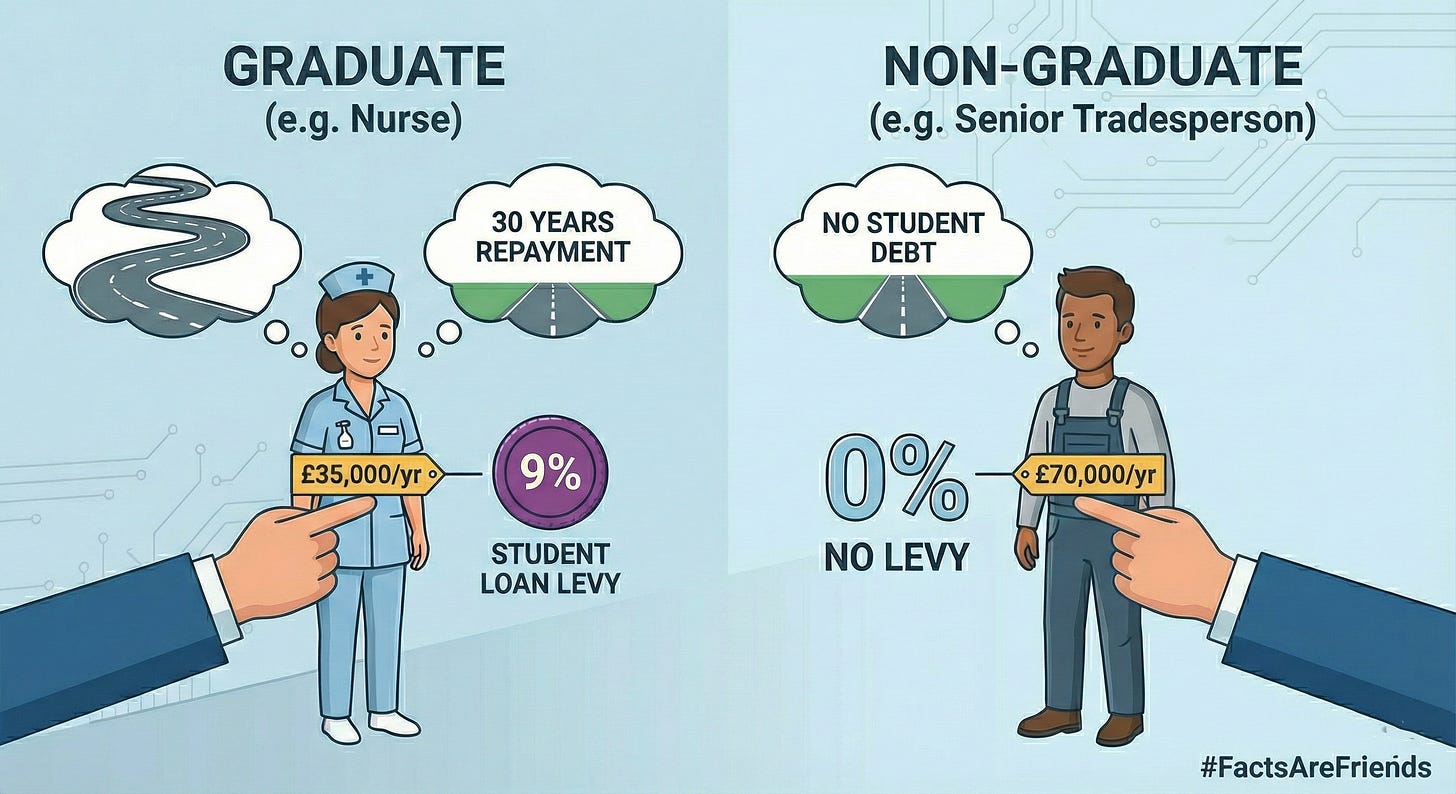
Now, one might respond: “So what? They didn’t use the service, so why should they pay?” Fair enough. But notice the sleight of hand. We were told this system funded higher education on the basis that graduates would pay from the excess earnings their degrees produced. The reality is that a nurse earning £32,000 pays the levy while an electrician earning £55,000 does not. The system taxes the credential, not the benefit.
The heart and soul workhorses of the graduate economy - teachers, nurses, social workers, junior civil servants - pay this 9% surcharge throughout their working lives. Many of these graduates (I dare say a majority and perhaps most) will never clear the balance. The system does not distinguish between them and a City lawyer earning £150,000 in terms of the levy’s design - both pay 9% above the threshold. But only one of them may ever escape it.
The minimum wage problem
The student loan was sold on the basis that only those who benefitted financially from their education would pay, and they would pay from the proceeds of that benefit.
The annual repayment threshold sits at £28,470 for the 2025-26 tax year. That figure was frozen at £27,295 from 2021 to 2025, rose modestly to its current level, and will increase to £29,385 from April 2026 - before being frozen again until at least 2030.
The National Living Wage for workers aged 21 and over is currently £12.21 per hour, rising to £12.71 from April 2026. A full-time worker on the current rate, working 37.5 hours a week, earns approximately £23,810 per year.
The gap between minimum wage earnings and the repayment threshold is currently around £4,660. But the threshold is set to be frozen from 2027, and the minimum wage rises every year.
Here is how that gap closes:
Tax Year Min Wage (£/hr) FT Annual (37.5hrs) Threshold Gap
2025-26 £12.71 £24,725 £29,385 £4,660
2026-27 £13.46* £26,187 £29,385 £3,198
2027-28 £14.26* £27,736 £29,385 £1,649
2028-29 £15.11* £29,388 £29,385 (£3)
2029-30 £16.01* £31,139 £29,385 (£1,754)
2030-31 £16.97* £33,007 £29,385 (£3,622)
* Minimum wage projections based on Low Pay Commission historical growth rates of approximately 6% per annum.
By the 2028-29 tax year, a graduate working full-time at the legal minimum wage will begin making student loan repayments. By 2030-31, they will be paying £327 per year towards a loan they are statistically almost certain never to repay in full.
These are not edge cases. They are the result of a structural feature of a system that was never designed to include people at this income level.
The tax rate nobody mentions
To understand what the student loan system actually does, you need to see it alongside the taxes it sits next to.
A graduate earning £30,000 in the 2025-26 tax year pays:
Income tax: 20% on earnings above £12,570
National Insurance: 8% on earnings above £12,570
Student loan repayment: 9% on earnings above £28,470
Between £28,470 and £50,270, the effective marginal rate is 37% (20% income tax + 8% National Insurance + 9% student loan). For every additional pound earned in that band, 37p goes to the state.
This is substantially higher than the marginal rate paid by someone earning £40,000 with no student loan, which is 28%. It is higher than the basic rate of income tax. And it applies to people in the early years of their career, often in their twenties and thirties, when they are trying to build deposits, start families and establish financial security.
At £50,270 - the higher rate income tax threshold - something remarkable happens. A graduate crosses into the 40% income tax band, and their effective marginal rate becomes:
Income tax: 40%
National Insurance: 2%
Student loan repayment: 9%
According to Nate, who I quoted earlier, these rates do more than just shrink a pay cheque; they create what he terms a “stagnation trap”. For a young professional, the incentive to take on a promotion or work overtime is severely blunted when nearly half of that extra effort is captured by the state. He describes it as essentially placing a “psychological ceiling“ on ambition at the exact moment in a career where risk-taking and extra effort should be most rewarded.
This chart shows that trap pretty clearly:
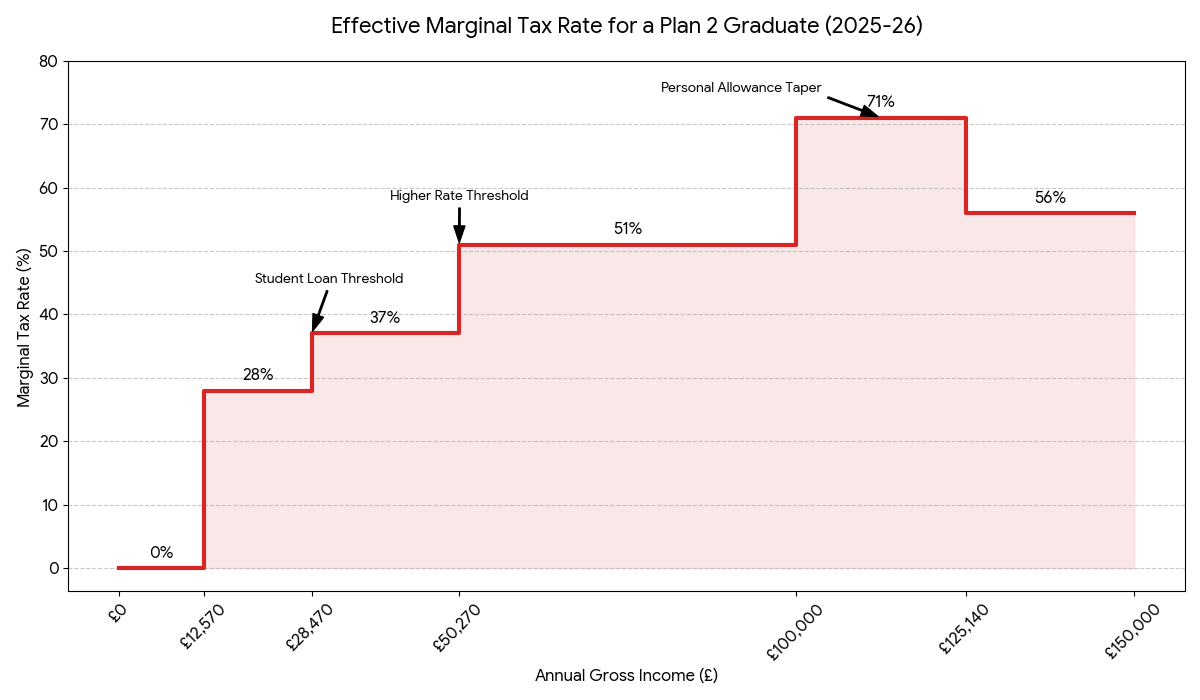
The chart clearly illustrates how the combination of Income Tax, National Insurance, and the 9% student loan surcharge creates significant marginal rate jumps:
The 37% Band: Once a graduate crosses the £28,470 threshold, their marginal rate jumps from 28% to 37%. This applies to almost all early-career professionals.
The 51% “Majority” Tax: At the higher rate threshold (£50,270), the state begins taking more than half of every additional pound earned (51%). At that point they are working more for the state than for themselves.
The 71% “Taper” Trap: The most extreme spike occurs between £100,000 and £125,140. Above £100,000, the personal allowance begins to taper - you lose £1 of allowance for every £2 earned, creating an implicit 20% surcharge on top of the 40% rate - the effective marginal rate reaches 60% for non-graduates. For a graduate with a Plan 2 loan in this band, the withdrawal of the Personal Allowance, combined with the student loan, creates a staggering 71% marginal rate (60% from the income tax taper, 2% National Insurance and 9% student loan). This is a stealth tax on the aspiring middle class.
There may not be much sympathy for the graduate paying over 70% marginal tax on the first £25,000 earned above £100,000 (meaning the graduate gets to keep about £7,500) but there may be more for the 28-year-old teacher who, having taken on additional responsibility and moved into the higher rate band, faces a marginal tax rate that exceeds that of a senior executive earning £90,000 who graduated before 2012. For every additional pound earned between £50,270 and £100,000, the graduate keeps only 49p. The Government takes more than half.
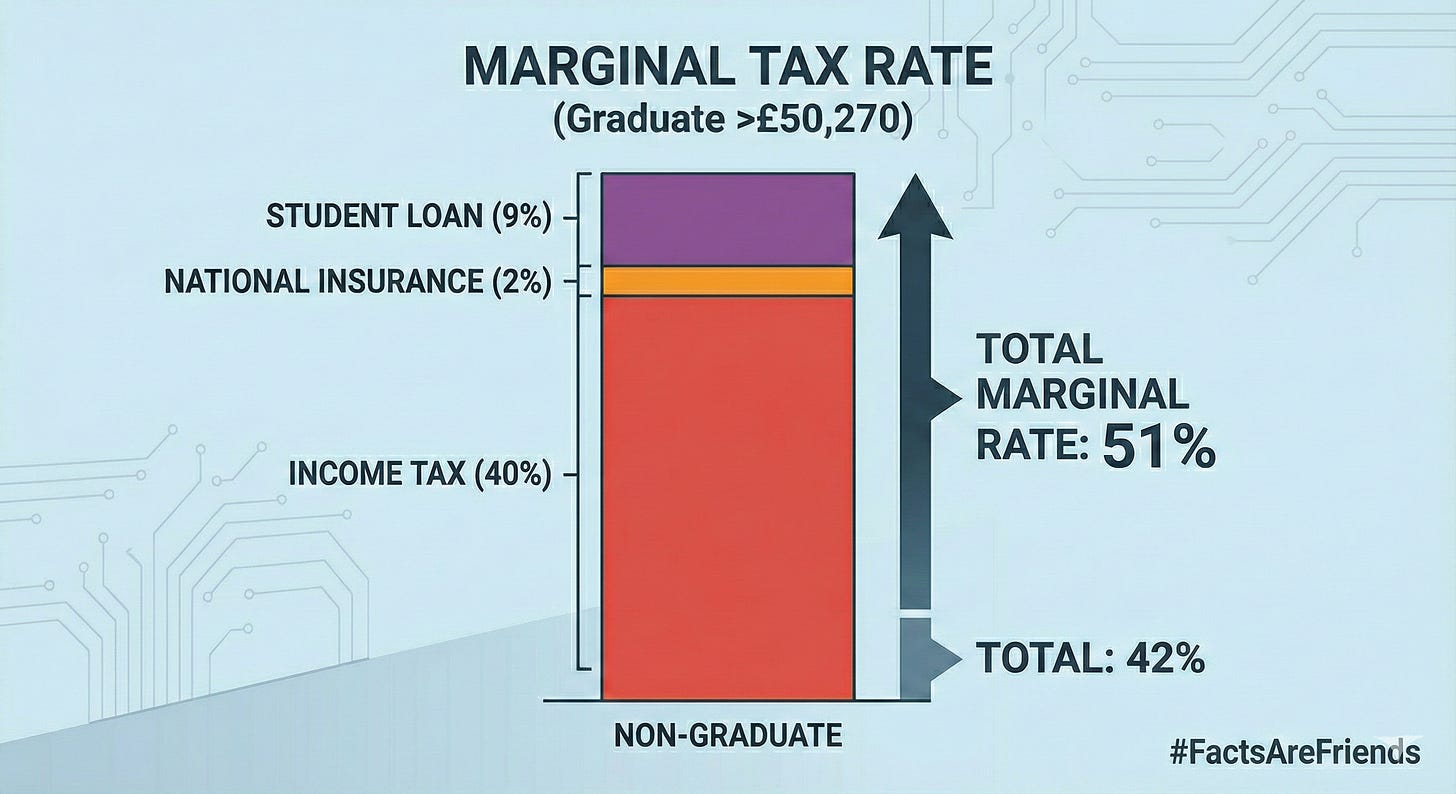
This is higher than the top rate of income tax paid by anyone earning up to £125,140.
At no point does the student loan repayment reduce or taper within these bands. It sits there as a flat 9% surcharge on income, from £29,385 until the balance is cleared or written off after 30 years.
This is a parallel income tax system that applies only to people who went to university after a certain date. The language of repayment disguises what is actually happening. A generation is paying materially higher marginal tax rates than their predecessors, and most will do so for the majority of their working lives without ever clearing the nominal balance.
If the system were presented honestly - as a 9% graduate contribution on income above £29,385, lasting up to 30 years - the conversation would be entirely different. We would be asking whether that rate and threshold are appropriate, whether it makes sense to impose such high effective rates on people in the early stages of their careers, and whether this is really the best way to fund higher education. Instead, we talk about debt and repayment and avoid those questions entirely.
Currently, one of the few ways graduates can mitigate this combined tax burden is through pension salary sacrifice - an arrangement where pension contributions are made from gross pay, before tax, National Insurance and student loan deductions are calculated. It is a legitimate and widely used tool. For a graduate on a modest salary, it is one of the only mechanisms that reduces the effective 37% marginal rate.
Graduates now face what Martin Lewis of Money Saving Expert has called “double fiscal drag”. Income tax thresholds have been frozen since 2021 and will remain frozen until April 2031. Student loan thresholds have been frozen from 2027 until 2030. As earnings rise with inflation, more income is captured by both the income tax system and the student loan system simultaneously. Each frozen threshold makes the other more punishing.
A graduate whose salary rises from £28,000 to £32,000 between 2026 and 2030 will see their income tax bill increase and their student loan repayments begin - not because rates changed, but because thresholds didn’t. The effect compounds. Each frozen threshold makes the other worse.
And from April 2029, the Government plans to cap the National Insurance advantages of salary sacrifice at £2,000 per year. Contributions above that cap will attract employee National Insurance - and, critically, student loan deductions.
The Chartered Institute of Taxation has warned that this change will “disproportionately impact those with student loans who earn above the repayment threshold, as they will have incurred an extra 9% student loan deduction from their pay”. A basic rate taxpayer with a student loan will face an effective 17% hit on pension contributions above the cap: 8% employee NICs plus 9% student loan. A higher rate taxpayer without a student loan faces just 2%.
Read that again. Two colleagues, sitting side by side, making the same pension contribution. One faces a 17% charge. The other faces 2%. The difference? One went to university.
Conservative MP Mark Garnier has described the measure as targeting “basic rate taxpayers and student debt repayors”, noting that wealth managers are already devising workarounds for higher rate taxpayers who can afford their services. In his words, the policy “messes up for ever a brilliant scheme that only sees one year of marginal benefit to government coffers”.
The pattern is consistent. Every time the system intersects with another area of tax policy, the 9% graduate levy amplifies the unfairness. It is not a standalone burden. It is a multiplier.
The Student Loan can make pensions unaffordable, defeating Parliament’s intention
The 2029 changes create a specific risk that has received almost no public attention: graduates being driven out of auto-enrolment entirely.
If we take a graduate earning £50,000 then, after income tax of £7,540, National Insurance of £3,016 and a student loan repayment of £1,962, their net income is £37,752. The standard auto-enrolment employee contribution of 5% requires approximately £2,500 each year from that net income. For a graduate also managing housing costs and the cumulative effect of frozen thresholds, that contribution may simply be unaffordable.
If they opt out, they do not merely lose their own contribution. They lose the statutory 3% employer contribution - approximately £1,500 per year - that the auto-enrolment legislation was designed to guarantee. Parliament determined, when enacting auto-enrolment, that £4,000 per year is the minimum that should be going into a young person's pension. The interaction of student loan repayments, the salary sacrifice cap and the auto-enrolment threshold prevents that minimum from being met - specifically and disproportionately for Plan 2 holders. A graduate earning £50,000 per year takes home approximately £726 per week after tax, National Insurance and student loan deductions. The standard auto-enrolment contribution of 5% requires approximately £48 per week from that net income. For a graduate also managing housing costs and frozen thresholds, that £48 may simply not be there.
The interaction of student loan repayments with the 2029 salary sacrifice cap undermines that intention precisely for the Plan 2 cohort - the generation the system was supposed to treat fairly.
There is a further dimension that has received almost no public attention. The 2029 changes remove the employer's National Insurance benefit from salary sacrifice arrangements. Once that benefit disappears, many employers are likely to stop offering salary sacrifice entirely - it will no longer make commercial sense for them to administer it. A Plan 2 graduate who relies on salary sacrifice to manage their combined tax burden may find that the mechanism is simply withdrawn by their employer, with no replacement available. The result is that Plan 2 holders will carry substantially lower pension pots at retirement than graduates who entered university before 2012 or after 2023 - a distinction with no logical justification and significant long-term consequences for retirement income. We should foresee the "student loan problem" become an "old-age poverty problem”.
Parents are penalised even more
There is a further interaction affecting working parents that has attracted almost no comment.
Free childcare for working parents is withdrawn entirely when annual net income exceeds £100,000. That threshold is calculated after pension contributions but before tax and National Insurance - and, crucially, before student loan repayments. The effect is that the cliff edge at which the entire benefit is lost arrives at a lower gross income for Plan 2 graduates than for non-graduates on the same salary.
The threshold at which Free Childcare is withdrawn operates at a net income level that is effectively 9% lower for Plan 2 holders than for non-graduate colleagues on the same gross salary. At a gross income of approximately £105,263, making a 5% pension contribution, a graduate's net income for Free Childcare purposes sits just below £100,000. But their student loan repayment of approximately £6,911 on that income is not deducted in the calculation. The cliff edge therefore arrives earlier, in real terms, for Plan 2 holders than for their non-graduate peers.
The near-unlimited marginal rate at that cliff edge - losing a benefit worth thousands of pounds for a single pound of income over the limit - is already well documented.
Many families currently manage it by making additional pension contributions to stay below the threshold.
From 2029, that route closes for graduates. A Plan 2 holder earning £130,000 who sacrifices £30,000 into a pension to bring their net income below the threshold will see their tax and National Insurance reduce by approximately £15,600 - but they will also face a student loan deduction of 9% on that £30,000, adding £2,700 to their repayments on income sitting in a pension fund and unavailable to them. Their net available income after tax is approximately £59,920 - compared with £68,557 for a colleague on the same gross salary without a student loan. The gap between them is £8,637 per year - and the pension capital used to bridge it cannot be accessed to meet living costs.
The impact on working mothers
To retain Free Childcare after 2029, a Plan 2 holder faces a narrowing set of options: salary sacrifice is less likely to be available from employers who no longer benefit from the NIC relief, and additional pension contributions above the cap attract student loan deductions rather than reducing them. Reducing hours becomes, in many cases, the only remaining mechanism.
Typically, it is the mother who forfeits earnings and that has lasting consequences for their career trajectories, lifetime earnings and pension accumulation. Contributions not made in their thirties cannot be recovered.
The consequences extend beyond the individual. Graduate mothers working reduced hours means lower tax receipts and reduced economic output. In some cases grandparents may withdraw from employment to provide childcare support, compounding the effect. We see that student loan isn't just a tax on the young; it's a drag on the entire family tree's productivity.
Compound growth over thirty-plus years from contributions made early is among the most powerful financial mechanisms available to a young worker. The system quietly removes it from those least able to rebuild it later.
These are structural consequences of a system whose interactions with other areas of tax and benefits policy have never been properly disclosed to those living with them.
Two graduates, same loan, different lives
Here is the practical reality: a graduate earning £35,000 per year repays roughly £585 annually - 9% of the £6,530 above the threshold. Over 30 years, assuming modest salary growth, they might contribute somewhere around £17,000-£20,000 towards a loan that started at £45,000. The remainder disappears.
A graduate earning £75,000 per year repays roughly £4,187 annually. Depending on the interest rate - which for Plan 2 loans ranges from RPI (3%) to RPI plus 3% (6%), depending on income - they may clear the balance entirely within 12 to 18 years.
Both borrowed the same amount. One pays a 9% levy for three decades without ever clearing the debt. The other pays the same rate for half that time and walks free. The higher earner may pay more in absolute terms but escapes the system entirely in their late thirties or early forties.
Lower earners do not “benefit” from paying less in total. They simply pay for longer, at a rate that is a greater proportion of their disposable income, and never reach the point where the levy ends. The higher earner repays more in absolute terms but escapes the system entirely in their late thirties or early forties.
Bankers pay more but escape the levy by early middle age. Teachers pay less, but carry it until retirement. The system is progressive in amount but regressive in time - and for most graduates, it is the duration, not the total, that shapes their financial lives.
The mortgage affordability trap
The mortgage affordability picture sharpens this further: here the system’s design creates a particularly cruel bind.
That 9% deduction reduces the amount a lender will offer - on a £35,000 salary, by perhaps £1,000 to £1,500 in borrowing capacity. Graduates know this, and many assume that clearing the loan will substantially improve their mortgage position.
On a £35,000 salary, a graduate pays approximately £585 per year in student loan deductions - roughly £49 per month. Most mainstream lenders apply a multiplier of around 4.5 times salary for mortgage calculations, but that calculation is performed on income after the student loan deduction has been taken into account. The impact is not dramatic - perhaps £1,000-£1,500 reduction in borrowing capacity - but it is real, and graduates know it.
So the question becomes: does paying off the student loan to increase your borrowing capacity make financial sense?
The answer is still no - and, again, the mathematics is stark.
Recall our earlier graduate with the £50,000 deposit. When we look at mortgage affordability specifically, the trap tightens, at risk of being a stuck record:
Option A: Keep the deposit, maintain student loan
Deposit: £50,000 (20% LTV)
Borrow: £200,000
Monthly student loan deduction reduces borrowing capacity by perhaps £1,000-£1,500
Net borrowing available: £198,500-£199,000
Mortgage rate: approximately 4.5% (strong LTV)
Monthly payment: £1,106
Annual cost: £13,272
Option B: Pay off loan, no deposit
Deposit: £0 (requires 95% LTV or family guarantee)
Borrow: £250,000
No student loan deduction - full borrowing capacity
Net borrowing available: £157,500 at 4.5x multiplier
Insufficient to purchase the property alone
This is the trap. Option B is not viable without either a guarantor or a substantial reduction in property price. The graduate who pays off the loan gains perhaps £1,000-£1,500 in theoretical borrowing capacity but loses £50,000 in actual purchasing power. They have traded certain capital for uncertain credit.
Even if we assume the graduate can access a 95% LTV mortgage product (increasingly difficult post-2022 lending rule changes), the comparison remains overwhelming:
95% LTV on £250,000: approximately 5.5-6.5% interest rate
Monthly payment: approximately £1,500-£1,600
Annual cost: £18,000-£19,200
Premium over Option A: £4,700-£5,900 per year
The student loan “saving” of £585 per year is dwarfed by the additional mortgage cost of £4,700-£5,900 per year. Every year. For 25 years.
Even accounting for the reduced borrowing capacity from the student loan deduction, the graduate with the deposit is £4,000-£5,000 per year better off. The mortgage affordability reduction from the 9% levy is real - but it is an order of magnitude smaller than the penalty of having no deposit.
The system encourages graduates to fixate on a “debt” that reduces their borrowing capacity by £1,000-£1,500, while ignoring that eliminating it costs them £50,000 in deposit capital and adds £4,000+ per year to their housing costs.
This is a conversation we might imagine happening in thousands of households right now, where parents and young graduates believe that “clearing the debt” will help with mortgage applications. It will not. Or rather, it will help so marginally that the cost of achieving it destroys the very financial security it was supposed to create.
No deposit means higher borrowing costs. It means worse mortgage terms. It means less negotiating power with lenders. It means, in many cases, being priced out of ownership entirely or forced into shared ownership schemes with their own complex cost structures. And throughout all of this, making contributions to reduce the “loan” (rather than satisfying it in full) has absolutely no effect - the graduate faces exactly the same 9% levy on their income as they would have done if they had kept the capital - because paying off the student loan does not reduce the levy until the debt is fully cleared.
A graduate earning £35,000 who pays off £45,000 of a £55,000 student debt still faces the 9% levy. They have simply thrown away £45,000 of financial security for no material benefit.
The only way the payment makes sense is if the graduate expects their income to rise so dramatically, so quickly, that they will clear the entire remaining balance within a few years. For most graduates, that is not a realistic prospect: it is a fantasy - I call that a “high class problem”.
The breakpoint: when does paying off actually make sense?
The question deserves a precise answer. At what income level - and career trajectory - does paying off a £50,000 student loan become financially rational compared to keeping that capital as a deposit?
The answer depends not on a single income figure, but on your starting salary and how quickly it grows over your career.
Teaching or NHS career (starting £28,000, 3% annual increases): By year 30, your salary reaches approximately £68,000. You will have paid £43,000 towards the loan, with £144,000 written off. Keeping the deposit is approximately £57,000 better than paying off the loan. Despite ending your career at a respectable salary, the years spent at lower incomes mean the deposit strategy wins decisively.
Typical graduate trajectory (starting £30,000, 4% annual increases): Your salary grows to approximately £97,000 by year 30. You pay £75,000 towards the loan, with £111,000 written off. Keeping the deposit is approximately £25,000 better. Even reaching a six-figure salary by the end of your career, you should keep the deposit.
Strong graduate job with good progression (starting £35,000, 5% annual increases): Your salary reaches approximately £151,000 by year 30. You pay £132,000 towards the loan, with £27,000 written off despite the high income. Here the calculation flips. Paying off the loan becomes approximately £61,000 better than keeping the deposit. The combination of higher starting salary and faster progression means the cumulative repayments exceed the mortgage savings.
Strong starting role (starting £40,000, 4% annual increases): Salary grows to approximately £130,000. You pay £125,000 towards the loan. Paying off the loan is approximately £54,000 better. Again, the higher starting point tilts the calculation.
High starting salary (starting £50,000, 3% annual increases): Even with slow progression, reaching £121,000 by year 30, you pay £137,000 towards the loan and clear it entirely. Paying off is approximately £66,000 better. The high starting salary dominates the calculation from the outset.
The pattern is clear. The breakpoint is not a single income figure. It is determined by your starting salary and career progression trajectory combined.
For graduates starting at £28,000-£32,000 - which captures teachers, nurses, social workers, most civil servants, junior marketers, HR professionals and the majority of graduate roles outside finance, law and technology - keeping the deposit is financially optimal even if their careers progress well. They will reach decent salaries, but they will spend a decade or more in the £30,000-£45,000 range where the deposit saving far exceeds the loan repayments.
For graduates starting at £35,000+ with strong progression (5%+ annual increases) or starting at £40,000+ with typical progression, paying off the loan begins to make mathematical sense. These are graduate scheme roles at major corporates, Big Four accountancy, management consulting, investment banking, senior public sector fast streams and technology companies. Even then, the advantage is not overwhelming until the starting salary exceeds £45,000. And then again, if you are made redundant or take a break from work, the numbers tumble again toward not repaying.
For me a critical realisation is that the system only functions as a genuine “loan” for the top 15-20% of graduate earners. For everyone else - the vast majority - it is a tax that never ends, and treating it as a debt to be cleared destroys financial security for no benefit.
The optimal financial strategy for most graduates is to treat the student loan as exactly what it is: a graduate contribution to be managed, not a debt to be cleared.
Too many young people are directing capital towards a “debt” that functions as a tax, while undermining their ability to build the asset base that genuinely determines financial security? Too many families are making this decision without understanding that it only makes mathematical sense for the highest earners?
The system pushes decisions in the wrong direction at formative moments. It encourages people to worry about a balance that does not matter, while underinvesting in stability that does.
Everybody’s circumstances are different
While the scenarios above cover typical career trajectories, your specific circumstances may differ. Every graduate’s situation is unique - different loan balances, different salary starting points, different career progressions, different expectations about career breaks or part-time work.
For those who prefer a more conversational approach, or who want to explore different scenarios interactively, Martin Lewis at Money Saving Expert has created a detailed AI prompt that you can use with ChatGPT, Claude, or other large language models to discuss your specific situation and ask follow-up questions. His prompt focuses on whether to voluntarily overpay your loan, while my calculator addresses the specific question of whether to use available capital to pay off the loan versus keeping it as a house deposit - related but distinct questions that together can help you make the most informed decision.
Remember: whether you use the calculator or an AI prompt, these are illustrative projections based on stated assumptions. They help you understand the financial logic of the decision, but they cannot account for life’s uncertainties. If you’re in doubt, the safer option for most graduates - particularly those earning below £40,000 or in public sector roles - is to keep the capital and maintain financial flexibility.
The system has been designed to make you feel you carry a debt that must be cleared. The mathematics suggests otherwise. Most graduates are better served by building the financial security that comes from having capital available, rather than eliminating a “debt” that functions as a time-limited tax they were unlikely to ever fully repay.
What a student starting today should know
Everything I have described so far relates to Plan 2 - the system that applied to students who started university between 2012 and 2023. But for anyone beginning a degree from August 2023 onwards, the picture has changed. In some ways it is better. In others, it is worse. And in one crucial respect, it makes the case for an alternative path more compelling than ever.
The university route: Plan 5
A student starting a three-year degree in England in 2025 faces tuition fees of £9,535 per year, rising to an expected £9,790 this year. Over three years, tuition alone will cost approximately £29,000. Add a maintenance loan - means-tested, but up to £13,762 per year for a student living away from home outside London - and the total borrowing for a three-year degree can easily reach £60,000-£70,000.
These students are on Plan 5, which differs from Plan 2 in important ways. The repayment threshold is lower - £25,000 rather than £28,470 - meaning repayments start earlier. The write-off period is longer: 40 years, not 30. On the positive side, interest is charged at RPI only, without the additional 3% margin that makes Plan 2 balances grow so aggressively. The Department for Education estimates that 56-61% of Plan 5 graduates will eventually repay in full - a significant increase from the roughly 25-30% under Plan 2.
But think about what “40 years” means in practice. A student graduating at 21 in 2028 will not see the balance written off until 2069, when they are 62. They will carry the 9% levy for essentially the whole of their working life. For the 39-44% who never repay in full, this is not a loan. It is a career-length tax, starting at a lower income threshold than Plan 2 and lasting a decade longer.
Nate expressed this succinctly: for the Plan 5 cohort, this isn't a transition into adulthood; it is what he called a "lifelong subscription service" to their own education.
Unlike a traditional loan that eventually ends, this 40-year window ensures that the "graduate premium" is extracted until the very threshold of retirement, fundamentally altering the lifetime wealth-building potential of an entire generation.
A student starting today needs to understand this clearly: the balance on the statement is, for most, a number that will grow for years before it finally disappears on an anniversary - that will be a day to celebrate freedom from a debt that dogged you but was never really a debt at all. Monthly repayments are determined by income, not by debt. The system will follow them for four decades.
The degree apprenticeship: a path without the levy
There is, however, an alternative that barely existed a decade ago - and it changes the calculation entirely.
A degree apprenticeship is a full-time paid role with an employer, combined with part-time university study, leading to a full bachelor’s degree (Level 6) or in some cases a master’s (Level 7). The qualification is identical to a traditional degree - the same BA, BSc or BEng from an accredited university. The critical difference is financial: the employer and the Government pay the tuition fees. The apprentice pays nothing.
No tuition fees. No maintenance loan. No student loan balance. No 9% graduate levy. No 30- or 40-year repayment term.
Instead, the apprentice earns a salary throughout. Starting pay for degree apprenticeships typically ranges from £18,000 to £25,000 per year, with some programmes at major employers - particularly in engineering, technology, finance and law - paying £22,000 to £34,000 from year one. By the time a degree apprentice completes their programme (typically three to five years), their salary has often risen to match or exceed graduate starting salaries. Government analysis suggests the median salary for a former Level 6 apprentice one year after completion is around £34,600 - comparable to the average graduate starting salary at leading employers of £35,000.
A recent conversation about informed choice
In February, I met George Hannah near his office south of the river at Blackfriars. George is a solicitor apprentice. Over a Chinese meal that stretched to three hours, we discussed his path into law - and I came away impressed by the clarity of his thinking.
George studied Chemistry and Biology at A-level. A careers adviser suggested law, and he explored the options. What he found horrified him: a traditional law degree would cost approximately £45,000-£50,000 in tuition alone, with total borrowing likely exceeding £60,000. He calculated the cost per contact hour and found it comparable to private school fees - a sobering comparison for any eighteen-year-old.
He then looked at degree apprenticeships. The route would take slightly longer - four years rather than three - but the comparison was stark. He would be paid throughout. He would gain real-world experience from day one. And critically, he would graduate without debt and without the 40-year levy that would have followed a traditional route.
George is now in his second year as a Solicitor Apprentice at Lewis Silkin, a leading London law firm. He will complete his qualification in 2030, with the same professional credential as any other newly qualified solicitor. But he will have been paid for four years rather than borrowing for three. He will have built relationships with clients, partners and colleagues - connections he rightly identified as critical in law and many other careers. And he will be free of the system entirely.
What struck me most was not the financial calculation - though that was sound - but the thoughtfulness of his decision-making. At eighteen, he had done the research, weighed the options and chosen a path that aligned with his goals. He had not been swept along by the default assumption that university is the only route. He had made an active choice.
I take my hat off to him.
The financial comparison over the first decade of a career
The difference compounds quickly. Take two eighteen-year-olds making different choices in 2025.
Student A goes to university. Over three years, they accumulate approximately £60,000 in student debt. They earn nothing during that time (or perhaps a modest amount from part-time work). At 21, they enter the job market. On a starting salary of £30,000, they begin repaying 9% of everything above £25,000 - roughly £450 per year - while their loan balance grows with RPI interest. They pay the levy for decades.
Student B takes a degree apprenticeship. Over four years, they earn a salary - conservatively averaging £22,000 per year, rising over time. By the end of the programme they have earned approximately £95,000-£100,000 in gross income. They graduate with the same degree, no debt and no graduate levy. Their student loan balance is zero. Their effective marginal tax rate is 28%, not 37%. And they have four years of professional experience on their CV.
By the age of 25, Student B is likely to have earned over £100,000 more in cumulative income than Student A. They have no loan repayments, no 9% surcharge, no 40-year liability. If they have been disciplined with savings, they may already have a house deposit.
The Sutton Trust has found that apprentices can expect to earn more over their lifetimes than graduates from non-Russell Group universities. Incomes Data Research reports that completion salaries for degree apprentices now match those for traditional graduate programme roles - both around £32,500. The salary gap between the two routes has been narrowing rapidly, and for many careers it has already closed.
The catch
Degree apprenticeships are not without trade-offs. They are highly competitive - acceptance rates at top employers can be as low as 2-10% - comparable to Oxbridge. They require a commitment to a specific career direction at eighteen, which suits some temperaments and not others. The social experience differs from full-time university. And they are not available in every discipline - humanities, pure sciences and many creative fields have limited or no degree apprenticeship provision.
There is also a practical constraint: availability. Degree apprenticeship starts have been growing rapidly - up 20% in 2024/25 - but there are still far fewer places than traditional university spots. The infrastructure is expanding, but it is not yet at scale.
From January 2026, Government funding for Level 7 (master’s) apprenticeships is restricted to those aged under 22, which narrows one route but leaves the Level 6 bachelor’s path fully open.
The question every family should ask
None of this means university is the wrong choice. For many careers - medicine, academic research, certain branches of law and science - it remains the only viable route. The university experience offers breadth, intellectual exploration and a period of personal growth that has value beyond the purely financial.
But for families making this decision now, the financial comparison should be made honestly. A degree apprenticeship offers the same qualification, comparable long-term earnings, four years of paid work experience and - crucially - freedom from a 40-year graduate levy that will quietly extract 9% of income above £25,000 for the duration of a career.
The fact that so few families are aware of this comparison is itself a failure of transparency. Schools have strong incentives to promote the traditional route - they also have a duty to explain the choice and ensure that the student is able to make an informed decision. The student loan system is designed to make university feel affordable at the point of entry. The true cost - decades of elevated marginal tax rates - only becomes visible long after the decision has been made.
If we are going to ask young people to make one of the most significant financial decisions of their lives at the age of eighteen, the least we can do is ensure they understand all of the options.
A model built for a world that no longer exists
The current system grew out of policy assumptions that made sense in the 1990s: stable career ladders, predictable salary progression, final salary pensions and lifetime employment with a single employer or within a narrow professional field.
The designers assumed that most graduates would see their earnings rise steadily over time, that career breaks would be rare and that the repayment threshold would keep pace with inflation.
None of those assumptions held.
In 2026, a graduate is far more likely to work portfolio careers, move between sectors, take extended breaks for caring responsibilities or work part-time while managing other commitments. Wage progression has flattened. Housing costs consume a far greater share of income than they did 30 years ago. The threshold has been frozen, unfrozen briefly, and is about to be frozen again.
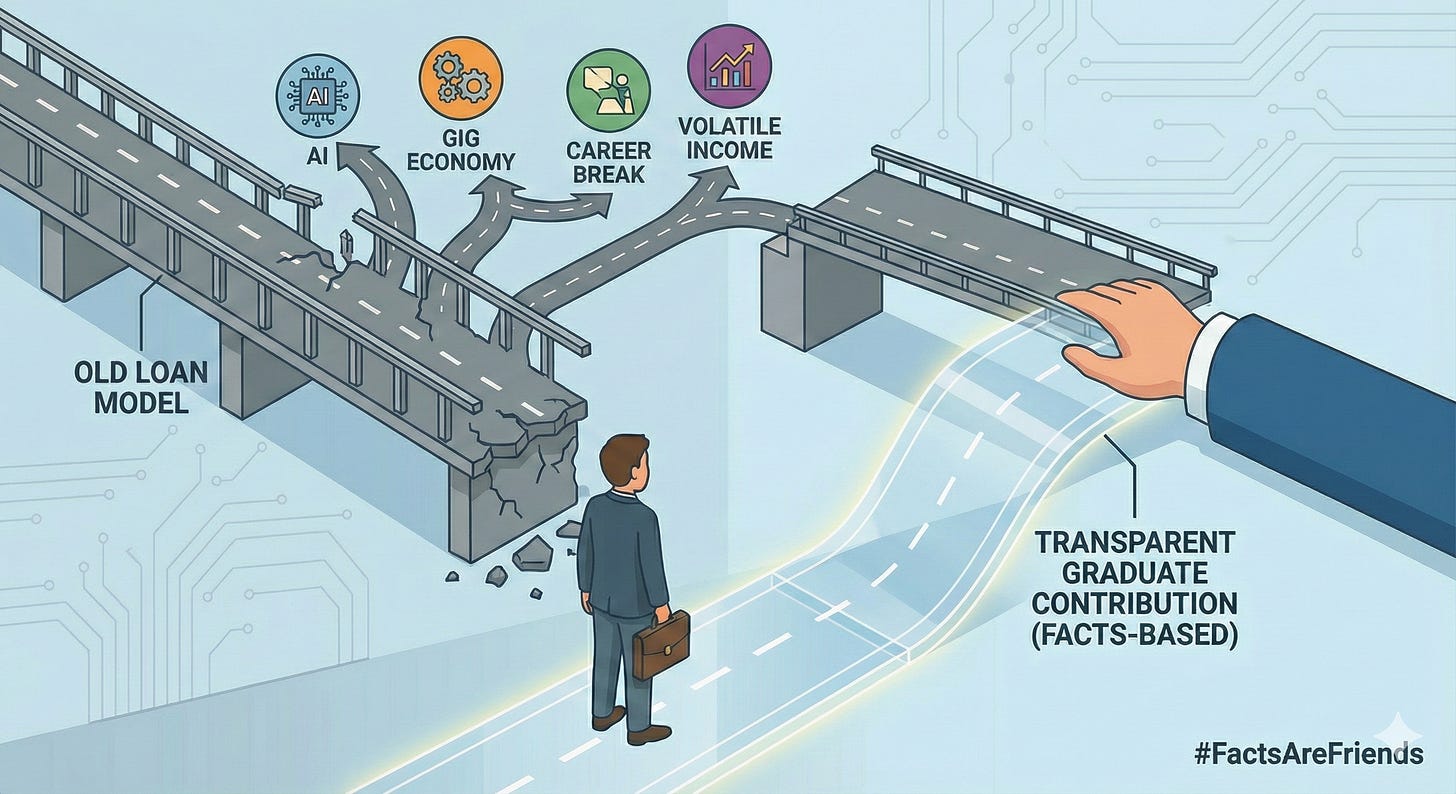
The repayment model still reflects the earnings path of a 1995 graduate. The people making repayments inhabit an entirely different economy. As AI begins to reshape labour markets - compressing some salary bands, eliminating predictable career ladders and creating more volatile income paths - a system built around stable earnings growth will become even more detached from reality.
The system mixes the language of debt with the mechanics of taxation and hides the consequences in plain sight.
For those familiar with my work, I believe AI is driving us toward a world of redundancy and abundance - and, perversely, if I am right, it means that the entire student loan/tax thesis is totally irrelevant: and I think that that is probably right - but not for today or tomorrow. Perhaps in several years or a decade or two. But my conclusion could be wrong, and the one thing we can be certain of is that the timing is uncertain.
The counterargument - and why it fails
The Treasury response to all of this might be: “Fine. Call it a tax if you like. The mechanics are the same either way. Graduates contribute to the cost of their education through income-contingent repayments, most people pay a manageable amount, and the system is broadly fair”.
There are two problems with that position.
First, language matters. If we called this a “Graduate Contribution System” from the outset - as Australia does with HECS-HELP and as other countries do with their income-contingent schemes - young people would plan around it differently. They would not agonise over “paying off the debt”. They would not avoid postgraduate study for fear of increasing the balance. They would not feel the weight of a five-figure sum hanging over them when, for most, it will never be repaid. The emotional cost of dishonest framing is real, even if the Treasury cannot put it on a balance sheet.
Second, the design is not neutral. The frozen threshold, the 30 or 40 year terms, the RPI-based or linked interest rates that may cause balances to grow faster than repayments for many graduates, the 2029 salary sacrifice cap that amplifies the burden precisely where it is already heaviest - these are not features of a simple contribution system. They are features of a system that extracts maximum revenue from a generation while maintaining the appearance of a fair loan. If the Government were honest about the mechanism, it would face far harder questions about the rate, the threshold and the duration.
Transparency is not a cosmetic issue. It is the difference between informed consent and structural deception.
What clarity would look like
The system should be redesigned for the world young people are entering, not the world their parents entered.
A transparent system might look like this: a clearly labelled graduate contribution, pegged to a fixed percentage of income above a realistic threshold, with no pretence of a “loan balance” that most will never repay. The same revenue, but with honest language and predictable rules.
Other countries with income-contingent systems call them exactly what they are: Graduate Contribution Systems. The terminology is not cosmetic. It shapes understanding. A “contribution” implies a proportional payment related to benefit received. A “loan” implies a fixed obligation to be cleared. The current system operates as the former but is labelled as the latter. This is a policy choice, not an accident of language.
Alternatively, if the system is to remain structured as a loan, it should function like one: fixed repayments, a clear term and an expectation that the amount borrowed will actually be repaid by those who can afford to do so.
The current model splits the difference and satisfies neither principle. It borrows the moral weight of debt without the clarity of taxation. It imposes a graduate levy without admitting that is what it is.
Young people deserve better. They deserve a system that explains itself honestly, that uses language that matches its mechanics and that allows them to plan their financial lives without decoding policy architecture.
But there is a broader question here: what happens when the world of work itself changes faster than the policy infrastructure can keep pace?
AI will reshape what work looks like. Some careers will compress or disappear. Others will emerge. Linear progression from qualification to retirement will become rarer. The idea that someone completes their education at 21 and then follows a stable earning trajectory for 40 years is already an anachronism. Within a decade, it will seem quaint.
A system that locks people into four decades of repayments based on choices made at eighteen is not just unfair. It is structurally incompatible with the economy those young people will inhabit.
The future requires something more flexible: a model that supports lifelong learning, that adapts to career pivots and retraining, and that does not penalise people for acquiring skills at different stages of their lives. The current system is built for an industrial economy. We need one designed for a knowledge economy where credentials, skills and careers are constantly in flux. Where EQ may trump IQ. Where we may have State sponsored Universal Income.
That does not mean free university for all. It means honest funding, transparent costs and systems that match the reality of modern working life. We should fund learning as an ongoing investment, not as a 40-year punishment for a decision made in adolescence.
Facts are friends
Young people are not failing. They are navigating a policy architecture that has not kept pace with the world.
They inherit a student finance model built for stable careers in an era of technological acceleration and economic volatility. They carry a “debt” that is not a debt, make “repayments” that are really a tax, and worry about a “balance” that will never determine what they actually pay.
Facts are friends. Clarity is respect. A more honest system supports dignity, autonomy and long-term planning.
The student loan system can be reformed. The assumptions can be updated. But what matters most is that we start by telling the truth about how the system actually works.
When young people understand the facts, they can make informed decisions. Until then, they are operating under a fundamental misunderstanding of their own financial position - and that is not an accident. It is a policy choice.
The narrative must shift from punitive debt language to open, factual explanation. This is not about removing contributions or reducing revenue. It is about respect.
When we ask young people to shoulder the cost of their education, the least we owe them is honesty about what that cost actually is.
Exploring how AI reshapes society, work, politics and human connection - from my forthcoming book.
#FactsAreFriends
SOURCES
All web sources accessed February 2026.
Plan 2 Student Loan Terms and Conditions
Student Loans Company - Plan 2 Repayment Terms Details of Plan 2 loan terms including 9% repayment rate above threshold, 30-year write-off period, and interest rates ranging from RPI to RPI+3% depending on income. https://www.gov.uk/repaying-your-student-loan/what-you-pay
Student Loans Company - Interest Rates Historical and current Plan 2 interest rates, including RPI calculations and income-based interest tiers. https://www.gov.uk/guidance/how-interest-is-calculated-plan-2
GOV.UK - Repayment Thresholds Current repayment threshold of £28,470 (2025-26 tax year), rising to £29,385 from April 2026, with freeze confirmed until 2030. https://www.gov.uk/repaying-your-student-loan/what-you-pay
Consumer Protection Cases and Regulatory Actions
Financial Conduct Authority - Payment Protection Insurance PPI mis-selling scandal resulted in over £50 billion in compensation payments to consumers. Banks failed to provide informed consent and sold unsuitable products. https://www.fca.org.uk/consumers/payment-protection-insurance
Financial Conduct Authority - Price Cap on High-Cost Credit Regulatory actions against payday lenders including Wonga and QuickQuid, implementing interest rate caps and requiring debt write-offs where borrowers could not afford repayments. https://www.fca.org.uk/consumers/high-cost-credit-including-payday-loans
Financial Conduct Authority - Packaged Bank Accounts Billions paid in compensation for mis-sold packaged current accounts where customers did not understand benefits or could not use them. https://www.fca.org.uk/news/press-releases/banks-building-societies-must-take-action-packaged-bank-accounts
Financial Conduct Authority - Interest Rate Hedging Products Banks required to review and compensate small businesses mis-sold complex interest rate swap products they did not understand. https://www.fca.org.uk/news/press-releases/fca-reports-interest-rate-hedging-products-review
Government Statistics and Forecasts
Department for Education - Student Loan Forecasts Estimates that 56-61% of Plan 5 graduates (starting from 2023) will repay in full, compared to approximately 25-30% for Plan 2 graduates. https://www.gov.uk/government/statistics/student-loan-forecasts-england-2023
Institute for Fiscal Studies - Student Finance Analysis Analysis of student loan repayment rates, lifetime contributions, and distributional impacts across different income groups. https://ifs.org.uk/publications/higher-education-funding-england-past-present-and-options-future
Office for Budget Responsibility - Fiscal Drag Analysis Impact of frozen income tax and student loan thresholds on tax take, showing how inflation increases effective tax rates without rate changes. https://obr.uk/box/fiscal-drag-from-frozen-tax-thresholds/
Tax Rates and Thresholds
HMRC - Income Tax Rates 2025-26 Current income tax rates and thresholds: personal allowance £12,570, basic rate 20% to £50,270, higher rate 40% to £125,140. https://www.gov.uk/income-tax-rates
HMRC - National Insurance Rates 2025-26 Employee National Insurance: 8% on earnings £12,570-£50,270, 2% above £50,270. https://www.gov.uk/national-insurance-rates-letters
HMRC - Personal Allowance Taper Personal allowance reduces by £1 for every £2 earned over £100,000, creating effective 60% marginal rate at that income level. https://www.gov.uk/income-tax-rates/income-over-100000
National Living Wage
GOV.UK - National Living Wage Rates Current National Living Wage £12.21 per hour (workers 21+), rising to £12.71 from April 2026. Historical rates and projected increases. https://www.gov.uk/national-minimum-wage-rates
Low Pay Commission - Minimum Wage Projections Analysis and recommendations for National Living Wage increases, showing historical 6% average annual growth. https://www.gov.uk/government/organisations/low-pay-commission
Pension Salary Sacrifice Changes
HM Treasury - Autumn Budget 2025 Announcement of £2,000 annual cap on National Insurance relief for pension salary sacrifice, effective April 2029. https://www.gov.uk/government/publications/autumn-budget-2025
Chartered Institute of Taxation - Salary Sacrifice Analysis “This change will disproportionately impact those with student loans who earn above the repayment threshold, as they will have incurred an extra 9% student loan deduction from their pay.” https://www.tax.org.uk/policy-technical/taxation-policy/pension-salary-sacrifice-cap-concern
Hansard - Parliamentary Debate Conservative MP Mark Garnier’s statement on pension salary sacrifice cap: “This measure targets basic rate taxpayers and student debt repayors” and “messes up for ever a brilliant scheme that only sees one year of marginal benefit to government coffers.” https://hansard.parliament.uk/commons/2025-11-14/debates/pension-salary-sacrifice
Plan 5 Student Loans (2023 onwards)
Student Loans Company - Plan 5 Terms Details of Plan 5 loans: £25,000 threshold, 40-year write-off, interest at RPI only (no additional percentage), 9% repayment rate above threshold. https://www.gov.uk/repaying-your-student-loan/plan-5
GOV.UK - Student Finance 2025/26 Current tuition fees £9,535 per year, expected to rise to £9,790 for 2026/27. Maximum maintenance loan £13,762 for students living away from home outside London (means-tested). https://www.gov.uk/student-finance
Department for Education - Plan 5 Impact Assessment Government’s own forecasts showing 56-61% of Plan 5 graduates will repay in full, with state contribution reduced from 44p per pound to 19p per pound compared to Plan 2. https://www.gov.uk/government/publications/higher-education-funding-reforms-impact-assessment
Degree Apprenticeships
GOV.UK - Degree Apprenticeships Overview Degree apprenticeships combine full-time paid employment with part-time university study, leading to full bachelor’s (Level 6) or master’s (Level 7) degrees. Tuition fees paid by employer and government. https://www.gov.uk/guidance/degree-apprenticeships
Department for Education - Apprenticeship Statistics 20% increase in degree apprenticeship starts in 2024/25. Historical growth trends and sector breakdown. https://www.gov.uk/government/statistics/apprenticeships-and-traineeships
GOV.UK - Apprenticeship Funding Rules From January 2026, government funding for Level 7 (master’s) apprenticeships restricted to learners aged under 22. Level 6 (bachelor’s) funding continues for all ages. https://www.gov.uk/government/publications/apprenticeship-funding-rules
Institute for Apprenticeships and Technical Education - Salary Data Typical starting salaries for degree apprenticeships range from £18,000 to £25,000, with major employers in engineering, technology, finance and law paying £22,000 to £34,000. https://www.instituteforapprenticeships.org/apprenticeship-standards/
Incomes Data Research - Graduate Outcomes Median salary for Level 6 (bachelor’s) apprentices one year after completion: £34,600. Comparison with traditional graduate starting salaries showing convergence at £32,500-£35,000. https://www.incomesdataresearch.co.uk/resources/apprenticeship-pay-survey
Sutton Trust - Apprenticeships vs University Research finding that apprentices can expect to earn more over their lifetimes than graduates from non-Russell Group universities, particularly when accounting for debt-free qualification and four years of paid work experience. https://www.suttontrust.com/our-research/apprenticeships-or-university/
Martin Lewis and Money Saving Expert
Martin Lewis - Student Loan Guidance “On a Plan 2 Student Loan? Beware! The Government is freezing the repayment threshold.” Comprehensive analysis of Plan 2 loan mechanics, overpayment decisions, and threshold freeze impact. Introduces concept of “double fiscal drag” from simultaneous freezing of income tax and student loan thresholds. https://www.moneysavingexpert.com/students/student-loans-repay/
Money Saving Expert - Student Loan Overpayments Detailed guidance on unintentional overpayments affecting over 1 million people in 2024/25, with estimated 5 million total overpayers. Instructions for reclaiming overpaid amounts. https://www.moneysavingexpert.com/students/student-loan-overpayments/
Money Saving Expert - Student Loan AI Calculator Prompt Prompt for AI tools (ChatGPT, Gemini, Claude) to help individuals calculate whether they’re likely to repay Plan 2 loans in full and whether voluntary overpayment makes financial sense. https://www.moneysavingexpert.com/students/student-loan-calculator/
International Comparison - Income-Contingent Systems
Australian Government - HECS-HELP Australia’s Higher Education Contribution Scheme uses “contribution” terminology rather than “loan” for its income-contingent system, despite similar mechanics to UK Plan 2/5. https://www.studyassist.gov.au/help-loans/hecs-help
New Zealand Government - Student Loan Scheme New Zealand’s income-contingent system explicitly describes itself as different from conventional loans, with clear disclosure of write-off provisions and income-based repayments. https://www.studylink.govt.nz/products/student-loan/
Mortgage Assumptions and Housing Market Data
Bank of England - Mortgage Rates Current typical mortgage rates by loan-to-value ratio: 4.5-5% for 20% LTV (80% mortgage), 5-5.5% for 10% LTV (90% mortgage), 5.5-6.5% for 5% LTV (95% mortgage). https://www.bankofengland.co.uk/statistics/mortgage-lenders-and-administrators/2025/2025-q4
UK Finance - Mortgage Lending Data Analysis of deposit size impact on mortgage terms, interest rates, and total costs over standard 25-year mortgage terms. https://www.ukfinance.org.uk/data-and-research/data/mortgages
Money Helper - Mortgage Affordability Guidance on how lenders calculate affordability including impact of student loan deductions on borrowing capacity. Typical income multiples of 4.5x with adjustments for committed expenditure. https://www.moneyhelper.org.uk/en/homes/buying-a-home/mortgage-affordability-calculator
Additional Context
Institute for Fiscal Studies - Higher Education Funding Comprehensive analysis of English higher education funding system, historical reforms, and comparative international systems. https://ifs.org.uk/publications/higher-education-funding-england
House of Commons Library - Student Loan Statistics Official statistics on student loan balances, repayment rates, write-offs, and government expenditure on student finance. https://commonslibrary.parliament.uk/research-briefings/cbp-8120/
Office for Students - Access and Participation Data on university access, participation rates, and outcomes by socioeconomic background and region. https://www.officeforstudents.org.uk/data-and-analysis/access-and-participation-data/
Notes on Sources
Government data: Where possible, figures are drawn from official government publications including the Student Loans Company, Department for Education, HMRC, and parliamentary records. These represent the most authoritative sources for loan terms, tax rates, and policy changes.
Financial calculations: Mortgage comparisons and breakpoint analysis are illustrative calculations based on stated assumptions about interest rates, salary growth, and housing costs. These use publicly available market data but represent scenario modeling rather than guaranteed outcomes.
Consumer protection cases: PPI, payday lending, and other regulatory actions are drawn from Financial Conduct Authority records and public reporting. Compensation figures represent cumulative totals as reported by regulators.
Martin Lewis references: Martin Lewis’s Money Saving Expert is cited as complementary consumer guidance. His “double fiscal drag” terminology is attributed directly. His AI calculator prompt addresses the related but distinct question of voluntary overpayment strategy.
International comparisons: References to Australian and New Zealand systems demonstrate alternative terminology for similar income-contingent mechanisms, supporting the essay’s argument about the importance of transparent language.
Academic and policy research: Institute for Fiscal Studies, Sutton Trust, and other research bodies provide independent analysis of student finance impacts, graduate outcomes, and alternative pathways including degree apprenticeships.
All sources are publicly accessible. URLs provided enable readers to verify claims and explore topics in greater depth. Where government policy or market conditions have changed since publication, the most current information is available through the linked pages.