 Facts are friends
This essay is part of an ongoing public debate I am having with Lev Loukhton, Founder of GrayHair Venture Partners and former Linklaters M&A partner.
The debate began with my five-part Substack series arguing that legal AI platforms are Trojan Horses inside law firms. Lev disagreed publicly.
You can follow the debate by searching #TrojanHorseDebate in LinkedIn (to find my posts, search #FactsAreFriends).
Lev’s response, “The Horse and the Ostrich,” is here. This essay is my reply.
And please add your own comment
A story about horses
I was brought up with horses. My father, who was born in Vienna in the first decades of the last century, told me that his father warned him that if he didn’t work hard he would end up clearing up after horses. He worked hard and still ended up clearing up after horses - it is just that he owned them, something that my grandfather never even contemplated.
And that is the problem for so many of us. We are not contemplating what might happen next. Lev is very much looking forward, and he and I have each developed different paths - either could be right. I happen to believe mine is; he of course thinks his is. In large part they run in parallel, and as we converse I am finding that his thinking illuminates my path: I hope my thinking helps him on his journey too. We both hope that you will benefit from our shared thinking - and we invite you to contribute.
The horse and the ostrich
Lev offers the horse and the ostrich as his central images in his response to my Substack essay.
The ostrich appeals to me particularly, because I draw on it regularly as an analogy for a specific type of legal professional. Richard Susskind has a name for the ostrich strategy in the legal profession. He calls it the “not us” response - the confident belief that AI will transform every other practice area, every other firm, every other generation of lawyers, but not quite us, not quite yet. It is not denial exactly. It is something more insidious: the assumption that one’s own position sits just outside the blast radius. History suggests that assumption is the last comfortable thought before the blast arrives.
Lev is emphatically not an ostrich. He has thought harder about this than most. But I want to show why his horse analogy, examined carefully, may support a more troubling conclusion than he contemplates.
Complete the analogy
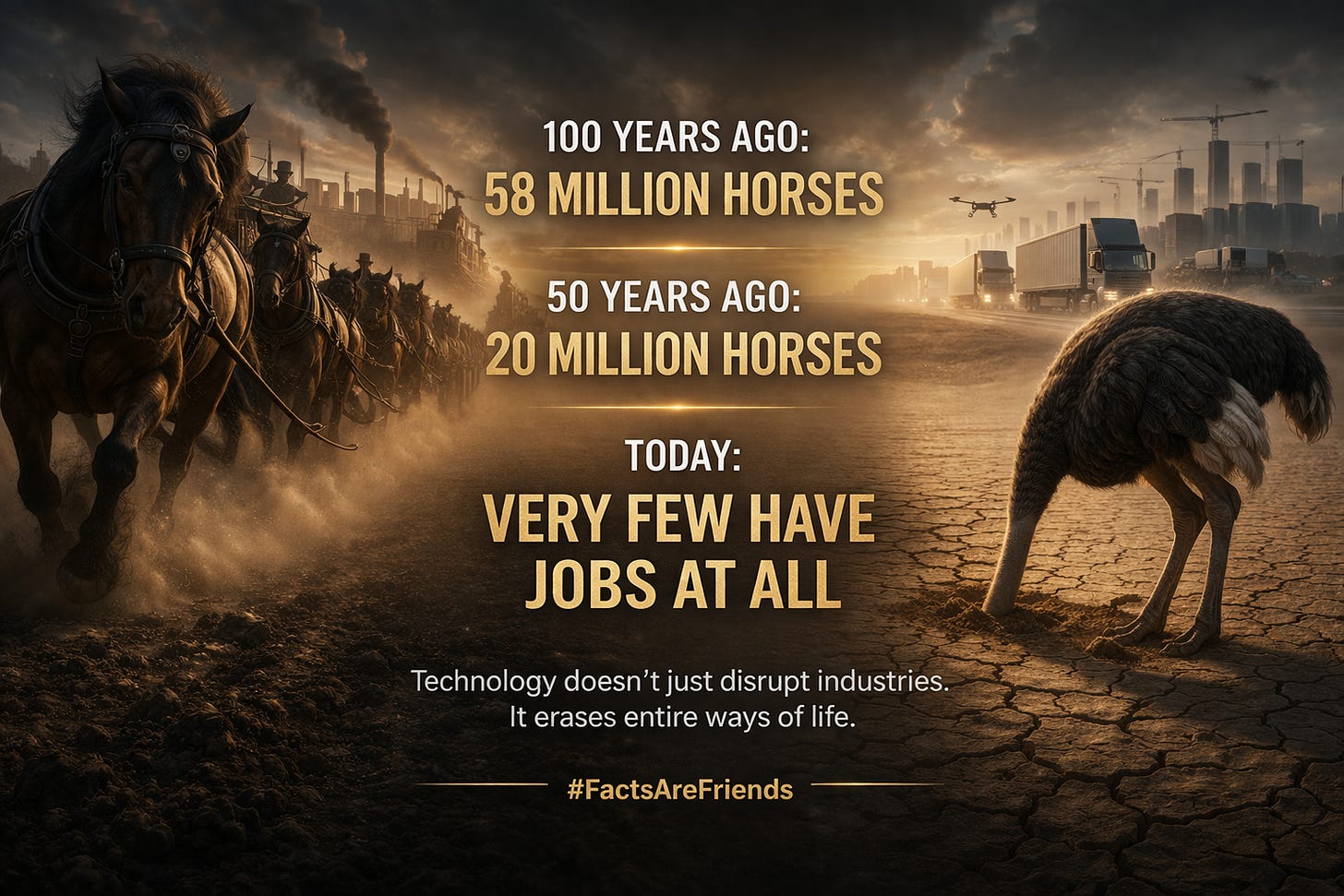
The global horse population fell from approximately 58 million in 1900 to under 20 million by the 1950s before partially recovering through leisure use - and it remains well below its pre-automobile peak today. The numbers in London are even starker - some sources say from 300,000 to 200 today. The horses that found new pastures were the exceptional ones - the racing thoroughbreds, the show jumpers, the dressage horses, the kind riding stables’ hackers. Those are the horses I was brought up around - “eventers” (dressage, show jumping, roads and tracks, and cross country). The working horses, the ones that ploughed fields and pulled carts and did the economic heavy lifting of the pre-automobile world, mostly did not make it. They were not retrained. They were replaced.
Lev’s horse analogy is a story about the top of the market. The Magic Circle partner who pivots to AI-native practice, the boutique specialist who builds a powerful personal brand, the legal tech founder who trained as a barrister and now sits on both sides of the disruption - these are the thoroughbreds. My argument is about what happens to the other 38 million horses.
The Y2K generation: squeezed out, not retrained
Lev’s adaptation argument implicitly assumes that the profession will train a new generation capable of working alongside AI. I challenge that assumption - not because training will cease, but because it will cease to matter in the way it once did.
The Y2K crisis offers an instructive parallel. When the millennium bug threatened global computing infrastructure, organisations reached back to veteran COBOL programmers who had written the original code decades earlier. Those programmers were brought out of retirement, paid handsomely, and put to work on a problem only they understood. They solved it. And then, gradually, as modern systems replaced the legacy code they had maintained, they were no longer needed. There was no next generation of COBOL programmers waiting to take their place. The skill became obsolete not through dramatic displacement but through quiet attrition - the old guard continued to serve while technology caught up, and by the time it had, the role had simply ceased to exist.
This is a trajectory I can see for the legal profession. The current generation of experienced practitioners will continue to serve. Their deep knowledge, their client relationships, their instinct for risk - all of this remains genuinely valuable while AI is still developing, still requiring human oversight to catch its errors. But AI is catching up fast. And by the time it has caught up fully, the sophisticated legal expert will not need to be replaced by a new generation of sophisticated legal experts. The work that required them will simply no longer require anyone.
There is no need to train the next generation. The current generation will serve out the transition. And when the transition is complete, the question of who takes over will have answered itself.
Orbitz: Does Lev’s own analogy undermine his argument?
Lev cites Orbitz as evidence that incumbents can own the platform layer. United, Delta, Northwest, American and Continental founded it in 2001 to compete with Expedia and Travelocity. It was sold to Expedia in 2015 for $1.6 billion - a fraction of the market value the airlines had anticipated and a fraction of what Expedia itself was worth by then.
The airlines did not capture the online travel market.
They created a platform, watched it develop independent economics, and ended up more commoditised than before. Orbitz became another instrument of their margin compression, not a rescue from it. Will ClearyX be different?
Lev introduces the analogy. I simply ask him to follow it to its conclusion.
The fund that tells the truth
Lev manages GrayHair Venture Partners, a specialist legal tech venture fund. He mentions it himself. I note this not to score a point but because it is the most honest signal in this entire debate. Lev is simultaneously arguing that law firms will adapt and thrive, and personally deploying capital on the thesis that the platforms disrupting them will generate superior returns. He may argue that the firms will blossom by using these tools, but perhaps that blossoming will change when we hit Autumn (oh yes, “the Fall”)?
That is not a contradiction - it is rational. Smart investors back the disruption, not the disrupted. But it does tell us something important about where the smart money thinks the value ends up.
If adaptation were sufficient - if law firms were genuinely going to capture the economics of the AI transition - there would be no investment thesis for a legal tech venture fund. The existence of Lev’s fund is his strongest concession to my argument.
Taylor Swift is not a record label success story
Lev cites Taylor Swift as evidence that disruption produces new winners in the music industry. She does. But look carefully at what she is actually evidence of.
Taylor Swift did not thrive because a major label adapted well to streaming. She thrived in explicit opposition to the old model. Her battle with Big Machine Records and Scooter Braun, and her decision to re-record her entire back catalogue to reclaim ownership of her masters, is not a story of institutional adaptation. It is a story of an exceptional individual talent escaping the incumbent model and rebuilding on her own terms. The label that signed her did not capture the value of the streaming era. She did - individually, and partly by dismantling her relationship with the intermediary that had previously profited from her work.
I sit on the board of Openstage, a platform built on exactly this insight. Openstage’s founding principle is that artists should own the relationship with their fans - not platforms, not labels, not intermediaries. It now supports fan relationships for more than 600 artists and 30 million fans worldwide, working with artists from Lana Del Rey and Sir Paul McCartney to Oasis and Bad Bunny. What I see from that vantage point is not an industry that adapted well. It is artists reclaiming ground that incumbents had captured and then failed to protect.
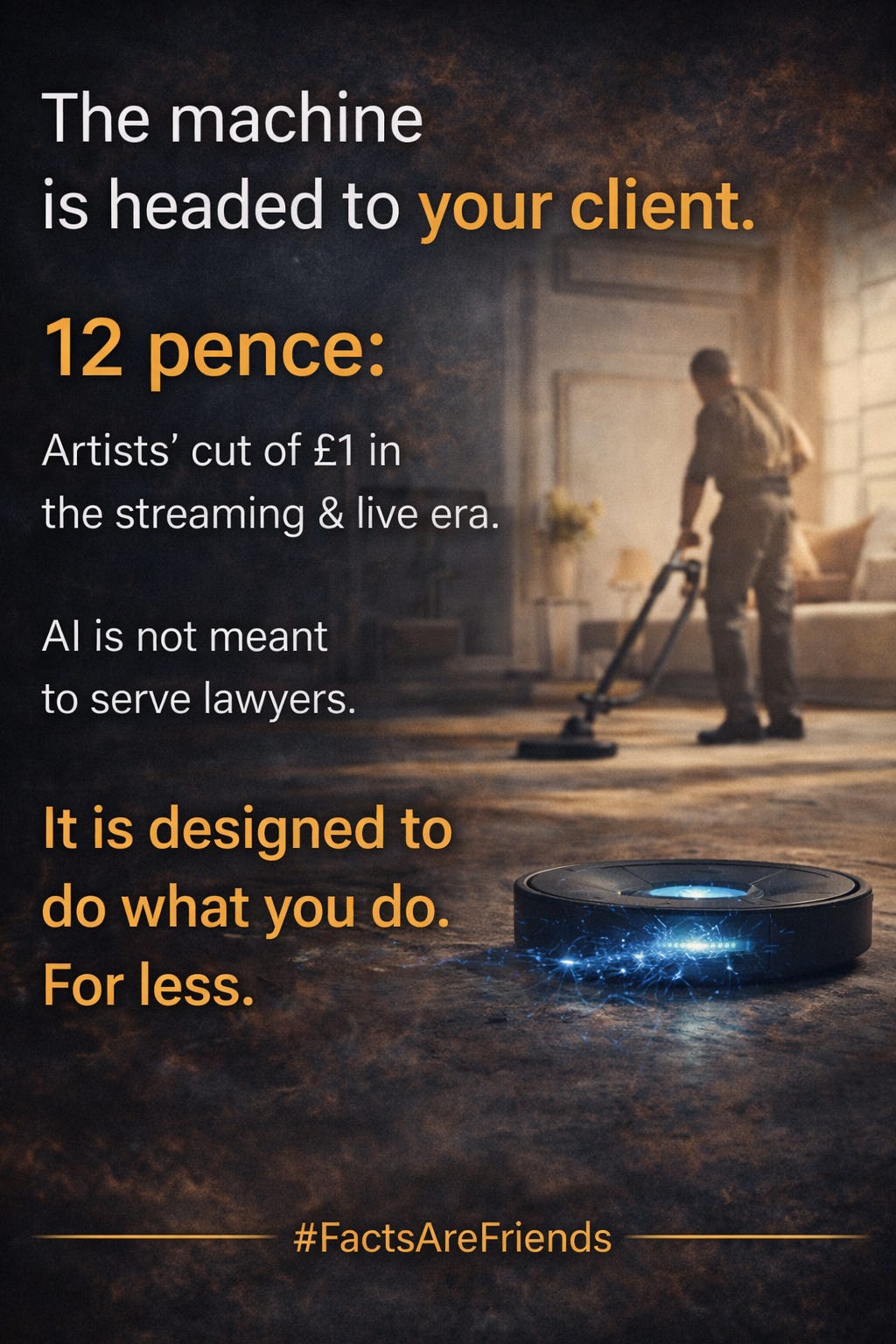
Here is the figure Lev does not cite when he invokes Taylor Swift: artists earn roughly 12 pence in every pound generated by their work across the streaming and live ecosystem. That is the actual outcome of the music industry’s disruption for the majority of artists. Taylor Swift is the exception that Lev has mistaken for the rule. The 12 pence is the reality for everyone else.
How many of today’s lawyers will achieve even the £012 return?
The good enough argument
Here is the argument that Lev’s adaptation thesis most needs to confront.
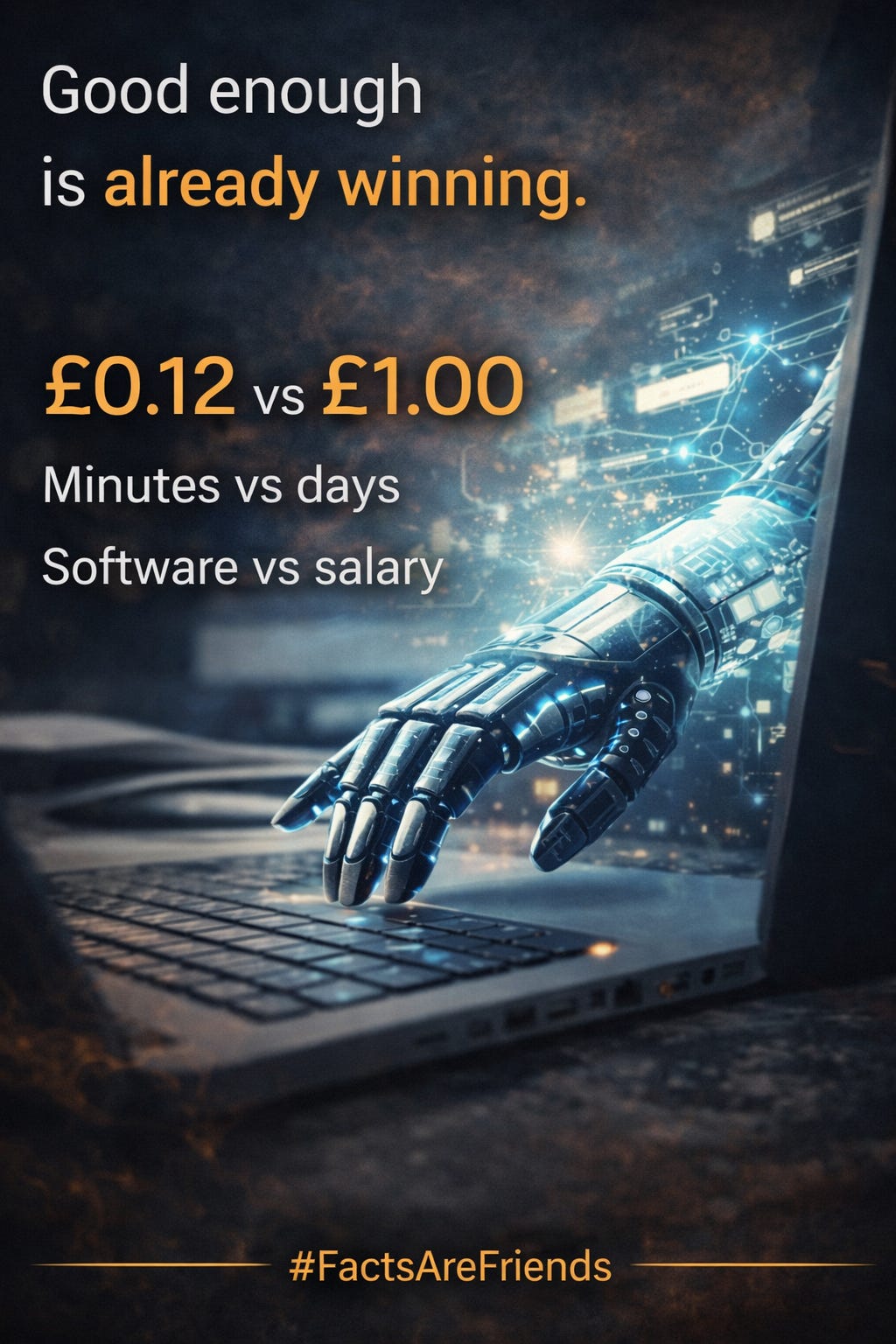
AI does not need to match the judgment of a senior partner at a Magic Circle firm. It needs to be good enough for what the client actually requires - and for the majority of legal work, that threshold has already been crossed or will be crossed very soon.
Most of a law firm’s revenue does not come from existential corporate transactions, contested M&A or novel regulatory questions at the frontier of the law. It comes from work that is repetitive, process-driven and fundamentally routine: reviewing terms and conditions, drafting privacy policies, advising on standard outsourcing contracts, checking employment agreements, updating standard commercial terms. This work is not intellectually trivial - it requires care and accuracy - but it does not require the accumulated judgment of a decade-trained specialist. It requires reliable, consistent, fast execution. And guess what? - AI already provides that for large categories of this work, and its capability is expanding rapidly.
Clients will not leave law firms dramatically. They will simply stop coming. Gradually, matter by matter, category by category, there will be attrition as clients discover that AI is good enough for the work they previously instructed a firm to handle. The firm does not lose a client. It loses a work stream. Then another. Then another. The relationship persists; the revenue does not.
The vacuum cleaner problem: legal AI is sold to the wrong people
I had a great conversation with Todd Trahan this morning (1 April 2026) and realised as I spoke what I regard as the deepest structural problem with the current legal AI market - and it is one that Lev’s optimism about firm adaptation does not address at all.
Todd said that workflow automation in the legal sector is not new - it has been developing for over twenty years. W hat has changed is the power of the underlying technology. But the legal AI market is overwhelmingly selling to lawyers, not to clients. Harvey, Legora, CoCounsel - all are priced for and marketed to law firms and their professionals. The technology is being channelled through the existing intermediary rather than reaching the people it could most transform: the businesses, individuals and institutions who need legal clarity and currently pay lawyers to provide it.
Think of it this way. Imagine that vacuum cleaner technology has been developed - a genuinely transformative tool that would allow the homeowner to clean their own home faster, more thoroughly and at a fraction of the current cost. Now imagine that instead of selling the vacuum cleaner to the homeowner, the technology companies sell it exclusively to the cleaning companies. The cleaner becomes marginally more efficient. The cleaning company charges slightly less. The homeowner continues to pay for a service they could now perform themselves, because nobody has told them the technology exists or put it in their hands. And then they see what the cleaning company is doing, and realise that they can buy the vacuum themsleves.
That is legal AI today. The result is exactly what you would expect. The cleaning company gets a better broom. They do great, until the homeowner discovers they could do it themselves.
Legal friction (and this isn’t fiction)
This all matters because the true potential of legal AI is not to make lawyers more efficient. It is to eliminate the friction that makes lawyers necessary in the first place.
Todd identified five distinct friction points that have historically made legal services indispensable:
the time it takes to navigate the law;
the procedural complexity that requires a guide;
the scarcity of legal knowledge that creates information asymmetry;
the institutional opacity that leaves clients not knowing where to go or what to do; and
the financial burden that prices most people out of the system entirely.
AI can address all five - not by making the lawyer faster at navigating them, but by removing the need for navigation altogether.
When those friction points are eliminated, the commercial relationship between parties changes fundamentally.
If both sides of a corporate transaction allow their AI agents to access their respective systems, total transparency becomes achievable.
Trust and living contracts
Businesses want sustainable business relationships. The problem historic problem has been that the playing fields are uneven and trust is lacking. Trust is the foundation of every sustainable commercial relationship. It no longer needs to be mediated by a lawyer who certifies that each side has disclosed what they should (or even what they could) have disclosed - the new technology can ensure that both parties are sure that they have disclosed, and wil continue to disclose, everything that they should (and it is in their interests to do so). It can be built directly into the architecture of the transaction itself. This is the world of living contracts that I have written about elsewhere: agreements that monitor themselves, adjust in real time and resolve disputes avoiding the need to crystallise into litigation that benefits no one but the lawyer (at least in the UK where most times one party loses, and the other is put in the position it would have been in but for the breach - which is an odd sort of “win”).
The lawyer as intermediary is not replaced in that world. The lawyer as intermediary is rendered structurally unnecessary. The friction is mistrust simply evaporates. Its not utopian, it is possible and in the interests of everybody who wants a transparent, sustainable business relationship.
Steward or gatekeeper
Surely the legal profession was always meant to be a steward of the process, not a gatekeeper.
Stewards serve the transaction and the parties to it.
Gatekeepers extract rent from the passage between parties who need each other.
Legal AI, sold to lawyers and priced for law firms, is currently reinforcing the gatekeeper model while quietly building the infrastructure that will eventually make the gate itself redundant.
The homeowner will eventually find the vacuum cleaner. IT will come with a robot to use it, too. After that has happened many may forget the old ways and wonder why they ever paid a cleaner to use it.
What remains - and who is better placed to provide it
I am not arguing that sophisticated commercial judgment disappears. It will remain. What I am arguing is that the lawyer’s claim to be the natural provider of that judgment is far weaker than the profession assumes.
The work that survives AI is commercial assessment, appraisal and negotiation - the deep market-segment knowledge that comes from decades of exposure to how deals are done, how risks play out and (for so long as they are human) how counterparties behave under pressure.
That is genuinely scarce and is genuinely valuable.
But lawyers do not have a monopoly on it. Investment bankers, accountants and management consultants are often just as well placed - sometimes better placed - to provide the strategic advice the client actually needs. The lawyer’s current position at the advisory table exists not because legal training is the best preparation for commercial judgment, but because lawyers are present at the right moment in a transaction and have earned trust over time through the breadth of their involvement.
That positioning is contingent, not structural. As AI handles the legal process itself, the justification for the lawyer’s advisory role weakens. The client does not need a legally trained adviser to tell them whether a deal makes commercial sense. They need someone with deep knowledge of their market, their counterparty, and the pattern of how similar situations have resolved. A seasoned investment banker or an experienced industry consultant may provide that more effectively than a partner whose expertise is primarily in the mechanics of legal documentation.
The lawyer’s role exists because they were at the table first. AI changes who gets to sit down.
The structural problem: a firm built for a world that is ending
The law firm as an institution is not designed for what is coming. Its structure was built around the economics of scarcity - scarce legal knowledge, scarce trained practitioners, scarce access to the expertise clients needed. That scarcity justified the pyramid, the partnership, the real estate, the infrastructure and the brand.
Law firms have grown up in the tradition of being reassuringly expensive. That reassurance was always grounded in the scarcity of knowledge. As AI advances, knowledge becomes abundant. The scarcity that commanded the premium evaporates, and the premium evaporates with it.
The wide pyramid structure - many juniors billing at the base, funding the spread that rewards equity partners at the apex - becomes unnecessary once AI performs the work currently done by the base. The real estate portfolio, the support teams, the knowledge management infrastructure, the billing machinery - all of these become overhead in a world where the work they were built to support is done by software.
The equity partnership model itself was designed for a world in which multiple specialists needed to collaborate continuously, sharing both risk and reward because their combined contribution exceeded what any individual could achieve alone. In an AI-native practice, that logic weakens. Specialists can collaborate on an ad-hoc basis without the structural overhead of a partnership. The equity model that worked when human expertise needed to be bundled becomes a liability when AI unbundles it.
What is left, structurally, is a small number of exceptional practitioners offering genuine commercial judgment, supported by technology that handles the process work. That is not a law firm in any recognisable sense. It is a boutique. It may be highly profitable for the individuals involved. It does not sustain the institution.
The broken ladder: the argument Lev does not address

Lev’s response is almost entirely about senior practitioners - firm leadership, platform ownership, the exceptional individuals who will find new pastures. He says nothing about what happens to the training pipeline.
The profession produces its senior partners by giving junior lawyers work to do. That is the entry-level curriculum through which every trainee solicitor and junior associate has always learned to think like a lawyer. AI now does that work. NALP data shows summer associate hiring in the US hit an all-time low in 2024, with median offers per office at the lowest level since tracking began in 1993. Entry-level salaries fell 3% for the Class of 2024 - the first decline since 2011, coinciding precisely with mass AI deployment across firms. UK training contract numbers peaked in 2024 and are already declining.
But as I argued in the Y2K section: this may not matter in the way it once did. The stables are emptying. And by the time the current generation of horses has completed their working lives, the question of who replaces them will have been rendered obsolete by the answer that AI has already provided.
Engels’ Pause: why record profits are a warning sign
Am Law 100 firms posted record profits per equity partner in 2024 - $3.15 million on average, up 12.3% year on year. Lev points to this as evidence of health. I read it differently.
This is Engels’ Pause - the historical pattern, observed during the first Industrial Revolution, where productivity gains from new technology accrue to capital before the labour market adjusts. Weavers worked harder for less. Mill owners prospered. The profession is currently in exactly that phase. AI efficiency gains are flowing to equity partners in the form of record PPP.
Junior hiring is contracting. Entry-level salaries are falling.
The base of the pyramid that sustains the structure long-term is hollowing out while the apex reports record returns. That is not a sign of health. It is the shape of a transition whose second phase has not yet arrived.
The moat that is reversing direction
Lev identifies regulation and insurance as the khazoke’s surviving pillars. What he does not address is that both are directionally reversing.
Regulation designed to exclude non-lawyers from practising was built on the proposition that legal advice requires trained human judgment to protect the client. Once AI demonstrably produces better outcomes on measurable tasks - and the evidence is already building - the regulatory case for human-only legal practice becomes philosophically untenable. The regulator cannot simultaneously acknowledge that AI produces better outcomes and maintain that only qualified humans can deliver legal services.
On insurance: Munich Re has been offering law firms AI-specific coverage since at least 2024. In April 2025, Armilla Insurance Services launched an AI liability insurance product underwritten by Lloyd’s of London syndicates, explicitly covering hallucinations, deteriorating model performance and mechanical failures. Google announced a partnership with Beazley, Chubb and Munich Re embedding insurance directly into its cloud AI offerings.
In March 2026, Munich Re’s HSB subsidiary launched AI Liability Insurance specifically for small and medium businesses.
The moat is not just shrinking. It is changing sides.
As AI comes with insurance, the regulatory system long used by lawyers as a protectionist moat becomes a hurdle to be cleared before they can compete with the (perhaps unregulated, but certainly insured) AI alternative (I hesitate to say competitor).
What Lev and I actually agree on
Lev and I agree on far more than the debate structure suggests.
We both accept the billable hour pyramid is structurally threatened. We both accept the platform economics are real. We both accept that exceptional individuals will find new pastures.
Where we diverge is on what happens to the rest. Lev’s frame is agency - the profession should choose to own the disruption. My frame is arithmetic - the structural economics make that ownership extraordinarily difficult for the majority of firms, for reasons that are not managerial but structural.
The legal profession is not building its extinction, but it is facilitating it walking, eyes open and largely without a map, into a future where the economics flow elsewhere.
The question is not whether the profession will adapt. It will. The question is whether adaptation is the same as survival - and for how many.
My grandfather never contemplated that his son would own the horses. The profession is not contemplating what comes next either. Lev is - and so, I hope, are you.
Kodak adapted. It even phoenixed, eventually. As a shadow of its former self.
Quentin Solt is a UK solicitor, legal consultant and non-executive member of several early stage technology businesses.
His forthcoming book, AI, Abundance and the Future of Work, explores how AI reshapes society, work, politics and human connection.
He writes under the #FactsAreFriends on LinkedIn and Substack.
This essay is part of a public dialogue with Lev Loukhton at #TrojanHorseDebate.
References
Horse population decline 1900-1950: https://www.fao.org/faostat/
Richard Susskind - “not us” framing: https://legaltechnology.com/2024/01/02/richard-susskind-the-market-will-show-no-loyalty-to-the-traditional-way-of-working/
Orbitz history and sale to Expedia 2015: https://en.wikipedia.org/wiki/Orbitz
GrayHair Venture Partners: https://www.linkedin.com/company/grayhair-venture-partners
Openstage - artist fan data platform, 600+ artists, 30 million fans:
https://openstage.live
Openstage - Lana Del Rey, Paul McCartney, Oasis, Bad Bunny: https://medium.com/platform-stream/openstage-puts-artists-in-control-of-fan-relationships-by-uniting-once-fragmented-data-e27ebcdf163c
IQ Magazine - Openstage expansion 2026: https://www.iqmagazine.com/2026/02/openstage-expands-access-to-fan-data-platform/
Artists earn 12% of revenue in streaming era - Openstage analysis: https://uk.linkedin.com/company/openstagelive
NALP summer associate hiring all-time low 2024: https://www.nalp.org/0925research
Thomson Reuters - AI saving 240 hours per lawyer per year: https://www.thomsonreuters.com/en/reports/state-of-the-legal-market.html
Munich Re AI insurance for law firms: https://www.abajournal.com/magazine/article/does-your-professional-liability-insurance-cover-ai-mistakes-dont-be-so-sure
Armilla AI liability insurance underwritten by Lloyd’s, April 2025: https://www.hunton.com/hunton-insurance-recovery-blog/affirmative-artificial-intelligence-insurance-coverages-emerge
Munich Re HSB AI Liability Insurance for businesses, March 2026: https://www.munichre.com/hsb/en/press-and-publications/press-releases/2026/2026-03-18-introducing-ai-liability-insurance-for-small-businesses.html
Google AI insurance partnership with Beazley, Chubb and Munich Re: https://www.hunton.com/insights/publications/how-insurance-policies-are-adapting-to-ai-risk
Am Law 100 2024 financials - PPP and headcount: