 Facts are friends
A wealth manager’s quarterly investment update landed on my desk this week. In it, Ben Kumar - Head of Strategy at 7IM (Amicus Wealth Management) – asks the question that every sentient professional is now asking: “Which ‘job’ is AI coming for?”
His answer is, in essence: relax. He relies on historical analogies to show us that automating tasks doesn’t eliminate jobs:
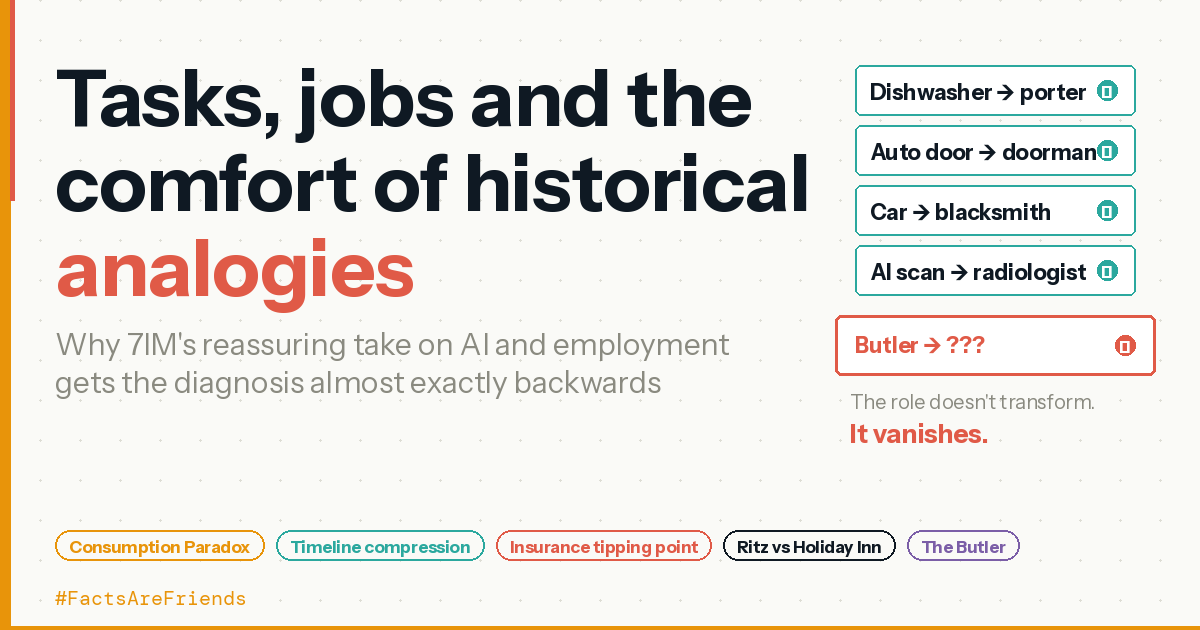
Dishwashers didn’t kill kitchen porters.
Automatic doors didn’t kill doormen.
Cars didn’t kill blacksmiths – they turned them into car factory workers.
And AI in radiology hasn’t reduced the number of radiologists.
Therefore – and here comes the kicker –
It’s a beautifully written piece. It also risks being a story of dangerously misplaced comfort.
Let me take his arguments one by one. Where I think he’s right, I’ll say so.
Where I think he’s reading the map upside down, I’ll explain why.
You can read Ben’s article to which I am responding here 7IM Investment Update Q2 2026.
Buckle up, here we go!
“Nobody is quite sure what it’s going to do to the economy”
Verdict: Fair – but weaponised as reassurance.
Ben is right that uncertainty exists. Nobody has a crystal ball. But there’s a sleight of hand here: the uncertainty is being deployed to suggest that things will probably be fine, because they usually have been. That’s survivorship bias dressed up as pragmatism.
The honest version of “nobody knows” should provoke preparation, not relaxation.
When you smell smoke in a building but aren’t sure which floor it’s on, “nobody is quite sure” is not a reason to sit back down at your desk. It’s a reason to locate the exits.
The $2 trillion being spent on AI worldwide in 2026 isn’t being invested by people who think nothing will change. That capital has a thesis, and the thesis is disruption. When the people writing the cheques are betting on transformation, the people cashing them probably shouldn’t be betting on continuity. I don’t want the people looking after our money to run lemming like after the investors who have a higher risk tolerance, but nor do I expect them to assume that those investors are dopey.
“Most modern jobs aren’t a list of instructions”
Verdict: Correct – but it proves less than Ben suggests.
This is Ben’s strongest point, and I want to give it its due.
He’s right that jobs bundle skills in ways that aren’t always obvious. My background is as a lawyer, so I draw on what I know to illustrate the point.
Solicitors don’t just “draft contracts” – they manage client anxiety, navigate commercial relationships, exercise judgment about risk appetite and read the room in negotiations. A teacher doesn’t just deliver a curriculum – they manage behaviour, spot distress, inspire curiosity.
Where Ben goes wrong is in assuming this complexity protects the job itself.
Here’s the problem: you don’t need to automate the whole job to destroy it economically. You just need to automate the parts that justify the price tag. If AI can handle 70% of what a junior solicitor does – the research, the first drafts, the due diligence checklists, the document review – then you don’t need five juniors any more. You need two. The remaining 30% (the judgment, the client hand-holding) doesn’t generate enough revenue to sustain the other three.
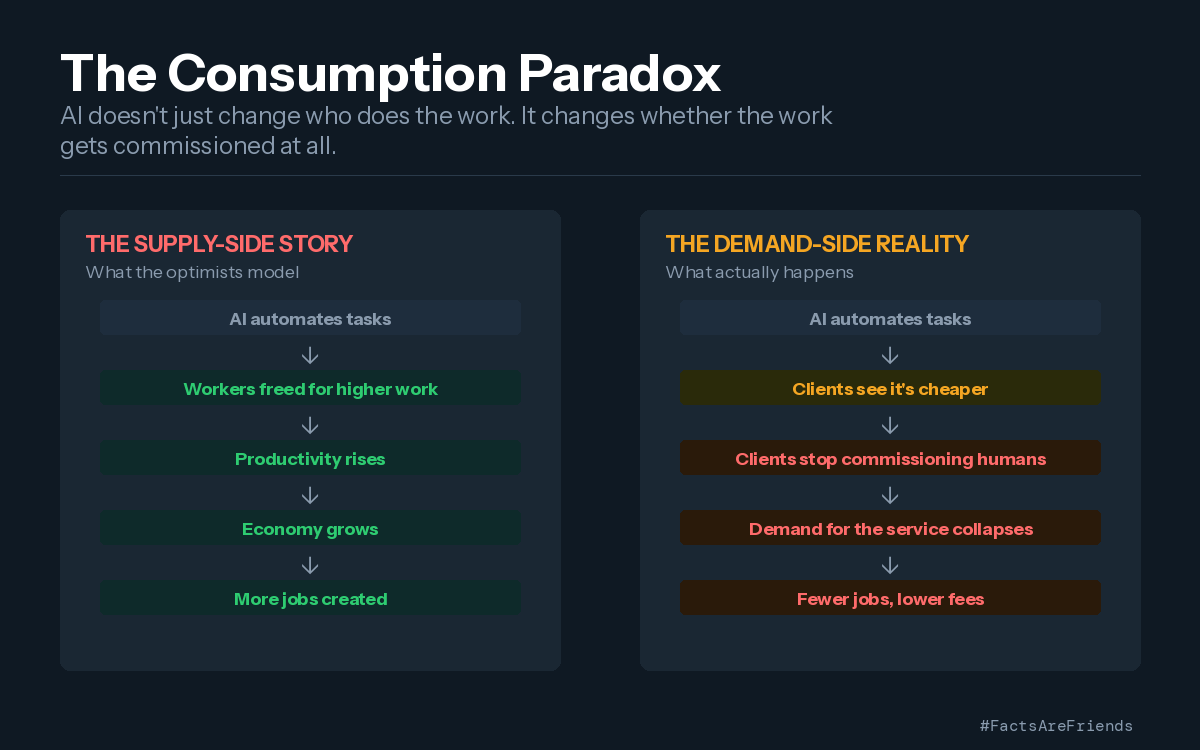
I call this the Consumption Paradox, and it works on the demand side, not the supply side. The question isn’t “Can AI do the whole job?” The question is “Will clients still pay for a human to do the whole job when AI does most of it for a fraction of the cost?”
The answer, increasingly, is no. Not because AI is perfect, but because it’s good enough. And “good enough” is moving up the food chain with every model release.
The dishwasher analogy: clearing bottlenecks creates more work
Verdict: Historically accurate, structurally misleading.
Ben’s dishwasher story is charming. Commercial dishwashers cleared a bottleneck – dirty plates – which meant restaurants could serve more covers, which meant more work for everyone else in the kitchen. The kitchen porter survived because the dishwasher expanded capacity rather than contracting the workforce.
This is a perfectly valid description of what happens when you automate a bottleneck in a system with unmet demand. The key phrase is “unmet demand”.
But what happens when AI doesn’t just clear a bottleneck – it removes the need for the service altogether?
Think about it in legal terms. Document review used to be a bottleneck. Law firms staffed armies of paralegals to plough through disclosure exercises. AI-powered review tools cleared that bottleneck – wonderful. But the consequence wasn’t that firms handled more cases with the same people. It was that clients will ask: “If the AI can do the review in two hours instead of two weeks, why am I still paying for a team of six?”
The dishwasher analogy works when the constraint is capacity and the demand is elastic. It fails when the constraint is cost and the demand is price-sensitive. In professional services, the constraint is increasingly cost. And the demand is brutally price-sensitive.
Put simply: the commercial dishwasher made it possible to wash more plates. Legal AI makes it possible to need fewer lawyers. Those are not the same dynamic.
The consumption paradox appears more acutely in the context of being able to provide services to more people. The assumption runs that while you may need fewer people to do the work you used to do, you are now able to provide the service to more people - so you have more jobs satisfying more people. That’s fine, provided that those who didn’t previously have the service now need people to provide it - the problem is when the technology disintermediates, so the service can be provided direct to the consumer - no person needed. And in the law, at least, that is exactly what I expect will happen.
The doorman fallacy: the door wasn’t the job
Verdict: The best point in the article – but it has a ceiling.
This is Ben’s most elegant argument, and he’s channelling Rory Sutherland well. The doorman’s real job wasn’t opening the door – it was security, welcome, reassurance, local knowledge. The automatic door replaced the mechanism, not the role.
I accept this point up to a threshold. In many roles, the human elements – empathy, judgment, presence – are real and valuable. A GP’s bedside manner matters. A barrister’s courtroom presence matters. A good doorman’s ability to read a situation and defuse it. These all matter.
But there’s a ceiling: the doorman analogy only works when someone is willing to pay for the human premium.
If you’re the Savoy or the Ritz, you’re keeping your doorman. The clientele expects it. The brand demands it. But these are premium brands, and they are not the economy. The economy is the Holiday Inn. And the Holiday Inn replaced its doorman with a card-operated entrance, a CCTV camera and a chatbot on the lobby screen. Not because the doorman wasn’t valuable, but because the Holiday Inn’s customers weren’t willing to pay the premium for that value.
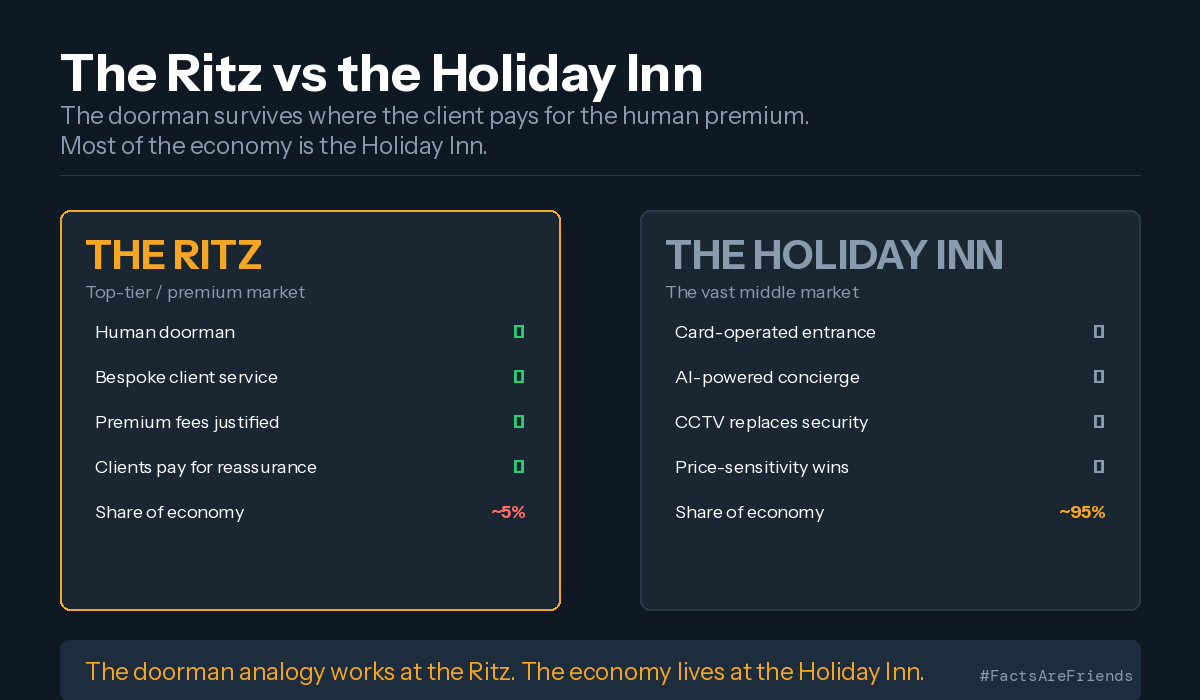
The same dynamic is playing out across professional services. The top-tier firms – the “Ritz” of the legal, accounting and consulting worlds – may keep their human experts. The premium clients will pay for the reassurance - I re-phrase Thomas Edison who said that he would make electricity so ubiquitous that only the super-wealthy would be able to afford the luxury of eating by candle light: in the context of AI the technology shall make it so that only the ultra‑wealthy will be able to afford having a human provide the service. But the vast middle market? They’re already asking whether they need the doorman at all, or whether the automatic door (with a bit of AI-powered concierge on the side) will do just fine. Look at your local bank (now in your pocket), the check out tills in the supermarket (who mans them? - much of the time you do it yourself) and the budget airlines (where you self check-in and the only human intervention is to police the size of carry-on luggage).
For professional services, this is the insurance tipping point I’ve written about before. The moment an AI system can be underwritten – the moment an insurer will stand behind its output – the economic argument for the human professional collapses for all but the most complex and high-stakes work. We’re not there yet for every profession, but we’re closer than most professionals want to admit.
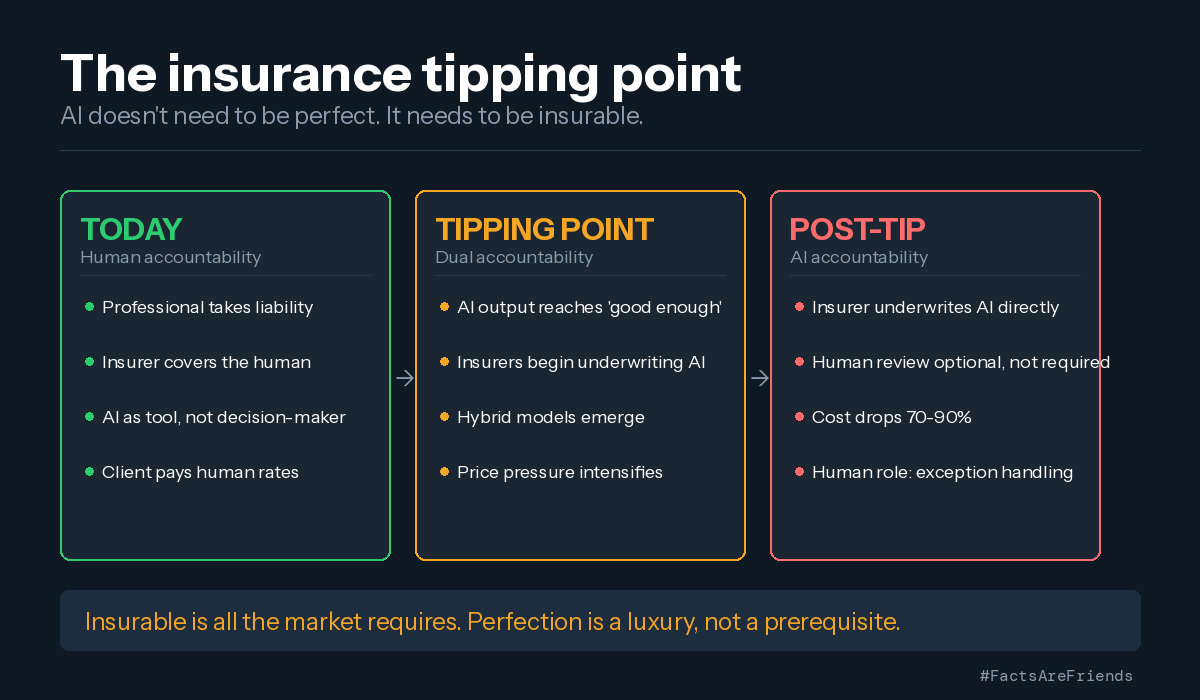
Consumers of other services don’t even have to wait for the insurance - they simply need to get to the balance where they trust the technology sufficiently to switch away from the human.
The blacksmith analogy: skills, not products
Verdict: Historically interesting. Temporally naïve.
Ben tells us that 250,000 blacksmiths in 1910 became 350,000 car factory workers by 1940. I have been unable to verify those numbers, but accept that they are directionally accurate. The skill was metalworking, not horseshoe-making. Workers adapted, and employment actually grew.
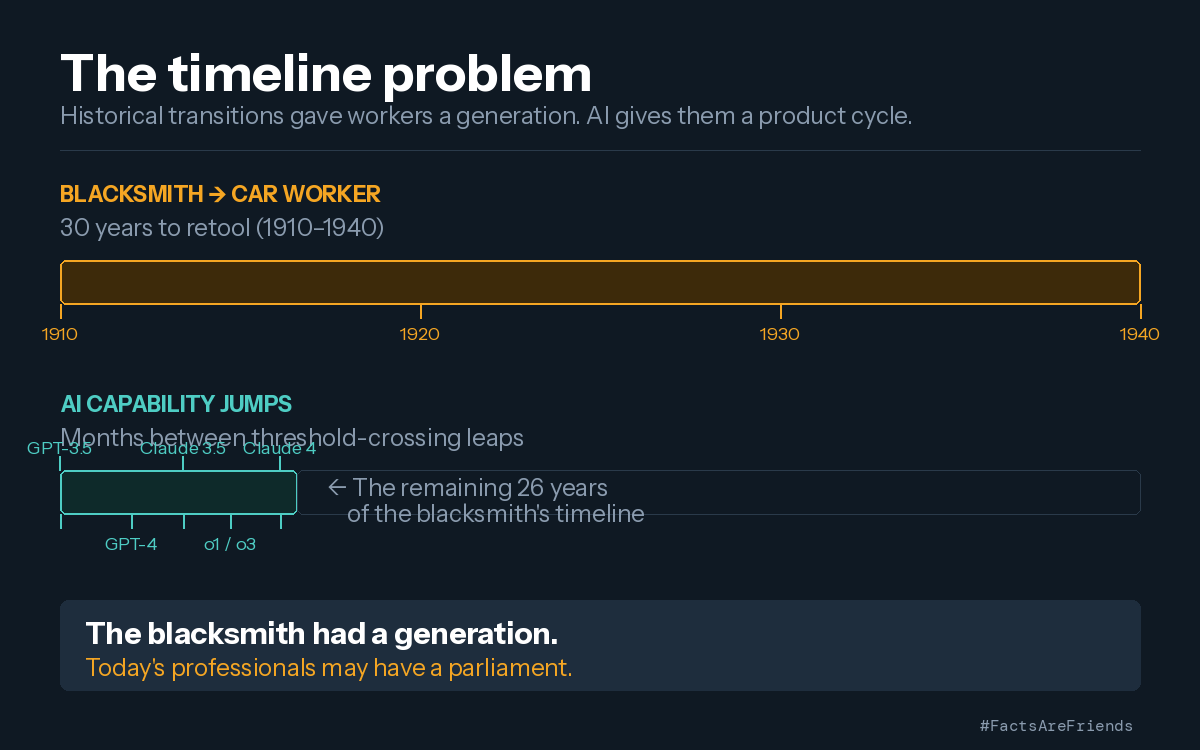
This is true. It’s also a story that played out over thirty years.
The horse-to-car transition gave workers a generation to retool. Sons of blacksmiths could train as mechanics. Communities could adjust. Apprenticeship systems could pivot. The Ford assembly line didn’t appear overnight and replace every farrier in the country by Tuesday.
AI isn’t working on that timeline. GPT-3.5 to GPT-4 was thirteen months. GPT-4 to Claude 3.5 Sonnet was about a year. Each jump doesn’t just improve performance – it crosses new capability thresholds. Last year’s “AI can’t do that” is this year’s “AI does that better than most humans”. Mythos will do more. Much more. OpenAI’s next rumoured model (commonly referred to as Spud, but hopefully will simply be ChatGPT5.6) will likely be pretty impressive too.
The blacksmith had thirty years to become a car worker. The modern knowledge worker has – what? Eighteen months? Two product cycles? The underlying skill transfer Ben describes may be real, but the timeline compression makes the analogy almost useless as a planning tool.
And there’s a much deeper problem. The blacksmith-to-car-worker transition worked because the new industry needed bodies. Physical labour couldn’t be automated, so humans were essential to the assembly line. The Iceberg Index from MIT tells us that the new jobs aren’t being created for humans. And I’ve been challenging that report for underplaying the impact of “embodied AI” - robots, powered by AI. The assumption that physical work is safe because robots are hard is already being undermined by advances in embodied AI. Boston Dynamics isn’t building dancing robots for YouTube views. Elon Musk is building an automaton workforce. His first ambition? To build robots that build … robots. Google has just released “Gemini Robotics-ER 1.6”: the name is more obvious than “Nanobanana” (its image generation tool), but it is no surprise that this behemoth is developing reasoning models specifically for real-world robotics tasks.
The robots will take manual jobs, the dilemma for people like Ben should be assessing not whether but when.
Some may laugh, but how many scoffed at the idea that you could have a conversation with your ‘phone even five years ago?
The radiology argument: AI boosted efficiency but demand increased
Verdict: Correct today. Almost certainly wrong tomorrow.
Ben’s radiology example is his most empirically grounded point, and it deserves serious engagement.
He’s right: AI has been in radiology for over a decade. Efficiency has increased by 15-20%. And yet the UK needs 30% more radiologists, not fewer. This is a genuine counterpoint to the “AI kills jobs” narrative, and I respect it.
But there are two things to note.
First, radiology AI to date has been narrow AI–pattern-matching tools assist radiologists but don’t (yet) replace their clinical judgment. They possibly could, but the regulations haven’t caught up yet. They will. So the radiologist still interprets, correlates with clinical history, communicates with the referring clinician and takes legal responsibility for the diagnosis. The AI is for now a tool in the radiologist’s hand, not a replacement for it. That is changing, and the inhibiting factor is probably not the technology but the real safety, validation and liability concerns (and once those are addressed, what is left is in effect the protectionism of regulation). I am seeing the same thing in law, where rules originally designed to protect the client (for example, privilege) become a protection for the legal practitioner - until the client elects to bypass the safety valve, at which point what was the professional adviser’s helpful moat becomes a hurdle to scramble across.
Second – and this is the critical point – the demand increase in radiology isn’t because AI created more work. It’s because the population is ageing, scanning technology has proliferated and clinical pathways now require more imaging than they did a decade ago. The demand is exogenous. It has nothing to do with AI and everything to do with demographics and clinical practice.
The question Ben should be asking is this: what happens when AI reaches the point where it is not allowed only to triage scans but when we accept that it issues diagnostic reports (with clinical-grade accuracy)? When the insurer says “We’ll accept the AI diagnosis”. At that point, you don’t need 30% more radiologists. You might need 30% fewer. The demand stays – we still need the scans read – but the supplier changes. Oh, by the way, the AI won’t have the innate bias humans have, won’t suffer from distractions, missing things or getting out of bed the wrong side. AI won’t strike for more pay, have relationship issues, demand holiday or even need to sleep; admittedly AI may introduce different systematic errors of its own - but the hope is that once errors are identified it should be possible to iron them out: and corrected once may be corrected for ever. Of course, it may not be that simple every time when we get there.
The radiology example proves that narrow AI augments professionals. It says very little about what happens when general-purpose AI reaches clinical competence.
“Tasks might well be done by AI. But jobs are done by people”.
Verdict: A bumper sticker, not an argument.
This is Ben’s big finish, and it sounds wonderful. It’s also a tautology that obscures the actual question.
Of course jobs are done (and often by people). By Ben’s definition, a “job” is a role occupied by a person. But did the role of translating cease to be a job because AI can do it better than a human? Is the automated chatbot (frustrating as they may be today) not doing a job which a human might otherwise have done? The question is whether there will be enough jobs for people to do – and whether those jobs will pay enough to sustain the current standard of living that those people expect.
If AI takes over 60% of the tasks that currently comprise a professional role, the remaining 40% might still need a human. That means that the employer keeps four people and lets six go. Those who the employer lets go have lost their livelihoods - and unlike the farriers, we don’t see a stream of factories opening up to build cars (or anything else). The bumper sticker is cold comfort to them.
What it seems to me that Ben ignores entirely is the economic incentive structure. Companies are not charities. They do not employ people because jobs “should” be done by humans. They employ people because those people generate more value than they cost. The moment AI shifts that equation – the moment that AI is “good enough” – the human goes and the silicon (and robot) substitute her or him. Not because the employer is cruel, but because the market is efficient.
What Mr Kumar gets right
To be fair to the piece, there are real insights here:
Jobs are more complex than task lists. True, and important.
Historical panics about automation have often been overblown. True, with caveats about timelines.
The doorman insight – that the visible task often isn’t the real value – is sharp and worth remembering.
The radiology data is factually accurate for the current moment.
But the overall framing – “relax, it’ll be fine, it always has been” – is the investment industry’s equivalent of “past performance is no guarantee of future results”, except Ben is using past performance to guarantee future results.
The missing analogy: the butler
Every one of the examples – the dishwasher, the doorman, the blacksmith, the radiologist – tells a story where tasks migrate but the human role survives in some form. The kitchen porter is still there. The doorman is still there. The blacksmith became a car worker. The radiologist is busier than ever.
But there’s an historical analogy conspicuous by its absence: the butler.
In the great houses of the 18th and 19th centuries, the butler was the indispensable intermediary. He coordinated the household staff, managed deliveries, controlled access to the family, relayed information between the house and the outside world, oversaw the wine cellar, managed the household accounts and maintained the social calendar. The butler didn’t just perform tasks – he was the system. He was the API between the family and everything else.
And then he disappeared.
Not because someone automated his tasks one by one, but because the entire structure that required an intermediary ceased to exist. Telephones meant the family could communicate directly. Refrigeration and supermarkets meant deliveries didn’t need orchestrating. Smaller households meant fewer staff to coordinate. The social conventions that demanded a formal intermediary between the family and the outside world simply dissolved.
The butler’s role didn’t migrate. It didn’t transform into something adjacent. It evaporated (I accept there are a few legacy butler roles, but so few as to make them of no relevance in this context). The functions he performed – coordinating, scheduling, relaying, gatekeeping – were absorbed by technology and structural change until there was nothing left to occupy.
This is the analogy that should keep us awake at night. Because AI isn’t just automating tasks within existing structures. It’s dissolving the structures themselves.
Think about the modern professional intermediaries. The solicitor sitting between a client and a property transaction. The financial adviser sitting between a client and an investment decision. The recruitment consultant sitting between a candidate and an employer. The insurance broker sitting between a business and an underwriter. Each of these roles exists, in large part, because the client cannot easily navigate the complexity alone. The professional is the butler – the human API between the client and the system.
But what happens when AI makes the system navigable without the intermediary? When a client can use an AI platform to handle their own conveyancing, or build their own investment portfolio, or match themselves to job opportunities, or compare insurance products with machine-grade analysis?
Remember travel agents - do you now use one, or book direct. They are the modern butlers.
The answer isn’t that the solicitor or the adviser or the broker does “higher-value work”. The answer is that the client stops calling. Not because the professional wasn’t good, but because the need for an intermediary has been disintermediated out of existence – just as the telephone, the refrigerator and the decline of the country house disintermediated the butler. And Expedia, SkyNet, AirBnB and a plethora of other direct to client solutions “did for” travel agents.
The framework proposed in Ben’s essay cannot accommodate this possibility because every one of his analogies assumes the role survives.
The dishwasher, the doorman, the blacksmith and the radiologist all end with a human still in the picture. The butler doesn’t. And the butler is the analogy that most closely maps onto what AI is doing to most intermediary roles right now.
And then we will have the embodied AI replacing the plumbers, electricians and care workers. But that is the next round of jobs to be hit.
What Ben Kumar’s essay misses
The entire framework ignores three dynamics that make this time structurally different:
The Consumption Paradox. AI doesn’t just change who does the work – it changes whether the work gets commissioned at all. When clients can get 80% of the answer for 10% of the price, the market for the remaining 20% shrinks dramatically. This is a demand-side disruption, and historical analogies about supply-side automation don’t capture it.
The speed of capability improvement. Every historical analogy deployed played out over decades. AI capability is compounding in months. The gap between “AI can’t do this” and “AI does this routinely” is closing faster than institutions can adapt. The blacksmith had a generation. Today’s employees may have a parliament.
When AI becomes “good enough”. AI does not need to be perfect, just good enough - at that moment everything changes. And if you want to know whether it is good enough, first ask your kids and then check out what the insurers are underwriting: they are doing the maths and assessing the facts. When they routinely insure technology to do what a human did, the human role is probably substantially over. It won’t mean AI is perfect. It will mean that it is insurable. And insurable is all the market requires.
Disintermediation. The analogies all assume the human role survives in some form. But the butler didn't survive. When technology makes the intermediary unnecessary, the role doesn't transform – it vanishes. AI is making professional intermediaries navigable-around, not just more efficient. That's not task automation. It's structural dissolution.
The real question
The article is reassuring. And I understand why a wealth manager would want to reassure clients. Markets don’t like panic, and anxious investors make bad decisions.
But reassurance based on incomplete analysis is worse than honest uncertainty. The question should not be “Which job is AI coming for?” The question is “What happens to the economic model that sustains middle-class professional employment when the tasks that justify those salaries can be done by machines?”
The dishwasher didn’t answer that question. The automatic door didn’t answer it. The Model T didn’t answer it.
And a quarterly investment update from 7IM – however elegantly written – doesn’t answer it either.
Read Ben’s article to which this a response here:
7IM Investment Update Q2 2026
Quentin Solt is a UK solicitor, legal consultant and adviser to fast growth businesses. His forthcoming book, AI, Abundance and the Future of Work, explores how AI reshapes society, work, politics and human connection. He writes #FactsAreFriends series on Substack and comments on LinkedIn.
This essay borrows heavily from the public dialogue he has with Lev Loukhton which may be found by looking for #TrojanHorseDebate on LinkedIn and Substack.
#FactsAreFriends