 Facts are friends
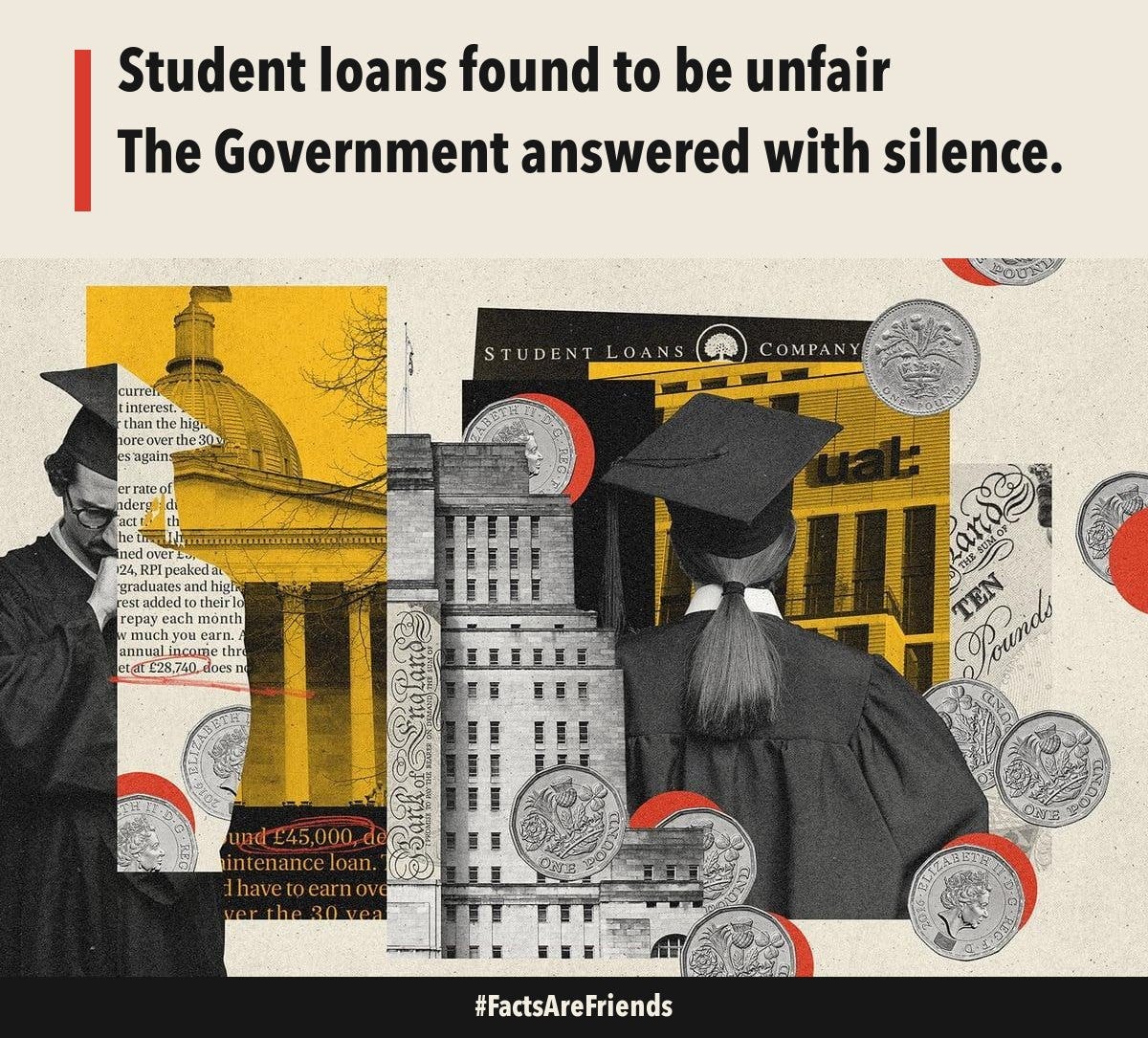
We told a generation that education was an investment in their future. Parliament has now questioned how that investment was sold. But the deeper question remains: what happens when the promised return does not arrive?
Imagine a young woman leaving university.
She worked hard at school, followed the advice she was given and went on to higher education. She believed that studying would improve her prospects and allow her to build a secure and fulfilling life.
She kept her side of the bargain.
Now she has a degree, a job and a student-loan statement showing tens of thousands of pounds outstanding.
Her earnings are not what she hoped. She is trying to save for a home. Every pay increase brings another deduction, but the balance on her statement may continue to grow.
She has done everything society encouraged her to do.
So who has failed whom?
This is the question I explore in my forthcoming book. It is also the question behind an essay I published in April, entitled The Student Loan: A Masterclass in Structural Deception.
I argued then that the student-loan system was fundamentally misdescribed. For many graduates, it operates much more like a time-limited income tax than a conventional loan. It is presented as personal debt, complete with interest, an outstanding balance and the implication that responsible people should try to clear it.
Six months later, Parliament has begun asking some of the same questions. And the Government has had an opportunity to respond.
Parliament has noticed
In July, the House of Commons Treasury Committee published its report on student loans. It concluded that three aspects of the way Plan 2 loans had been presented to prospective borrowers amounted to mis-selling.
The Committee was particularly concerned that students had not been adequately informed that the Government could change the terms retrospectively. It also criticised promotional comparisons with everyday expenditure which could give a misleading impression of repayments. The Committee went further. It said the Government had a moral obligation to reverse the freeze on the earnings threshold above which graduates must make repayments.
In September, the Government agreed to improve the information given to prospective students. It promised clearer explanations of its power to change the rules and more information about how career and life choices might affect repayments.
But it rejected recommendations concerning the use of RPI for calculating interest and the application of Consumer Duty-style protections.
And it did not commit to reversing the threshold freeze.
I welcome better information. It is overdue.
But telling people more clearly that the Government can change the rules is not the same as agreeing that the rules should be fair. Nor does better disclosure resolve the deeper question of whether this financial arrangement should have been presented as conventional borrowing in the first place.
I am not suggesting that the loans are unlawful.
I am suggesting that we should expect the Government to observe standards of fairness and transparency at least as demanding as those we expect of commercial lenders.
The Budget answered with silence
On 28 October, the Government delivered its Autumn Budget. The Plan 2 repayment-threshold freeze was not reversed. The threshold remains £29,385 and is due to stay there until April 2030. For a Plan 2 graduate earning £40,000, the annual repayment is approximately £955. At £50,000, it is approximately £1,855. The calculation is simple: 9% of earnings above the repayment threshold.
The consequences are less simple. When wages rise with inflation but the repayment threshold does not, graduates pay more even where their purchasing power has barely improved. This is fiscal drag, familiar from the wider tax system. It is the Government’s way of saying “tell we we are increasing taxes without saying that we are increasing taxes”. Some may say that this is dishonest.
And it becomes increasingly difficult to defend when we look at the minimum wage. From April 2026, the National Living Wage for workers aged 21 and over is £12.71 an hour. Someone working 40 hours a week for 52 weeks would earn approximately £26,437. The announced April 2027 rate of £13.21 would produce approximately £27,477 on the same basis. The Plan 2 threshold is £29,385. The gap is closing. So much for the loan being a tax on the graduate dividend. If it bites at the minimum wage either the Government maintains that you can now not get any job without a degree, or it has quietly “forgotten” that part of the sale script. My money is on the latter. This week we celebrated ten years of a grating phase on public transport, in public education I propose a variation: “See it. Say it. Bin those how bought it”.
I suggested in April that full-time minimum-wage earnings might approach the threshold by 2028-29. That remains an illustration, not a prediction: future wage rates, hours worked and policy decisions will determine the outcome. But the direction is unmistakable.
A repayment mechanism originally justified by the additional earnings associated with a university education is approaching the point where it could apply to someone earning the statutory minimum wage. What exactly is the graduate premium being taxed at that point?
And why should a person on such modest earnings be expected to contribute before their basic financial security is assured?
The promise behind the loan
There is a much deeper issue here.
For decades, we have encouraged young people to understand higher education as an investment. Study hard. Go to university. Obtain a qualification. Earn more. That was part of what I call the Old Social Contract.
The individual invested time, effort and increasingly money. The economy was expected to reward that investment. Of course, higher education has never guaranteed a particular salary. Some graduates have always earned more than others.
But the economic justification for asking students to assume substantial personal liabilities depends, at least in part, on the expectation that education will improve their future earnings. The difficulty is that the obligation remains even where the expected reward does not materialise. It is income-contingent, so a graduate earning below the threshold does not ordinarily have to make repayments. That is an important protection.
But above the threshold, the deduction applies whether the graduate’s earnings represent a substantial return on their education or simply the income needed to get by. And the annual statement continues to arrive. For some graduates it records a balance that may never be repaid in full.
That balance is legally and administratively meaningful. But it is not necessarily a reliable indication of what the individual will ultimately pay. It can nevertheless become a standing reminder of a promise which, in the graduate’s eyes, has been honoured by only one side.
The motherhood penalty
There is another unfairness which I heard about on Radio 4 and which caught my attention. It concerns those who take time out of paid employment to have and care for children. The student-loan system effectively penalises interruptions in earnings.
Compare two graduates, each owing £62,000 and earning £85,000 a year. One works continuously. The other takes 24 months away from paid employment to have and care for a child before returning to the same salary. During that absence, repayments stop, but the interest does not.
In an illustrative calculation using the Plan 2 repayment threshold of £29,385 and assumed annual interest rates of 6% while working and 4.1% during the career break, the outstanding balance after two years is approximately £67,289 for the parent, compared with £59,276 for the continuously employed graduate.
That is a difference of more than £8,000, despite both having borrowed exactly the same amount.
If those assumptions continued, the uninterrupted graduate would clear the loan after approximately 22 years and nine months, having repaid £113,694. The parent would take approximately 29 years and six months to clear the loan, having repaid £137,407. That is an additional £23,713 in repayments, with the debt taking six years and nine months longer to clear.
These are illustrative figures, not predictions. Actual repayments depend on future earnings, interest rates, thresholds and the terms of the relevant loan plan. The calculation assumes no earnings during the 24-month break and a return to the same salary afterwards. But the underlying injustice is worth confronting.
We tell young people that education is an investment in their future, then construct a repayment system in which taking time out to raise the next generation can leave them paying substantially more for the same education.
The contribution made through caring for children has enormous social value,
the financial system recognises only the interruption in taxable earnings.
We should be asking whether a society that claims to value families ought to penalise those who take time out to raise them.
What the figures actually tell us
The latest Department for Education forecasts make the distinction between different student-loan plans particularly important.
For full-time undergraduate borrowers starting in 2025-26, the Government forecasts an average debt of approximately £45,800 on entering repayment. It expects 55% of that cohort to repay in full. For the earlier 2022-23 Plan 2 cohort, the equivalent forecast was approximately 32%. In other words over half, and up to two thirds, just pay more tax for much of their working lives.
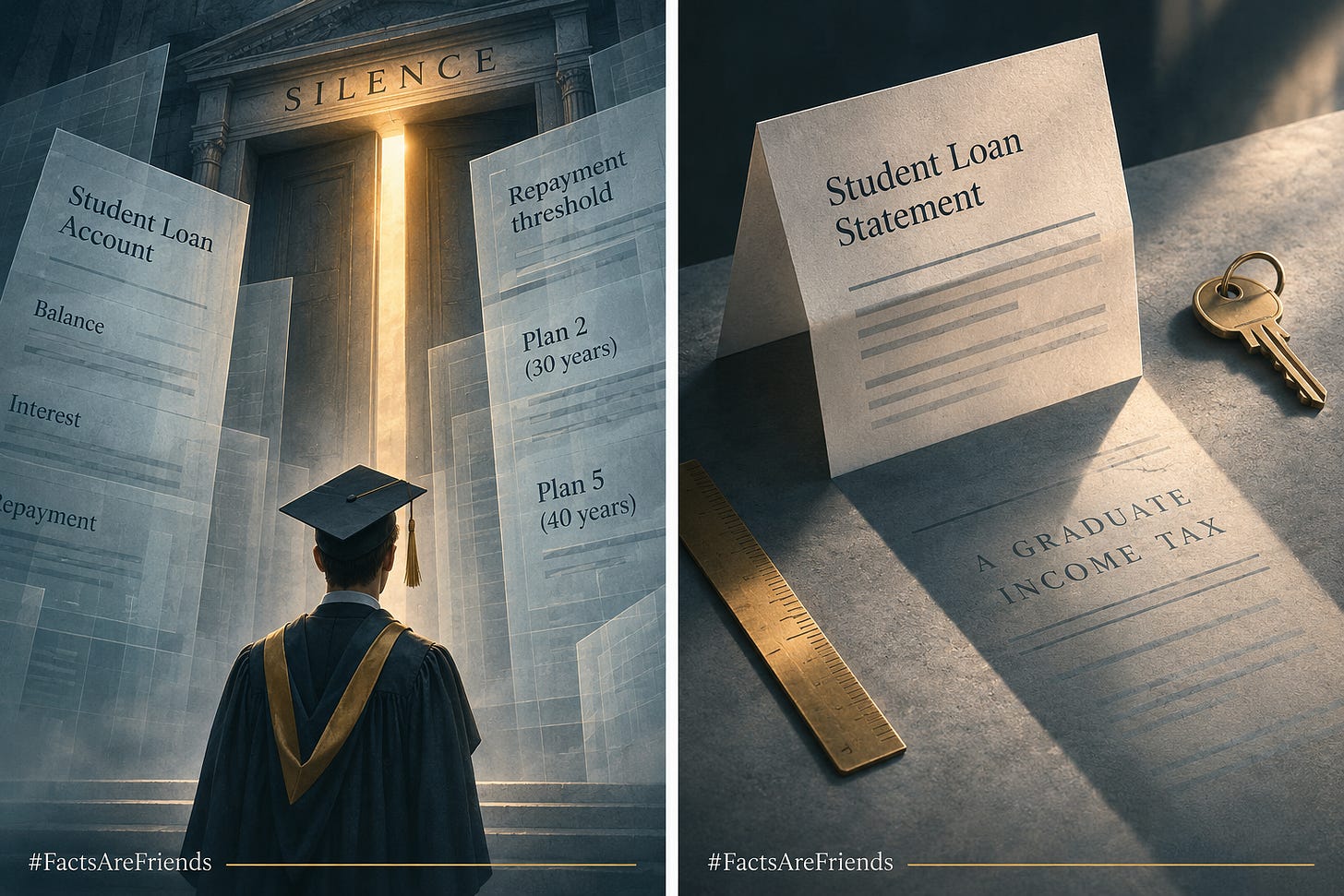
The difference is substantial. Plan 5 generally allows repayments to continue for up to 40 years, compared with 30 years for Plan 2.
So almost most half of those graduating today may repay in full. More are not expected to. Sounds like a pants “lending decision” to me.
The figures reveal that the new system has been changed so that a greater proportion of graduates are expected to repay their debts, in some cases over a much longer period. That may improve the Government’s recovery of its lending. Whether it improves the lives of graduates is a different question.
A 40-year repayment period is not simply a financial adjustment. It can accompany someone through much of their working life.
And even where the eventual amount repaid is manageable, the language of debt can influence decisions about housing, saving, careers and family life.
The financial consequences are real.
So are the psychological ones, although their scale requires evidence rather than assumption.
Why the interest-rate cap is not the answer
The Government has temporarily capped Plan 2 and postgraduate-loan interest rates at 6% for the 2026-27 academic year. For some borrowers, this is valuable.
Someone who is likely to repay their loan in full may benefit from lower interest and potentially repay less overall. But what about someone who is unlikely to clear the balance before the statutory write-off? Their monthly repayments are calculated by reference to earnings. Reducing the interest rate may lower the outstanding balance without reducing the amount ultimately collected.
That is why arguments about interest rates, although important, can distract from the central problem. We are asking people to understand an income-contingent repayment system through the language and accounting conventions of conventional debt.
The same nominal balance can mean very different things for two graduates. One may repay everything, including substantial interest. Another may pay for decades without clearing the balance. A third may earn too little to repay anything. They will likely receive welfare benefits. They are the “winners” in terms of fiscal gain from the system and likely losers in terms of satisfaction with their life choices. The annual statement, the document around which much of the anxiety and public discussion revolves, does not tell us which outcome is likely.
The hidden tax on earning more
For a basic-rate taxpayer in England, an additional pound of employment income commonly attracts 20p of income tax and 8p of employee National Insurance.
For a Plan 2 graduate above the repayment threshold, there is another 9p. That produces a combined marginal deduction of 37p. At higher earnings, the combined rate can be 51%. And within the income band where the personal allowance is withdrawn, the combined marginal deduction can reach 71%.
These are marginal deductions, not the average percentage taken from someone’s entire salary. Individual circumstances can change the calculation. But they illustrate the problem.
We describe student-loan repayments as debt servicing while collecting them through a mechanism that behaves like an additional tax on earnings. If that is the policy choice, we should say so.
And we should debate whether the threshold is sufficiently high to protect the income people need for ordinary living expenses.
Why the families with capital have an advantage
The difference between debt and tax also changes the choices available to families.
Suppose parents have £50,000 available and their child has a student-loan balance of the same amount. Paying off the balance might appear responsible. But if that graduate is unlikely to repay in full, the family could be using £50,000 to eliminate an obligation that would have required substantially less in future payments.
The money might instead provide a house deposit or financial security.
For a graduate expected to repay in full, the analysis may be different. There is no universal answer.
The point is that families with capital can make these choices. Families without capital cannot. Meanwhile, student-loan deductions reduce disposable income and may affect mortgage affordability. A system presented as helping people invest in their future can therefore make it harder for some of them to establish that future.
This is not an argument for taking opportunities away from families who can afford them. It is an argument for giving everyone a fairer foundation.
Raise the floor. Do not lower the ceiling.
But why are we treating education as an investment at all?
This is where my argument goes beyond the mechanics of student loans.
I do not believe the value of education should be measured principally by the additional salary it enables someone to earn. Education makes people more capable of understanding the world, participating in society, caring for others and enjoying their own lives. It can improve judgement, deepen relationships, encourage civic participation and open possibilities which have no obvious monetary value.
Those benefits do not belong solely to the individual graduate. They belong to the community as well. And learning is not merely preparation for something worthwhile later. It can itself be part of a worthwhile life.
Education is not simply a road to the destination. It is one of the destinations. That is why, in my book, I argue for education as a gift rather than an investment. Not because it costs nothing. It plainly has a cost, but the value is wider than the financial return captured by the person receiving it.
A society which believes that human worth comes before economic usefulness should be willing to educate people for reasons other than their future taxable earnings.
What would a better system look like?
There are two questions, and they should not be confused. The first is how to improve the system we have. The second is what system we ought ultimately to want.
For existing borrowers, the immediate priorities should include fairer thresholds, clearer information, predictable terms and meaningful protection for income needed to live. If graduates are to make an income-related contribution, that contribution should fall only on earnings above a level of basic financial sufficiency.
Not merely above an arbitrary figure which can be frozen until minimum-wage earnings catch up with it. One transitional reform would be to replace the language of conventional debt with an openly described Graduate Contribution. It would be a defined, transparent contribution from earnings above a protected threshold, payable for a defined period. That would not settle the wider question of who should fund higher education. But it would make the arrangement more honest.
My longer-term preference is more ambitious. I believe tertiary education should increasingly be treated as a public good, funded collectively and made available without loading an individual with a substantial personal price tag. And it should not be something offered only once, at the beginning of adult life. Someone who wishes to study history at 50, theology at 60, astrophysics at 70 or a completely different discipline after changing career should not be regarded as an anomaly.
Learning that furnishes a life rather than fills a vacancy deserves a place in our education system.
Other countries offer useful examples of adult learning and education directed towards personal development rather than qualifications alone. We can learn from them without pretending that their arrangements can simply be imported wholesale.
There is also a case for giving young people a period between school and adult working life in which to explore who they are, perhaps through study, community service and living alongside people from different backgrounds. No examination. No large debt. No obligation to turn every experience into a qualification. A period of formation, not simply preparation for employment.
These are larger proposals than can be settled in an essay about student loans.
But they explain why I am reluctant to treat a better-labelled graduate tax as the final destination.
Can we afford to think differently?
The obvious objection is cost.
And it is a serious objection. Universities need resources. Teachers need paying. Buildings need maintaining. A publicly funded education system must compete with other demands on the public purse. I am not suggesting otherwise.
Nor does the fact that some student loans are written off mean that abolishing tuition fees would somehow pay for itself. The fiscal arithmetic must be done. But we should also be honest about the costs of the existing system.
There is the public cost of lending which is not recovered. There are the effects of repayment deductions on graduates’ disposable income. There may be consequences for participation in education, household formation and wellbeing, although these require proper measurement before we assign them monetary values.
And there is the wider opportunity cost of treating education principally as a private financial transaction. The relevant question is not simply whether publicly funded education costs money. It is what kind of society we want that expenditure to produce, who should bear the cost and what we lose by continuing with the present arrangements.
We already invest substantial public resources in education. The question is whether we are organising that investment around the right objectives.
The promise we should be making
We have told generations of young people that education is the route to a better life. We have encouraged them to take on substantial financial commitments in pursuit of that promise. Now Parliament has questioned how those commitments were presented.
The Government has agreed that the explanation should improve. But the October Budget left the repayment-threshold freeze in place.
I think we need to ask a more fundamental question. What if the promise itself needs reconsidering? What if education should not be justified principally by the income it produces? What if its purpose is to help people become capable, thoughtful, generous human beings, able to contribute to society and enjoy lives worth living?
And what if we judged our education system not by the size of the debts it creates or the salaries its graduates command, but by the opportunities it gives people to flourish?
That would be a different social contract.
One in which education is offered as a gift rather than sold as a speculative investment.
One in which the income people need to live is protected before additional contributions are collected.
And one in which learning remains available throughout life, not simply as preparation for the next job but as part of what makes life worthwhile.
We should not abandon the legitimate questions of cost, fairness and public finance. We should answer them. But we should start by being clear about what we are trying to achieve.
The purpose of education is not merely to make people more economically useful. It is to help them live better lives.
Facts are friends. Clarity is respect.
This essay expresses my personal views. I am not an economist or tax specialist and nothing here constitutes individual financial, tax or legal advice. All repayment examples are illustrative. Actual outcomes depend on the relevant loan plan, earnings, interest rates, repayment periods and future policy.
For the original analysis, see The Student Loan: A Masterclass in Structural Deception.