 Facts are friends

About this series: This essay is part of an ongoing public debate with Lev Loukhton, Founder of GrayHair Venture Partners and former Linklaters M&A partner. The debate began with my five-part Substack series arguing that legal AI platforms are Trojan Horses inside law firms. Lev disagreed publicly. His latest essay, “The Future of Lawyers, or the Future of Hyperbole?” is here [link]. This essay is my reply.
The porcupine
Lev has named his own tactic before deploying it, which is either very honest or very confident - probably both. I recognise the tactic from thirty years of transactions and see how Lev earned his success in the law. The porcupine strategy: when close to losing a point, launch a volley of related, somewhat related and entirely unrelated arguments that must all be resolved before the original point can be properly conceded. He applies it with characteristic warmth and I receive it in the same spirit.
I read his essay with genuine enjoyment. Then I sat down and started removing the quills one by one. The irony of quills being removed from the law should not escape any of us.
At the outset I want to name what I think is the most important moment in Lev’s piece - not the porcupine, but the concession that precedes it. He writes that junior cohorts face pressure, leverage models need redesign and that parts of the legal market will compress. He then pivots immediately to “individual agency” and the strategic menu. But I want to stop the clock at the concession.
What Lev has just described - the junior pipeline contracting, the leverage model breaking, the middle of the market compressing - is the denominator. And once you have conceded the denominator, the debate about individual winners is a very different and considerably smaller argument than the one we started. I add to the denominator that Lev describes the “Good Enough” argument (clients will use an alternative when it is good enough) and the “Consumption Paradox” (as legal advice becomes less scarce, and consumption increases, that does not translate to more jobs for lawyers: instead the ubiquity comes from the price collapse and automation of processes).
The question is not whether lawyers continue to exist. It is whether the current economic structure of law firms survives.
The porcupine, I would (gently) suggest, is conceding the arithmetic and then firing quills at the argument, mainly by promoting “agency” (the ability for individuals to make choices about their own individual destinations). I never doubted the agency - it would be facile to suggest that lawyers do not have agency, but equally ill-advised to think that an individual’s self-determination alone can shift the world in which he or she is located.
I also want to return to the core thesis under discussion - my assertion that the BigTech businesses are Trojan Horses leading to the conclusion that the law firms (the Trojans) drag the glorious horse (the Legora, Harvey and their ilk) in to their Troy (even pay for them to arrive) and then - in the dead of night - the Greek soldiers lying hidden in the horse crawl out and open the gates and that allows the army of AI invaders in to defeat the Trojan lawyers. The Trojans never saw it coming because they were congratulating themselves on acquiring such a magnificent gift. Lev rejects that thesis. I stick by it. I accept some Trojans may survive, but their City will be gone.
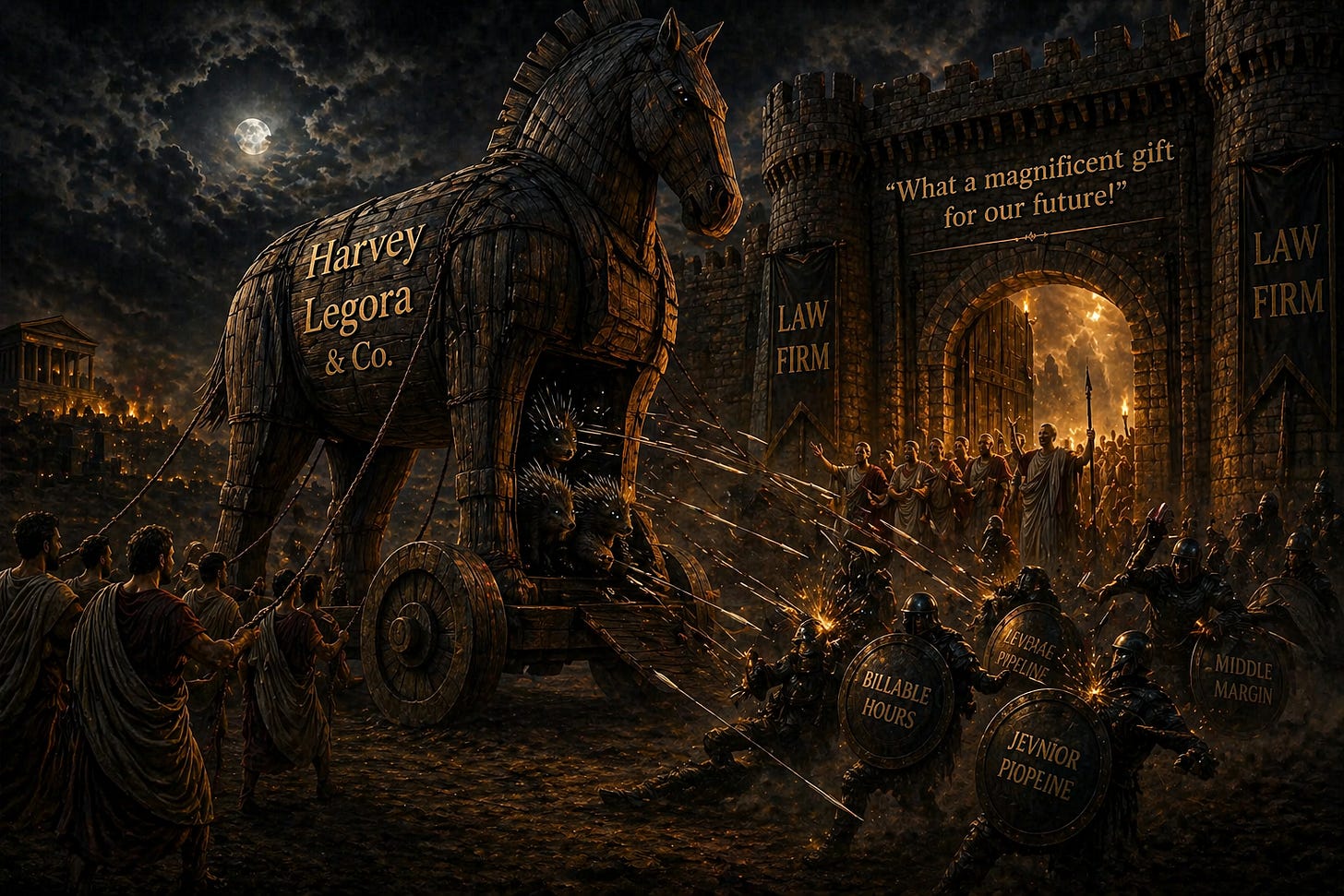
Lev identifies the porcupine—a defensive weapon designed to repel attackers from the walls. The Greeks did not need one; they had the horse. The side that deploys the porcupine is the side defending Troy, and in this story we know how that ends.
Finally for this introduction - an acknowledgment that Lev and I both have our heritage in what may be known as “big law” - corporate, commercial, financial transactions. I am no expert in litigation, conveyancing (real estate), tax, criminal, family or other “domestic” law; and I do not expect Lev to claim knowledge of all these areas either. Having said that, I am confident that what applies in one area of the law will substantially apply across the entire legal profession, although timing and impact will, of course, vary by segment.
What Lev gets right
Lev makes his strongest concession in acknowledging pressure on junior cohorts, leverage models and the middle of the market. He has never shied from this reality, and I am grateful for it. It is most important to accept that as a premise. He then throws his barbs and quills of defence. They need to be batted off or addressed, but before doing that I have concessions to make to Lev - and they are genuine and valuable. Of course, I do not believe that they defeat the arguments, but they are battles in the war that need to be skirmished.
The tech is not there, yet
Lev is correct that the gap between benchmark performance and enterprise deployment is substantial. Even five years ago the changes I contemplate would have been implausible. But if a week in politics is a long time, it seems that hours in AI can defeat decades of expectation.
The inertia is real
Procurement, regulation, insurance, governance, integration, client politics, inertia and human behaviour all live in that gap. I have not sufficiently acknowledged this. Mythos is not yet public. Claude Opus 4.6 scoring 90.2% on BigLaw Bench is not the same thing as a general counsel in Frankfurt switching off her external legal team on a Tuesday morning. The transition takes time. That is breathing space for the legal profession - and we are cruising in to and then through it. We will look back and wonder when the change happened - and we shall see then that by now it had already started.
Economics will prevail
Lev is also right that value distributes across layers in any technology ecosystem and that no single participant owns the factory entirely. I accept the economic point. It does not derogate from the assertion that the law firms themselves will be attacked, and eventually defeated. Some lawyers may do extraordinarily well in this world. But the profession as a whole is not insulated by that outcome.
The individual has agency
He is right that multiple strategic pathways exist for individual lawyers - and right that he has been making this argument longer than this debate. I accept the point.
He is right that the distinction between commodity legal work and mission-critical legal work is analytically real. A privacy policy review and a contested cross-border acquisition are not the same thing. However, as I have already mentioned, whatever individuals do alone cannot change the worlds in which they are based.
Now, the quills.
The first quill: accountants survived spreadsheets, so lawyers will survive AI
Lev reaches, as he has before, for the canonical reassurance: accountants survived spreadsheets, bankers survived electronic trading, doctors survived diagnostic machines. Ergo: lawyers will survive AI.
The analogy is seductive. It is also structurally wrong for this specific profession in these specific circumstances.
Accounting firms survived spreadsheets because their revenue model was already distributed across audit, tax, advisory and consultancy. When spreadsheets removed arithmetic from junior work, the junior work moved upward into more complex analysis. Accounting’s pyramid held because new revenue streams replaced the commoditised ones.
Investment banks survived electronic trading because margin compression in execution was offset by growth in advisory, structured products and proprietary activity.
Medicine survived diagnostic AI partly because regulatory and liability architecture makes AI-only diagnosis commercially non-viable in most jurisdictions, but mainly because the doctor-patient relationship and medical complexity carries dimensions that algorithms do not yet satisfactorily replicate. I do wonder whether the outcome would be different had medicine remained effectively isolated from the effects of technological “intelligence” in much the same way as law did - perhaps law is like the African continent countries that leap frogged over POTS (Plain Old Telephony Service - the copper wired telephone) direct to mobile? May be in the same way, economics will lead law to leading the world in new working practices?
Law firms face a different challenge to the structural problem the three exemplars faced. Law’s reward for equity partners at the apex relies on the base of the pyramid that few argue AI shall make redundant. Unlike spreadsheets, there is no parallel advisory revenue stream or upstream work that naturally absorbs the displaced junior work. Unlike banking, there is no proprietary activity to grow into. Unlike medicine, the regulatory protection is already reversing direction and clients are already showing appetite for “good enough”. And - critically - the law firm has no tangible assets when the transition completes: the law firm has partners, staff, costly IT and compliance infrastructure and a lease. Demand diminishes, the structure has to flex to reduce costs - or profits fall (and perhaps sooner or later the liabilities exceed the income).
The professions Lev refers to were disrupted at the edges. Law is being disrupted at the structural centre.
The second quill: decision-confidence under uncertainty is the durable product
Lev’s most elegant reframing is this: legal reasoning is an input; the “value-add” is decision-confidence under uncertainty. The lawyer’s highest value today is not actually knowing and applying the law but having and applying the judgment, accountability and trust that firms and their partners have built over decades.
I find this genuinely compelling - and want to press precisely on it.
Decision-confidence under uncertainty is exactly what AI systems are advancing fastest at providing. BCG research shows AI-assisted workers dramatically outperform humans was not in routine tasks, but the research shows that it is in complex analytical work - precisely the territory where judgment and synthesis matter - that it truly excels. Claude Opus 4.6 does not score 90.2% on BigLaw Bench because it has learned to search a database. It scores 90.2% because it reasons through legal problems with a consistency and breadth that junior lawyers cannot match and senior lawyers do not always achieve.
AI does not need to match the best in the profession. It needs to be good enough for what the client actually requires. And for the vast majority of commercial legal decisions, that threshold is approaching faster than Lev’s framing suggests.
The third quill: the Netflix ecosystem - who actually has the margin compression?
Lev argues that value distributes across layers in the legal AI ecosystem, as it does in the Netflix model. I welcome the economic point, but I suggest following his analogy to a next stage conclusion.
In the Netflix ecosystem he describes Netflix captures the customer relationship and the data, the chipmakers sell at premium margins, the cloud platforms extract rent from every layer above them. The losers - who suffer the “margin compression” are the artists and content producers - the creators of the underlying material that flows through the infrastructure. Some (Jeremy Clarkson, for example) do extraordinarily well - but these are the legacy dinosaurs: harnessed to capture wallet share while new, cheaper, “home grown” talent is harvested and contracted cheaply - before AI models (read that whichever way you choose) steal their roles altogether. The content producers who have fared best in the streaming era are those who understood this early and acted on it - who owned the direct relationship with their audience rather than allowing a platform to sit between them and the people they served. I sit on the board of Openstage precisely because that insight matters: artists who own their fan relationships capture value that those who cede the relationship to intermediaries do not. Taylor Swift did not thrive by working within the label structure. She thrived by dismantling her relationship with it and rebuilding on her own terms. The lawyers who thrive in the AI era will be those who own the client relationship directly - not those who allow a platform to become the client's first call while they wait in the back office. The infrastructure captures the rent. The relationship captures the value. These are different things
The lawyers are the content producers in this ecosystem. They harness the legal reasoning and generate the documentation. The platforms - Harvey, Legora, ClearyX and such like - slowly capture the workflow data and then creep in to the customers’ hearts (why else Jude Law and Harvey Spectre?) and minds (the portals giving direct access to their firms’ knowledge) and in doing so start to cement a new relationship.
The cloud providers and model builders capture the infrastructure rent.
The lawyers, like recording artists in the streaming era, find that a smaller share of a larger market is not obviously a better outcome when the market has been restructured around them.
Lev’s ecosystem argument is correct as economics. As comfort for the legal profession, it is the twelve pence in every pound that Spotify pays artists dressed up as reassurance. There is one signal in this debate that requires no analogy. Lev's GrayHair fund invests in the infrastructure layer - in the platforms, the workflow tools, the data architecture where legal AI value accumulates. It does not invest in partnership structures. That is not a criticism. It is perhaps the real signal about where Lev himself believes the value will ultimately flow. The content producer and the infrastructure investor are not the same person. In this ecosystem, Lev has chosen his position carefully.
The fourth quill: the cabbie’s strategic menu
Lev offers eight strategic options for the London cabbie facing Uber. The list is imaginative and genuinely expansive. He is right that the strategic menu is larger than I implied.
The question I want to answer: of the tens of thousands of cabbies who actually faced Uber’s arrival in London, how many executed options from three through to eight? Not how many theoretically could have - how many actually did?
The answer is a very small fraction.
Most took option one - sat still while earnings eroded - or option two - became Uber drivers at lower economics. Yes, the menu exists. The execution rate is the empirical fact that matters.
So Lev relies on the execution rate among the legal profession exceeding the execution rate of the London’s cabbies. That is a brave assumption, but running with it what that they reveals is a greater number chasing a smaller prize with I suggest no better outcome for any of them. Lawyers will face the same constraints as cabbies: habit, the comfort of current income, the difficulty of reinvention while the current model is still generating returns and - then, for most - capital limitations.
Yes Lev, agency is real. There is a choice, but execution is rare. I know it, and I believe that you know it, too.
The fifth and sixth quills: the butler distinction, the junior layer, and what the senior specialist is actually selling
Lev makes his sharpest analytical point when he distinguishes between the butler who arranges wine deliveries and the senior adviser on a contested acquisition. He is right. The distinction is real. But I want to pursue it to a point beyond where Lev goes.
If we think carefully about why the very best lawyers are valuable on a major transaction. we must conclude that the value is not that they know the law. Their value is, in reality, their “judgement” advice which in turn is reliant on their being at the table from the beginning.
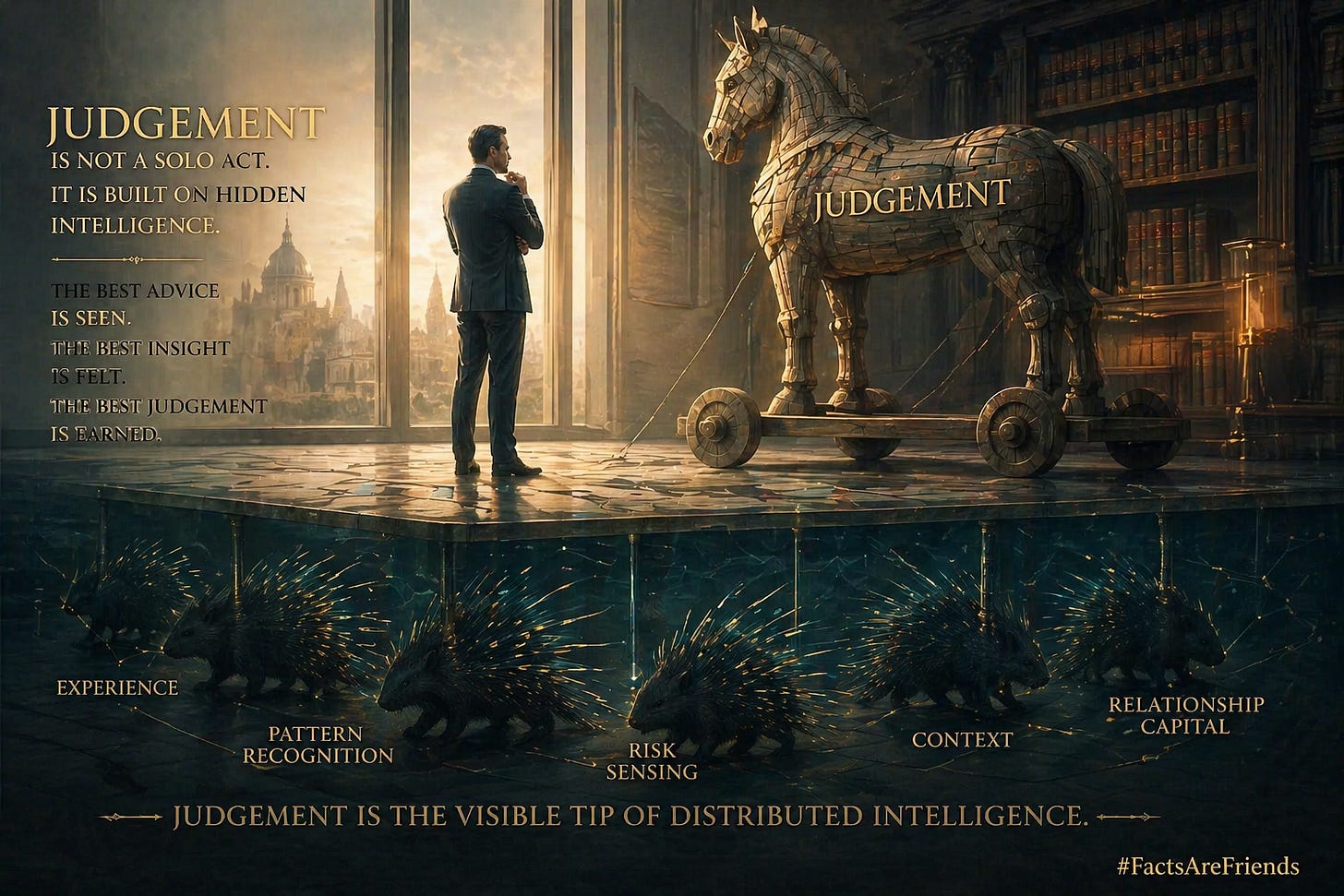
That presence is critical because being involved in a transaction from its earliest conception confers knowledge of the commercial intent, the political dynamics between the principals, the pressures each side is operating under, the things said informally and never written down. That presence allows the partner to know what the client actually wants as distinct from what the client has said it wants. The relationship grown during the transaction informs a knowledge matrix to help the client assess risk tolerance and give them the “backbone” to walk away - not because the client told them, but because they have been watching.
If we accept that, then there is something equally critical that Lev’s framing quietly omits: that presence and knowledge are not solely the senior partner’s alone. They rely in more than a small part on the junior layer.
The associates who drafted the documents, worked from the templates and precedents familiar to the partner, flagged every issue as it arose and consulted upward at each decision point - those lawyers were the partner’s eyes and ears in the detail of the transaction. They kept the senior partner briefed continuously without the senior partner needing to read every page. They were the mechanism by which a partner managing multiple matters could remain genuinely across each one. Remove that junior layer and the senior partner does not simply become more efficient. They lose the briefing structure that sustained their involvement. And trying to dive back into that detail reveals the truth of “losing sight of the woods for the trees”. It was not until I was myself a partner that I realised how much easier it is to do that job supported by trusted associates and juniors and how impossible for those at the “coal face” to do it themselves.
Lev may argue that if AI replaces the junior layer with better tools - a system that processes the entire transaction document set overnight and produces a comprehensive issue summary - then AI can also deliver a briefing document. But if that is right, the value is not in knowledge of the law but in something else. The value of the unique situational awareness produced by the junior team is lost. AI produces outputs on demand. The partner who managed complexity by delegating the relationship with the detail will find that AI gives them better documents, better briefing but no sustainable substitute for the relationship which can be so valuable to both the client and the lawyer.
Now here is the quill that Lev has not yet thrown but will: the senior partner also brings trust. The partner has probably known the client for years, sometimes decades. They have been through difficult moments together. The client calls them before the crisis is fully formed. That trust is real and valuable.
But trust is not the exclusive province of the legal profession. It is earned, not conferred by qualification.
The client’s investment banker may hold that relationship just as deeply - may have been through more transactions with the client than the lawyer, may understand the client’s commercial instincts more precisely because bankers sit closer to the commercial decision. The client’s long-standing accountant, their trusted strategy adviser, their most senior commercial director - all of these people can hold the relationship Lev describes. Trust follows presence, history and demonstrated judgement. It does not follow the legal qualifications.
Break down what the senior adviser is actually selling and it is, I suggest, the following in a thick wrapper of trust:
deep knowledge of the market segment accumulated over years;
knowledge of the specific transaction from its inception;
experience of what has gone wrong in comparable situations;
understanding of the psychology of the parties - what they actually care about, what they will concede, what they will not move on regardless of the legal position; and
the judgement to know which risks are real and which are noise.
None of that is taught at law school. The psychology of negotiation can be studied. The segment knowledge, the transaction pattern recognition, the instinct for what a counterparty will actually do under pressure - can be learned over decades of being in the room. Much of the rest cannot be taught in advance.
And many people accumulate precisely that knowledge without being lawyers at all. A senior corporate finance director who has executed thirty acquisitions in a specific sector knows the dynamics of those transactions as well as any lawyer who has advised on them - sometimes better, because the director has sat on the principal side and experienced the commercial consequences rather than simply the legal ones.
The lawyer’s advantage is that he is in the room from the start. Well, at least until now he has been there. The question remains whether a client will instruct a lawyer (as a lawyer) to be in the room when the legal work is completed by AI systems.
The seventh quill: the good enough scenario means the senior partner may not be invited in at all
There is a quill Lev has not thrown yet that I want to address before he does, because it is the one that most directly challenges the survival of the senior specialist.
If AI gives the client good enough legal analysis from the outset, the client’s question changes. It is no longer:
“which firm do we instruct?”
but
“at what point, if any, do we need external counsel at all?”
A CFO embarking on a significant acquisition who has AI tools capable of running initial legal analysis, flagging risk areas and producing first-draft documentation has a rational commercial question to ask before calling a senior partner billing at £1,000 an hour from day one: do I actually need this person yet?
The power of inertia, the strength of existing relationships and genuine risk tolerance will, for some time, ensure that clients on larger transactions continue to retain senior counsel early. But those forces are not permanent. Relationships retire. Risk perception shifts - not the objective risk of the transaction, but the perceived risk of proceeding without a lawyer in the traditional role. As AI demonstrates reliable performance across more transaction types, the perceived risk falls. The senior partner who was once called on day one is called on day thirty. Then at day 90. Then only when something has gone wrong. Then, perhaps, not at all.
The fact that clients still instruct lawyers today tells us about transition, not destination.
When a lawyer is brought in late, the legal expertise is intact but the moment to deploy it has passed: the judgement may still be needed, but the unique qualification to provide it may have evaporated and (worse) passed to another.
The comparative market knowledge and transactional pattern recognition I described earlier depend on being present throughout. Bring the senior partner in at a later stage and they are reading the room from a transcript rather than sitting in it.
The eighth quill: privilege, fiduciary duty and the inversion of protection
Lev may argue that the lawyer’s trust carries structural backing that relational trust cannot replicate: privilege, fiduciary duty and professional regulatory accountability. And, of course, he would be right. These make the lawyer’s advice structurally different from everyone else’s.
I concede this with no argument. These protections are real and they were designed with genuine purpose. Privilege exists so that a client can brief their adviser with complete candour. Fiduciary duty exists to ensure the adviser places the client’s interests above their own. Regulatory accountability exists to give clients recourse when those duties are breached.
But reflect on what each of these actually rest on.
Privilege was granted to lawyers because lawyers were the trusted intermediary through whom clients communicated sensitive information in order to receive advice. The “right” should not belong exclusively to lawyers. As a matter of policy, I suggest the protection belongs to the function rather than the professional title. Current law does not yet reflect that distinction. If an AI system embedded within the client’s own organisation receives the same sensitive instructions, that AI system is effectively adviser (as well, perhaps as being the client, in the same way as in house lawyers) - and privilege, in its original conception, may not be necessary at all, because there is no third party through whom the information passes or - since “someone” (or something) other than a lawyer performs the function of trusted adviser, the logical case for extending equivalent protection is identical to the case that created privilege for lawyers in the first place. The privilege framework rests on a tacit admission: that counterparties in a transaction cannot fully trust one another. If that is the rationale, it applies to any trusted adviser performing that function.
On fiduciary duty: lawyers are not the only people who carry it. Company directors owe fiduciary duties to shareholders (in the UK this is imposed by the the Companies Act 2006 and by common law). Trustees owe fiduciary duties to beneficiaries. Investment managers owe them to clients under FCA regulation. The fiduciary obligation is not a quality inherent in people who become lawyers. It is a requirement that lawyers are obliged to accept as a condition of regulation. Any person or entity that voluntarily submits to equivalent regulation and accepts equivalent obligations can carry the same duty.
And here is the argument I want to press most firmly. Those protections - privilege, fiduciary duty, regulatory accountability - were designed to benefit the client. They were granted to lawyers because lawyers were performing a function that clients needed protected. If lawyers are no longer performing that function, retaining those protections exclusively for lawyers does not serve the client. If deployed to serve the lawyer they become protectionism.
A lawyer with a genuine fiduciary duty to the client - a duty to place the client’s interests above all else - would, if true to that duty, advocate for the client to receive the best available advice by the most appropriate adviser, not for the preservation of their own monopoly. The fiduciary duty and the monopoly are in direct tension. Lev cannot rely on both simultaneously.
The ninth quill: unauthorised practice rules protect the gate
Lev will point out that bankers and accountants cannot give legal advice in most jurisdictions. Unauthorised practice of law rules create a structural barrier that AI alone cannot dismantle. The gate has the teeth of law, not just reputational ones.
Again, the protection is real and it should not be dismissed. But the most valuable work I have been describing - the senior adviser at the table from the start, providing sector expertise and transactional judgement - already sits in territory where unauthorised practice rules are ambiguous.
Advising on whether a deal makes commercial sense, how a counterparty is likely to respond, which risks matter - none of that is straightforwardly legal advice. The regulatory gate that matters for commodity legal work is strong. The gate that matters for the senior adviser’s most valuable contribution is already permeable.
More fundamentally: as with privilege unauthorised practice rules were designed to protect the client. Once AI produces analysis that matches or exceeds human legal advice across a broad range of work, the regulatory requirement that only qualified lawyers can provide it ceases to serve its original purpose and becomes something it was never intended to be - a mechanism for protecting the profession from competition at the client’s expense.
I challenge those raising this argument to explain how lawyers demonstrating genuine fiduciary duty to their clients can simultaneously advocate for barriers that prevent the client from accessing “better” advice. The duty and the monopoly cannot coexist honestly.
The competitors I am describing are not trying to practice law. They are trying to sit at the table. Who may sit at the table should be decided by the client. Not the regulator.
The tenth quill: the sector knowledge argument and the emergence of the independent adviser
Lev may press the conflict of interest point. Bankers and accountants do not solely represent the client - they have their own commercial interests, other relationships in the same deal, and a primary motivation to secure their fee.
This is a fair observation. It also applies to lawyers. A lawyer whose fee depends on the transaction completing has an interest in the transaction completing. A lawyer who wants to maintain a long-term client relationship has an interest in giving advice that smooths the relationship. The independence Lev describes is structural in theory and sometimes compromised in practice.
More importantly, the conflict of interest argument does not lead to the conclusion that lawyers are the answer. It leads to the conclusion that there is a role for an independent adviser - someone genuinely independent of the transaction economics, with no contingent fee, and with duties that place the client’s interests first. That person need not be a lawyer. They need to be independent, knowledgeable and trusted.
We have a precise parallel for this in financial services. Before the Financial Services Act 1986 and its successors (in particular the Retail Distribution Review of 2012,) financial advice was dominated by tied agents - advisers who recommended products from a single provider and whose remuneration came from that provider. The conflicts were systematic. The regulatory response was to create the Independent Financial Adviser: a regulated class of adviser explicitly independent of product providers, whose duty runs entirely to the client. IFAs are not a banker, an insurer or a fund manager. They are something new - an independent expert whose value is precisely their independence from the parties whose products they assess.
The legal profession is waiting for its IFA moment. The independent transaction adviser - someone with deep sector knowledge, no contingent fee, voluntary submission to regulation imposing fiduciary-equivalent duties and no requirement for a law degree - is a role that the market logic of this transition is already creating.
And if that is where the market is going, then a question I pose to those who say that lawyers have secure roles going forward is this: what is law school for?
If the value the senior adviser brings is sector knowledge, transactional pattern recognition, psychological judgement and relational trust - none of which is taught in law school - then law school is the entry ticket to a profession whose most valuable outputs it does not teach. The law degree gets you into the room. The decade of experience teaches you what to do once you are there. If the room is accessible by other routes, the experience can be accumulated outside the legal profession and cannot be accessed through a role in a legal firm then the gateway function of the law degree weakens considerably.
The name that outlasts the function
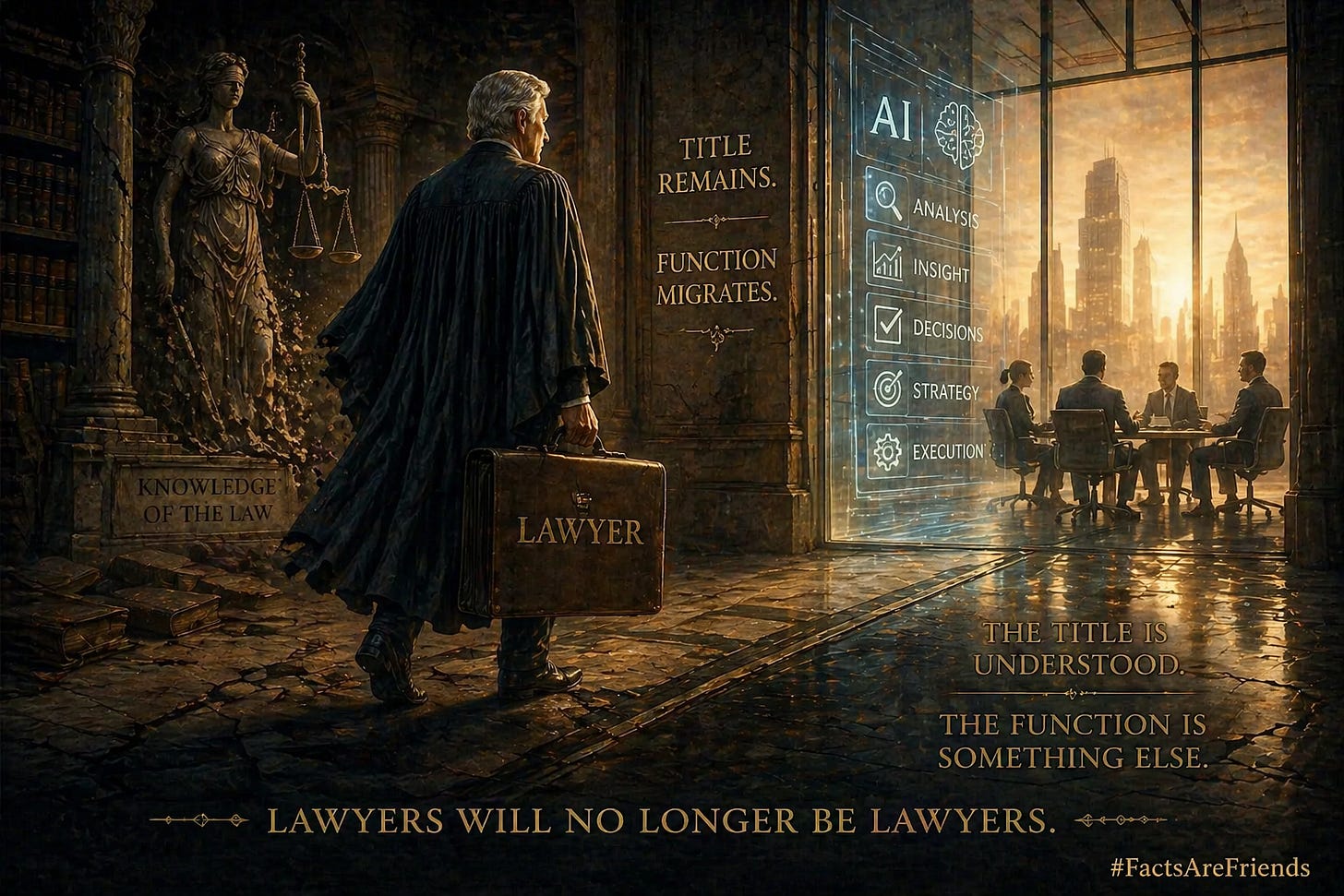
Before I close, I want to address a quill Lev has thrown about the “won’t be lawyers” formulation - his argument that the label follows the function and the regulatory status, not the tool. A lawyer using AI for process work and deploying judgement on strategic questions is still practising law.
The distinction I am drawing is not about tools. It is about the primary basis of value. And I want to go further than semantic argument, because we already live with professions where the name has outlasted the function it once described.
In the United Kingdom, we call pharmacists “chemists.” The name has persisted for well over a century after actual chemistry ceased to be the function. The original chemists compounded medicines - they performed real chemistry, mixing compounds specific to each patient. When pharmaceutical manufacturing industrialised, the chemist stopped doing chemistry. Today’s chemist dispenses what others have manufactured. Nobody is confused. The title persists as a perfectly understood description of something entirely different from what it once named.
The word “clerk”, Google tells me, offers an even more precise parallel. It derives from “clericus” - a clergyman. For centuries, clergy were the literate class and so administrative functions fell to them. When literacy became universal and the religious connection disappeared entirely, the word remained - now describing an office function with no connection whatsoever to the church. Nobody hiring a filing clerk expects a priest. The function that created the name has vanished. The name persists as a historical residue, understood by everyone, descriptive of nothing it once meant. (By the way, in the UK we refer to “clarks” - no idea why we depart from the logical pronunciation that our American cousins adopt, but I like the differentiation - the same applies to Lieutenant and schedule).
The senior lawyers who survive may similarly retain the title long after the function has migrated. They will be called lawyers. The title will be understood. And it will no longer describe the primary basis of their value. That explains why I say that lawyers will no longer be lawyers.
What Lev and I now agree on
We are closer than the framing suggests:
We agree that the profession is not extinct;
we agree that exceptional individuals will thrive;
we agree that the transition is real and already underway;
we agree that multiple strategic pathways exist (and Lev is right to correct my previous criticism that this is a new line, I had failed to recognise it previously).;
we agree that the denominator faces structural pressure;
we agree that the training pipeline needs redesign; and
we agree that the traditional law firm’s business model is under strain.
There is one question that sits beneath all of this that Lev has not yet answered - and I do not raise it as a debating point but as a genuine invitation. If the value the senior adviser brings is sector knowledge, transactional pattern recognition, psychological judgment and relational trust - none of which is taught in law school - then what, precisely, is law school for? It remains the entry ticket to the profession. But if the room is now accessible by other routes and the experience that makes the senior adviser indispensable can be accumulated outside the legal profession entirely, the gateway function of the qualification weakens. That question has consequences not just for law firms but for law schools, for the regulators who depend on qualification as the basis of their oversight, and for the thousands of young people currently deciding whether to invest three years and considerable debt in a legal education. I hope Lev will address it in his next round. It deserves a direct answer.
What we disagree on is the scale of the structural compression and the fate of the majority.
Lev’s frame is agency - those who engage with the transition will find a way. I accept both these propositions. My moderation claim is that although the options are available very few will engage. Engagement requires capital, optionality and risk appetite that many (perhaps most) lawyers do not have. Lev is unusual, he has already made the big step outside the law. Many of his erstwhile partners will be looking on with admiration and jealously.
I also maintain that structural issues will route the largest share of value away from the partnership structure regardless of how intelligently any individual partner navigates it.
The porcupine’s quills are sharp. I have enjoyed removing them. But once they are removed, the animal beneath is far smaller than it first appeared.
And Mythos is not yet public.
#FactsAreFriends.

Quentin Solt is a UK solicitor, legal consultant and board member of Openstage. His forthcoming book, AI, Abundance and the Future of Work, explores how AI reshapes society, work, politics and human connection. He writes the Law at High Tide series on Substack. This essay is part of a public dialogue with Lev Loukhton at #TrojanHorseDebate.
References
Lev Loukhton - “The Future of Lawyers, or the Future of Hyperbole?”: https://www.linkedin.com/search/results/all/keywords=%23trojanhorsedebate%20le
Claude Opus 4.6 - BigLaw Bench 90.2%: https://www.anthropic.com/news/claude-opus-4-6
Claude Mythos - 93.9% SWE-bench: https://www.infoq.com/news/2026/04/anthropic-claude-mythos/
BCG research - AI-assisted workers outperforming humans on complex tasks: https://www.bcg.com/publications/2023/how-people-create-and-destroy-value-with-gen-ai
Am Law 100 2024 financials:
NALP summer associate hiring data: https://www.nalp.org/0925research
Companies Act 2006 - director fiduciary duties: https://www.legislation.gov.uk/ukpga/2006/46/part/10/chapter/2
FCA - investment manager fiduciary obligations: https://www.fca.org.uk/firms/asset-management/investment-management