 Facts are friends
Quentin Solt | March 2026
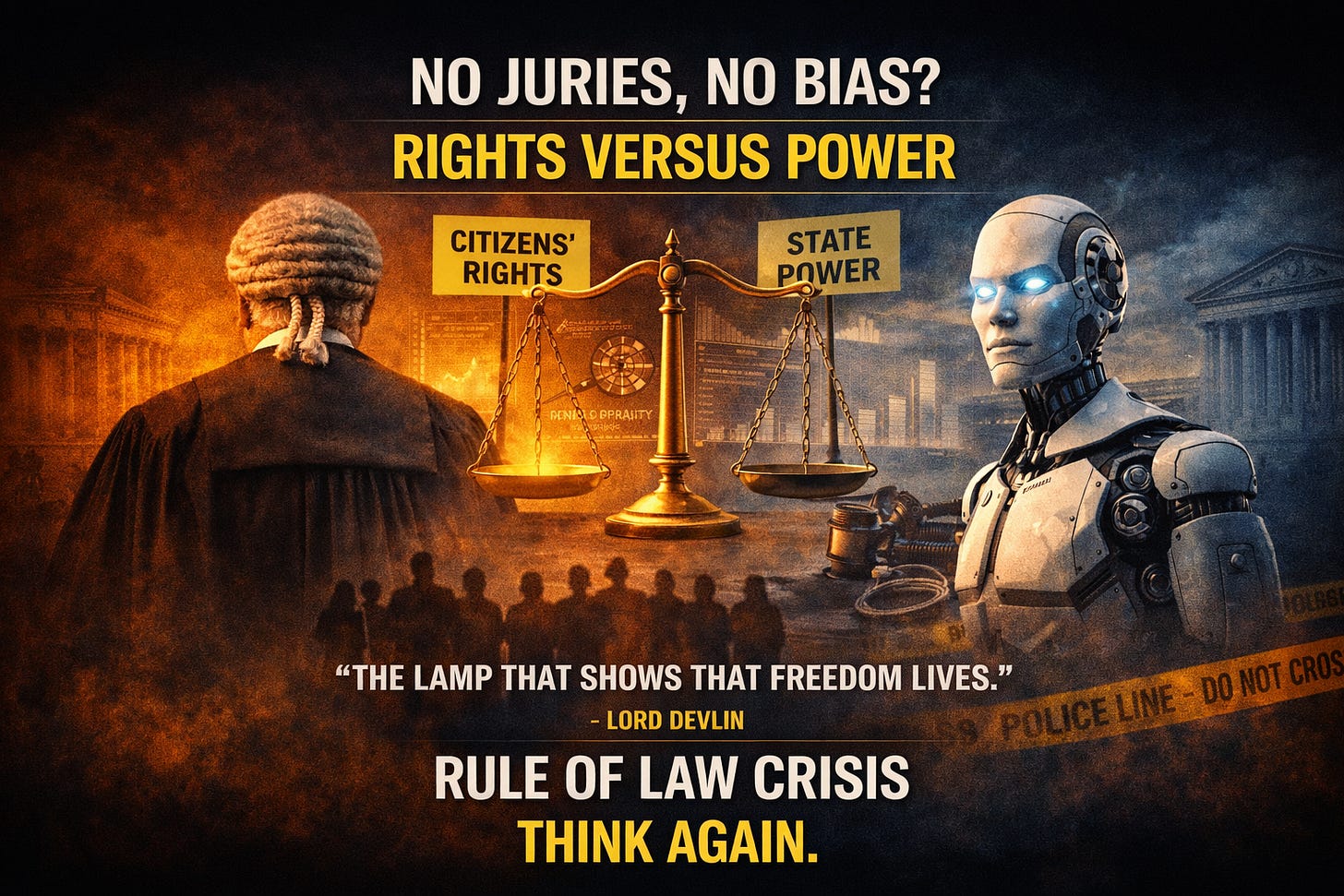
A note on context: This essay is a sequel to “AI in the Jury Box: The Case for Logic Over Passion in Justice”, published in November 2025: . That essay was written against the backdrop of an American mock trial experiment. Four months on, Parliament has supplied far more consequential material for analysis. The Courts and Tribunals Bill, introduced on 25 February 2026 and given its second reading on 10 March 2026, has made the questions that essay raised unavoidable. This piece traces what the original predicted, tests those predictions against the evidence, and either restates or revises the conclusions in light of what has actually happened.
What has changed since November
I now realise that when I published “AI in the Jury Box” the most provocative claim was about human beings: that our justice system’s greatest exposure is not the technology we might introduce, but the fallible, biased, exhausted humanity we already have running it.
The data was uncomfortable then. In a remarkable turn of events, it is now government policy.
The Courts and Tribunals Bill has arrived not as a vehicle for AI but as a vehicle for reform driven - in the government’s own words - by the failure of human systems:
80,000-case Crown Court backlog,
average of 255 days to complete a Crown Court case. For adult rape cases, 423 days,
nearly 2,000 rape cases waiting for over a year
These are the numbers that forced the government’s hand. They are also numbers my original essay would have recognised immediately: they are what injustice looks like when it accumulates at scale.
Where is the Bill today (March 2026)
The bill passed its second reading by 304 to 203. Ten Labour MPs voted against the government, and press reports said around 90 Labour MPs abstained or did not vote.
Karl Turner, the most vocal backbench opponent, stood down from outright rebellion after being offered a seat on the public bill committee, with a view to amending rather than blocking the legislation.
The legal profession, represented by over 3,200 signatories including 22 retired judges, 2,000 barristers and 300 King’s Counsel, called for the proposals to be dropped. Charlotte Nichols, a Labour MP who disclosed she had been raped, accused the government of weaponising victims’ testimony to drive through reforms that were “not directly relevant” to their needs.
This is the landscape we are now navigating. The original essay predicted movement. It did not predict the particular direction. It is worth being honest about both.
Human bias as the driver of injustice

The original essay’s central claim was that the wrongful conviction crisis - driven by confirmation bias in 75% of wrongful conviction cases, eyewitness misidentification in 70% of DNA exonerations, and racial disparities that see Black defendants seven times more likely to be wrongly convicted of murder - constituted the primary argument for structural reform of how decisions are made in criminal courts. The government has not contested this analysis. It has adopted it. It has reached a reformist conclusion from a different starting point: not primarily wrongful-conviction analysis, but backlog, delay and victim experience.
David Lammy’s case for reform rests not on ideology but on failure: the failure of the existing system to deliver timely, consistent justice. In November the essay cited the “hungry judge effect” - the Israeli study showing favourable rulings dropping from 65% to nearly zero within a decision session, recovering only after food breaks - as evidence that even experienced judges are profoundly unreliable decision-makers. Nobody in the parliamentary debate contested this either, the debate simply did not seriously engage with that wider behavioural literature. The bill is, in one reading, an implicit acknowledgement that individual human judgement - stretched thin, poorly resourced, inconsistently applied - cannot be the only mechanism through which justice is delivered.
The debate arriving sooner than expected
The original essay noted that naysayers would deny the possibility of AI in courts until it happened, and that the debate about the reliability of human versus algorithmic decision-making would force itself into public consciousness regardless.
Four months later, Parliament has debated jury trial reform in terms that directly echo the essay’s analysis. Whether the human judiciary is diverse enough, consistent enough and free enough from cognitive bias to be trusted as the sole arbiter of guilt has moved from academic speculation to live legislative controversy.
The body language argument used defensively
The original essay observed that critics of AI in courtrooms would rely on the body language argument - the claim that only human jurors can properly assess witness credibility through non-verbal cues. The legal profession’s opposition to the bill has deployed precisely this logic, arguing that the nuance and humanity of jury deliberation cannot be replicated. The essay conceded the point for current AI systems, then challenged it on two grounds:
the science shows that human reading of body language is a poor truth-detection mechanism, and
multimodal AI is already outperforming human baselines in emotion recognition.
Neither point was central to the parliamentary debate, which has focused far more on constitutional legitimacy and speed than on the psychology of credibility assessment.
The bar may prefer the romantic version of jury deliberation to the empirical one. Sir Geoffrey Vos was right to note that the rule of law is too important to be left to opaque formulations that obscure more than they illuminate. The same is true of jury deliberation. This is what I say #FactsAreFriends.
The rule of law: what we actually mean
There is a prior question that neither side in the parliamentary debate has addressed directly, and Sir Geoffrey Vos put his finger on it this week. Lawyers, he observed, have allowed the phrase “rule of law” to become opaque - even to other lawyers.
Non-lawyers tend to understand it as being about the enforcement of law against citizens: catching criminals, imposing sentences, clearing backlogs. This is precisely the frame the government has used to justify the bill. But Vos’s own definition runs in the opposite direction: the rule of law is about “upholding the rights of citizens against the state” - about access, predictability, fairness and protection.
On that definition, both the case for reform and the case against it look different.
The backlog is a rule of law failure because victims cannot access justice. The removal of jury trial is a rule of law risk because defendants lose a protection that the state has provided - and the state is simultaneously the prosecutor, the judge and, under this bill, increasingly the determiner of which forum decides. That is not an argument against all reform. It is an argument for being very precise about what we are trading and why.
The prediction that requires revision: the central irony of the bill
“The reform substitutes twelve diverse human minds for one tired judge - and calls it progress.”
Here is where intellectual honesty demands a revision. The essay argued for a partnership model: AI augmenting human decision-making, providing consistency, reducing bias, and freeing human judges to focus on the cases that genuinely require moral reasoning. What Parliament is actually proposing is troubling.
The Courts and Tribunals Bill does not introduce AI into the courtroom. It restricts access to jury trial in a significant class of cases, while preserving jury trial for the most serious offences.
Cases with a likely sentence of three years or less may be allocated to a new Bench Division, heard by a single judge, without a jury or lay justices. Separately, the bill also removes the right of defendants to elect Crown Court trial in triable-either-way cases and expands magistrates’ court sentencing powers. The government’s stated purposes are efficiency and victim welfare.
But we have seen that diverse juries systematically outperform individuals in complex decision-making. Diverse juries deliberate approximately 20% longer, cite significantly more case facts and make fewer factual errors. Samuel Sommers’ landmark 2006 research showed that even before deliberation began, white jurors knowing they would sit in diverse groups processed information differently - with only around 35% initially voting guilty, compared to 50% in homogeneous groups. The Condorcet jury theorem mathematically demonstrates that collective accuracy approaches certainty with sufficient voters. None of that proves that a jury will always reach better outcomes than a judge, but it does strengthen the argument that replacing a group with a single decision-maker creates real accuracy and legitimacy risks.
The bill replaces this collective, diversity-enhanced mechanism with a single judge. The same judge who (as the essay documented) is susceptible to anchoring bias, hindsight bias and egocentric tendencies regardless of legal training. The same judge whose favourable rulings collapse to nearly zero within a decision session before recovering after lunch. The same judge who is, on average, 69 years old, between 71% and 80% white, and between 66% and 73% male - a composition that diverges sharply from the communities whose cases will be decided.
Charlotte Nichols made the diversity argument on the floor of the House. She was right to do so, and the data supports her. The irony is painful: the government is attempting to address one form of systemic injustice - delay - by introducing a mechanism that the evidence suggests will exacerbate another - individual judicial bias.
The Institute for Government has assessed that the proposed reforms will unlock only relatively modest reductions in demand, whilst magistrates’ courts may be just as unable to deal with this extra demand as the Crown Court is. Large structural reforms soak up workforce and leadership time and often cause substantial disruption and performance declines in the short term. These are not arguments against all reform. They are arguments for designing it carefully - something the bill’s critics and the government alike should welcome rather than treat as obstruction.
The global context is relevant. The Alliance for Lawyers at Risk - to which some of England's most senior judges lend their names - exists precisely because the architecture of justice is fragile in ways that comfortable legal systems tend to forget.
This week, its annual award went to Ruth López, director of an anti-corruption unit in El Salvador, who was arrested last May for her work exposing unlawful surveillance and unconstitutional restrictions on public access to information. She has not been tried or convicted. The connection to the Courts and Tribunals Bill is not direct, but the principle is. A justice system in which decisions affecting liberty are concentrated more heavily in named, predictable, institutionally exposed individuals - rather than by anonymous panels of twelve - is a system whose architecture more closely resembles those that lawyers at risk are working to reform than those they are working to protect. This is not a comparison anyone should make lightly. It is one that the bill's architects should at least have considered.
Concentration in State appointed experts rather than submission to panels of citizens raises different questions about independence, pressure and legitimacy. That does not make England and Wales comparable to jurisdictions in which the rule of law is under acute political attack. It does, however, remind us that institutional design matters, and that apparently technical changes can alter the balance between citizen participation and state power.
The AI trajectory nobody is discussing
There is a genuinely new development that the parliamentary debate has almost entirely ignored, and that the original essay did not anticipate in its precise form. AI is entering the UK justice system. But not from the direction contemplated.
David Lammy, speaking at a Microsoft AI event in London, confirmed plans to expand AI use across UK courts and tribunals, including transcription, case summarisation and magistrates’ court case progression. Microsoft’s UK chief executive described the Ministry of Justice as “one of the fastest-growing adopters of agentic AI”. In probation, AI-assisted transcription has already recorded more than 150,000 meetings between offenders and officers, saving an estimated 25,000 hours of staff time. Lammy also said that transcription based on the same technology is being tested in courts and tribunals, and that in the Immigration and Asylum Chamber some judges are using it to help formulate notes and write remarks.
King’s College London is developing a working prototype AI tool to assist magistrates with traffic offence decisions, having engaged over 300 survey participants and integrated diverse stakeholder insights into the AI’s development framework. The judiciary’s own guidance on AI, updated in October 2025, emphasises that the use of AI must be consistent with the obligation to protect the integrity of the administration of justice - a carefully worded acknowledgement that AI use by judicial office holders is now a live question rather than a theoretical one.
“AI is not yet entering the courtroom as a juror. Today it is entering as a clerk. The partnership model is being built whether we name it or not.”
So the original essay’s prediction is materialising, just in a different sequence than anticipated. AI is not yet entering the courtroom as a juror, but rather as a clerk, a transcriptionist, a research assistant, a case manager. The partnership model the essay advocated is, in embryonic form, already under construction - but the debate is not being conducted in those terms.
The arguments raised in Parliament: a direct response
Charlotte Nichols: victims weaponised
Charlotte Nichols’ contribution to the second reading debate deserves respect . She disclosed that she had waited 1,088 days to go to court, that the mental health consequences of her trauma were played out in public and that she was regularly subjected to social media abuse. She then argued, with clarity and courage, that her experience and those like it had been “weaponised” as rhetorical misdirection from what the bill actually does.
She is right on the substance. The bill’s jury reforms do not primarily address the delays experienced by rape victims. Rape is an indictable-only offence: it will retain jury trial under the proposals. The cases being diverted from jury trial are mid-level either-way offences where the likely sentence is three years or less. The government’s use of rape victim testimony to build the case for reforms that do not directly apply to rape cases is precisely the kind of rhetorical manoeuvre that damages public trust in law-making.
At the same time, the general point about delay and re-traumatisation is valid and important. The original essay’s data on wrongful conviction rates, eyewitness misidentification and racial bias was not offered as an argument that victims do not matter. It was offered as evidence that the system as currently designed fails both defendants and victims. The two concerns are not in competition.
The bar and the ‘lamp that shows freedom lives’
The Criminal Law Solicitors Association invoked Lord Devlin’s famous description of jury trial as “the lamp that shows that freedom lives”. It is a magnificent phrase, and it deserves a serious response rather than dismissal.
The lamp metaphor is honest about what the jury does: it provides visible, public evidence that justice is being done by ordinary citizens, not by the state acting alone. This is a legitimacy argument, not an accuracy argument. And it is a good one. A system in which the state prosecutes, the state judges and the state sentences raises obvious concerns about accountability that twelve randomly assembled citizens help to address.
The lamp metaphor raises an important question: what if it is highlighting wrongful convictions instead of justice? What if freedom ‘living’ looks, from the perspective of the 3,700 exonerated defendants documented by the National Registry of Exonerations, rather like freedom dying? The lamp is not a perfect instrument of justice. It is a legitimacy mechanism that carries real costs. Those costs deserve acknowledgement alongside the genuine values the jury system embodies.

The bar’s argument that jury trial is a constitutional safeguard that should not be touched is not wrong. But it is incomplete. The safeguard needs to be designed as well as preserved.
The original essay argued for design: encoding fairness principles into decision-making systems, whether human or algorithmic. The bill’s opponents have not engaged with design; they have advocated preservation of the existing system, which the evidence suggests produces systematic injustice alongside its genuine protections.
The efficiency argument and its limits
The government’s efficiency argument is straightforward: 80,000 cases are waiting, victims are being failed, and structural reform is the only solution that will materially reduce the backlog. The opponents argue that increased sitting days and efficiency savings would achieve the same result without removing jury trial rights.
The empirical picture is genuinely contested. The Institute for Government has expressed serious doubts that the reforms will produce the efficiency gains the government claims, noting that magistrates’ courts are already struggling with their existing caseload, and that adding substantial new work - without addressing legal aid deserts, staffing shortages and crumbling court infrastructure - may simply shift the bottleneck rather than resolve it. Karl Turner’s compromise proposal - a pilot scheme - is, in this respect, intellectually sound: it would generate comparative data rather than requiring a leap of faith in either direction.
What the pilot should measure
If, as seems likely, the bill proceeds to implementation with the Bench Division reforms beginning in 2028, the most important question becomes: what do we measure, and how?
The original essay argued that the New York bail study is a template for what good algorithmic justice research looks like: it measured not just efficiency but racial equity in outcomes, it identified precisely where human decision-making was going wrong, and it demonstrated that well-designed systems could simultaneously reduce crime and reduce racial disparities. A similar framework is needed for the Bench Division pilot.
The pilot should measure outcome consistency: do similarly situated defendants receive similar outcomes before different judges? It should measure racial disparity: do Black and minority ethnic defendants receive comparable treatment in Bench Division proceedings to White defendants? It should measure wrongful conviction rates: do appeals from Bench Division decisions reveal systematic errors? And it should measure victim satisfaction: do victims of crime experience timely, respectful, effective proceedings?
None of this data currently exists in a form that would allow rigorous evaluation. Building the measurement infrastructure before the reforms are implemented is not bureaucratic obstruction. It is the minimum required for honest accountability.
Revised predictions: the road to 2028 and beyond
In November, I predicted that AI would play an increasing role in justice systems regardless of whether legal traditionalists were comfortable with the change, and that the question was whether this would happen on our terms or on someone else’s. That prediction stands, and is now being borne out in practice.
What requires revision is the sequence. AI is entering UK courts through administration and support functions, not through decision-making. This is the right order: it allows trust to be built, accuracy to be demonstrated, and accountability structures to be established before algorithmic outputs are given any determinative weight. The partnership model the essay advocated is being assembled, piece by piece, without being named as such.
By 2028, when the Bench Division reforms are expected to be implemented and assuming that the present trajectory continues, I expect AI will be routinely used for case management and scheduling, transcription and summarisation, legal research and precedent identification, evidence organisation and flagging, and risk assessment tools informing bail and sentencing decisions, subject to human oversight and the right of override. What it will not be doing - and should not yet do - is making the final determination of guilt or innocence. The original essay was clear that this is a function requiring human moral authority, at least for now. That position has not changed.
What has changed is my confidence that the journey from augmentation to greater algorithmic involvement is inevitable, and that the current bill - by replacing diverse juries with single judges rather than moving towards transparent, accountable, well-designed hybrid systems - may take us in the wrong direction at a critical moment. We are making a structural change to who decides, without asking whether the person we have chosen to decide is any less fallible than the system we are replacing.
There is one further voice that has not yet entered this debate but should. Sir Geoffrey Vos, Master of the Rolls and the second most senior judge in England and Wales, spoke this week to the Alliance for Lawyers at Risk about what the rule of law actually means - and what we should say when people outside the profession ask us. His answer deserves to be placed at the centre of this debate. The rule of law, Vos said, is about "the clear and accessible predictability of the legal system that applies equally to all" and "access to fair justice for all". It is about "protecting the fundamental rights of all" and "proportionate and accountable power". And he addressed head-on a point that the parliamentary debate has (to my mind conspicuously) avoided: "what we are talking about is not for the benefit or self-aggrandisement of the lawyers, but for the benefit of all citizens - to enable them to live and let live in a tolerant society where their rights are respected".
If that is what the rule of law means, then the questions this essay has been asking are not peripheral. They are central.
Does a system with an 80,000-case backlog and cases not scheduled until 2030 offer "clear and accessible predictability" to the victims waiting for it? It does not. Does replacing twelve diverse minds with a single judge - without measuring the racial disparity, consistency or accuracy of the outcomes - offer "fair justice for all"? That remains, at best, unproven. Both the crisis and the proposed remedy are rule of law questions.
Conclusion: the covenant holds, but we must design for it
“Let justice roll on like a river, righteousness like a never-failing stream.” — Amos 5:24
The law’s covenant - between reason and mercy, between the individual and the community, between the state and those it governs - does not change because Parliament passes a bill. What changes are the systems that uphold or undermine justice .
The Courts and Tribunals Bill is an attempt to honour the covenant with victims who have waited unconscionably long for justice. It deserves credit for that ambition. But by replacing twelve diverse minds with one individual judge, it risks betraying the covenant with defendants - particularly Black and minority ethnic defendants - who rely on precisely the collective, diversity-enhanced deliberation that the research suggests can improve fairness, accuracy and legitimacy.
The original essay argued that we cannot stop the tide of technological and structural change in justice systems, and that the choice is whether to help build the boats or watch from the shore. That argument stands. What the Courts and Tribunals Bill demonstrates is that not all boats are built to the same design. Some boats, constructed in haste to relieve immediate pressure, create new problems downstream.
The facts are still friends. They tell us that the status quo was indefensible. They also tell us that a single judge is not self-evidently a better decision-maker than twelve diverse citizens, and that the most promising path forward is transparent, accountable hybrid systems that combine human moral authority with algorithmic consistency - not a simple substitution of one form of individual judgement for another.
The lamp Lord Devlin lit is still burning. Our task is to ensure it illuminates justice, not merely the process by which decisions are reached. That requires design, not just preservation. And it requires data, not just conviction.
The crossing is coming. Let us at least know where we are headed.
#FactsAreFriends
Quentin Solt | March 2026
Sources
Courts and Tribunals Bill 2024–26, House of Commons Library: https://commonslibrary.parliament.uk/research-briefings/cbp-10515/
Courts and Tribunals Bill, GOV.UK: https://www.gov.uk/government/publications/courts-and-tribunals-bill
Institute for Government, ‘Beyond Reasonable Doubt?: Reviewing Proposed Reforms to Jury Trials’, March 2026: https://www.instituteforgovernment.org.uk/publication/reviewing-proposed-reforms-jury-trials
Criminal Law Solicitors Association, Analysis of the Courts and Tribunals Bill 2026: https://www.clsa.co.uk/courts-and-tribunals-bill-2026-an-analysis/
Judiciary of England and Wales, AI Guidance for Judicial Office Holders (October 2025): https://www.judiciary.uk/guidance-and-resources/artificial-intelligence-ai-judicial-guidance-october-2025/
King’s College London, ‘The Future of AI in the Justice System’ (October 2025): https://www.kcl.ac.uk/research/the-future-of-ai-in-the-justice-system-building-fair-practices-and-public-trust
New Statesman, ‘Labour MPs Weigh Up Rebellion Over Jury Trials’ (March 2026): https://www.newstatesman.com/politics/2026/03/labour-mps-weigh-up-rebellion-over-jury-trials
Second reading debate: Charlotte Nichols MP, Commons Hansard, 10 March 2026
Joshua Rozenberg, ‘Juries: The Verdict’, A Lawyer Writes, 11 March 2026
Sommers, S.R. (2006), ‘On Racial Diversity and Group Decision Making’, Journal of Personality and Social Psychology, 90(4)
National Registry of Exonerations: https://www.law.umich.edu/special/exoneration/Pages/about.aspx
Kleinberg et al. (2017), ‘Human Decisions and Machine Predictions’, Quarterly Journal of Economics, 133(1): https://academic.oup.com/qje/article/133/1/237/4095198