 Facts are friends

This is the final part of this analysis, Parts 1 to 3 have been published over the last three weeks.
By way of recap:
Part 1: The valuation bubble, with 80x revenue multiples built on untested renewal cycles and the “AI tourist” phenomenon
Part 2: The Trojan Horse thesis - how law firms are paying to commoditise their own expertise whilst consulting firms build protective moats around theirs
Part 3: The convergence threat from foundational models, the rise of AI-native law firms, and the real danger from Accenture and the Big Four who are competing for client relationships rather than just legal work
Part 4 - this Part draws together the risks for Legal Tech and considers what law firms should do next. It argues that law firms are funding the commoditisation of their own expertise, while clients capture the productivity gains and (for now) the Legal Tech platforms capture the upside.
Firms that do not change course will not be displaced by AI immediately but they should expect to be hollowed out by it quickly.
What law firms should do
If lawyers are not to suffer at the hands of these Trojan invaders, they need to pull up the drawbridge and dig their own moats quickly.
The consulting firms show one path: build proprietary AI capabilities on top of your own knowledge. McKinsey’s Lilli, BCG’s internal platforms and Bain’s Centre of Excellence all share a common characteristic - they capture firm knowledge in AI that the firm controls.
Law firms could do the same. With training costs collapsing - Allen AI’s OLMo 3.1, 32B open model cost $2.2 million to train, less than the annual compensation of partners at many Magic Circle law firms - the technical barriers have essentially evaporated. New models such as Bolmo (byte-level tokenization; processing raw bytes instead of subword tokens for better code text handling), Arcee AI’s Distillkit and recently NVIDIA’s ground breaking Nemotron 3 Nano - which will be seen as another step in democratisation of AI - will rapidly be displaced by its own Super and Ultra versions which are anticipated to extend the efficiency gains to larger-scale reasoning And it would be a brave person who discounted the Gemma opensource models from Google: the point? AI will become the utility, the transport layer - not the scarce resource but as common and commodity as electricity and the internet are in the West today: it will be what you do with it, not that you have it at all, that will differentiate. And as with the internet, the established trust will be the key. Law firms have a window now to establish the trust.
Today a consortium of mid-tier firms could share the cost. A single Magic Circle firm could fund it without touching its core strategic budget. But then they may be competing head to head with the big foundational models - and they would have to rely on having built the moat: I wonder if too much water has already escaped?
Most law firms will not do this. They lack the technical expertise, the organisational appetite and the strategic vision. They may ostrich like cling to the “Not Us” articulated by Professor Richard Susskind - not us, at least, until we are no more.
For these firms, the choice is starker:
Differentiate on what AI cannot replace. Client relationships, industry expertise, negotiation judgment, strategic counsel, courtroom advocacy - these capabilities cannot (yet) be automated or commoditised. They are what clients will (for the time being) continue to pay premium rates for. Everything else becomes a cost centre.
Control client expectations. If clients are going to learn that AI can assist with legal analysis, law firms should be the ones teaching them - and defining the boundaries. The alternative is that clients learn from general-purpose AI tools and conclude that lawyers add less value than they claimed. Many of you will already have experienced that, and while we all have our favourite stories of the client who relied on Chat GPT to write something which made no sense at all We should also be big enough to recognise that those are the exceptions that will prove the rule.
Think carefully about what you upload. Every template, precedent and playbook uploaded to a third-party platform is knowledge that the firm no longer exclusively controls. The platform may not (or may) train on it - but the firm is still sharing externally and teaching its clients to expect AI-assisted delivery.
The fundamental choice: rent or own
I shall save here:
Own what makes you irreplaceable.
Rent everything else.
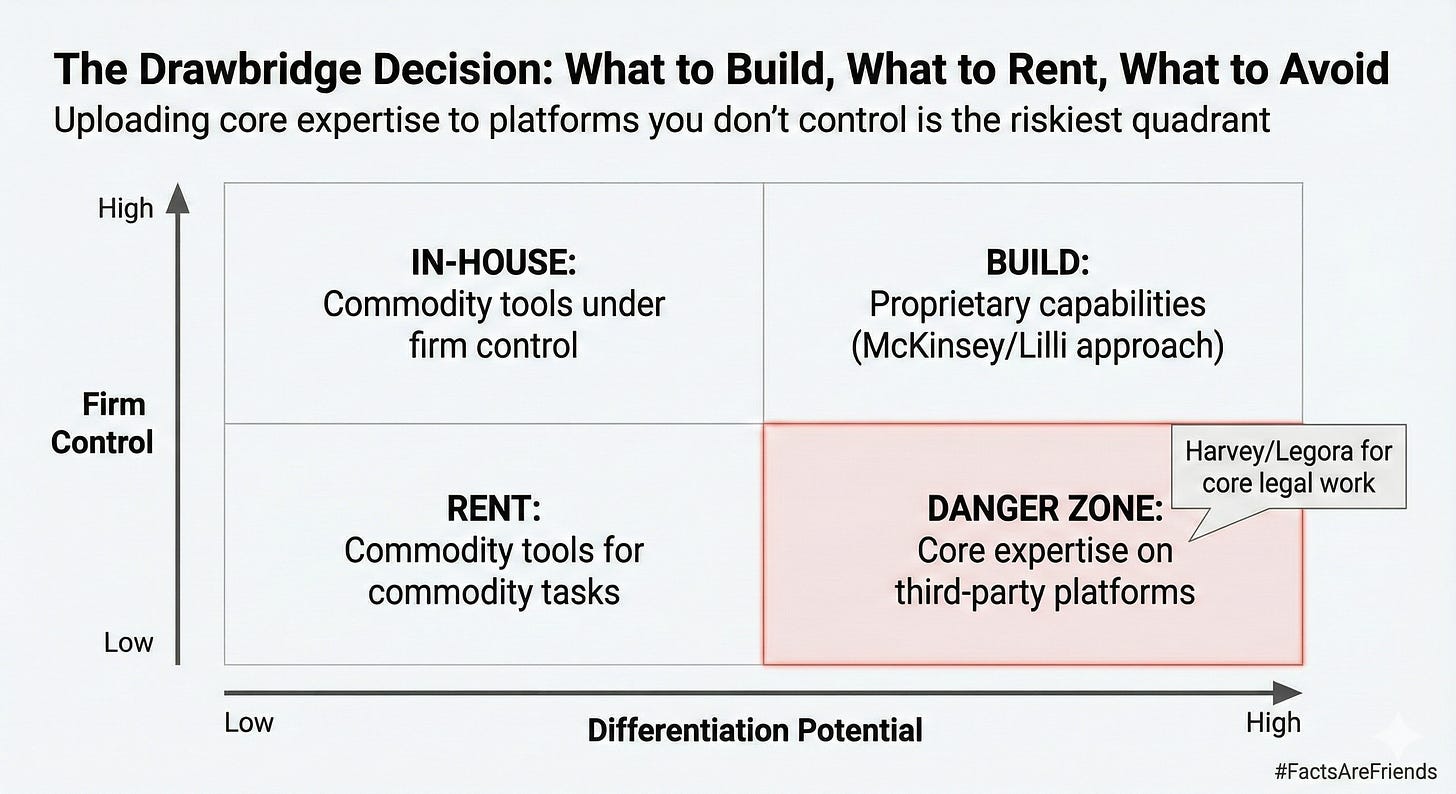
For most law firms, legal AI is a “rent” category. The differentiation that matters may escape public scale automation. The tools that support this work are increasingly interchangeable. Do not start to rely on an interface above all others: that root leads to system dependency which leaves you vulnerable to that interfaces failure and exposed to its commercial whims. It also means that you may have to pay a premium for staff who are familiar with the interface. For now corporate interface remains a major hurdle, as we move forward AI will become the virtual operating system And any consumer who can use it will be instantly familiar with the corporate version (there will still be a learning curve in discovering what is available, but having discovered it the historic difficulties of using it will be substantially ameliorated).
But do not mistake renting tools for building capabilities. The former is tactical. The latter is strategic. It is an important distinction.
The emerging counter-model: proprietary AI and client-centric service
While many law firms subscribe to Harvey and Legora, a significant minority is pursuing the strategy that consulting firms adopted: building proprietary AI that creates genuine competitive advantage AND transforms client service. These are the ones to watch. I have identified some here, there are others (and if you identify yourselves I would be delighted to add you in to updated versions of this essay).
Building the moat
Cooley LLP developed ‘Vanilla,’ a proprietary in-house platform - complete control, zero vendor dependency, no 80x revenue multiples to justify.
Lewis Silkin and Ius Laboris launched ‘Delphius’ in 2025, an AI-powered guide to global employment law trained on their firms’ expertise across 50+ jurisdictions. Joint Managing Partner Richard Miskella explained the client focus:
“We’ve developed Delphius directly as a result of conversations with our clients, many of whom were asking us for faster, smarter access to reliable international legal knowledge”.
This is the defensible moat. Harvey and Legora cannot train on client data at scale without creating regulatory, contractual and professional-conduct risks that firms cannot accept. But Delphius is trained on Lewis Silkin’s proprietary expertise, captured over decades. Cooley’s Vanilla is built on Cooley’s workflows and precedents. These are moats competitors cannot replicate by subscribing to a platform.
As Draftwise’s CTO observes:
“The next breakthrough for Legal AI is not more computing power, but moving beyond general intelligence toward specialized systems that learn from actual negotiation outcomes, understand firm-specific precedents, and compound expertise”.
Every contract Cooley negotiates through Vanilla, every employment matter Lewis Silkin handles through Delphius, deepens the moat. Harvey and Legora get none of this learning.
Macfarlanes adopted a hybrid approach. Having licensed Harvey to 70 users in 2023, they expanded to all 950 people by 2025 and launched ‘Amplify’ - a custom workflow platform using Harvey as infrastructure but building proprietary applications on top. They are treating Harvey as commodity middleware whilst building distinctive capabilities. There may be alternative (better/ cheaper/ different) middleware solutions and Macfarlanes will be taking care to ensure that it does not get locked into the platform, and that is - of course - the problem for the platforms.
A&O Shearman deployed Harvey to 3,500 employees but insists on human audit of every AI output - building firm-specific quality controls. I am less convinced about this as a strategy, and those of you who have read other things I have written will understand why I say that the “human in the loop” becomes a crash dummy who will be sacrificed until the regulators recognise that it is the underlying AI that should assume responsibility. The A&O Shearman approach is respectable for today, but the longevity must be questioned.
Baker McKenzie emphasises client-by-client AI sandboxing to align with custom data security requirements. Orrick served as beta partner for CoCounsel, helping shape the product whilst building tailored use cases.
The pattern is clear: sophisticated firms use platforms as infrastructure whilst building proprietary workflows, quality controls and applications that create genuine differentiation. They rent the commodity layer. They own the distinctive layer.

AI competence: the hidden advantage
There is a critical misconception underlying most discussions about legal AI: the assumption that the people who build AI are the experts in how to use it. They are not.
As Ethan Mollick (Professor of Management and Co-director of the Generative AI Labs at the Wharton School, University of Pennsylvania, where he teaches entrepreneurship and innovation) has observed:
“The people who build AI are often not the best at using it”.
The bottleneck has moved from model builders to operators - people who can apply AI competently inside real legal work. You can design flight-control software without being a pilot. While AI competence may be the most in-demand skill in the economy today, it does not qualify to build the workflows or design guardrails around the data repositories: but working with experts these “engineers” turn messy, human workflows into agentic systems, translate domain knowledge into prompts, constraints and policies and allow AI to operate in intentional, safe and efficient ways.
This is why Lewis Silkin’s Delphius works and why Cooley’s Vanilla creates a moat. If these firms have implemented well they will have translated proprietary legal expertise - accumulated across decades, refined through thousands of matters - into AI systems that embody their distinctive approaches. The AI competence was understanding which aspects of practice can be systematised and which still require human judgment, then building infrastructure to support both. The scope of the AI competence will extend, but for today the balance optimises efficiency, safety, compliance and client acceptance.
Law firms waiting for their technology teams to “figure out AI” are looking in the wrong direction. The advantage is not having AI. The advantage is knowing where AI is useful and where it is noise. That judgment requires legal expertise combined with operational understanding of AI capabilities and limitations and commercial nouse. Miss any one of these three and you miss the target. And missing the target at the speed of today’s trajectory will - at the very least - be expensive.
Domain experts will define the next stage of AI progress in law - not the model builders at Harvey and Legora. The firms that thrive will be those that strengthen their core legal capabilities whilst learning to pair them with AI competently. The gap has not closed yet. But it will.
Redefining client service
But the deeper insight is what these firms understand about client expectations. The lesson from Uber was not that it provided better drivers - it won by managing expectations. Clients knew where their driver was, when their driver would arrive and giving certainty as to what it would cost. Then they added the insurance hype, because that is what the customer wanted. Transparency and predictability, not just quality. it is like McDonald's many people go not because they like the food but they know that they will not dislike it and they knew what to expect and get what they expect.
Law firms building proprietary AI can transform client service in precisely this way.
As I understand it, Delphius gives clients instant guidance on employment law across 50 countries - they know the answer immediately, not after expensive research bills. Clients can ask follow-up questions, drill into details, and when they need human expertise, the system connects them directly to the right specialist. This is not about replacing lawyers - it’s about managing client expectations and delivering transparency. the solution is certain quick trustworthy, represents better value than doing the same thing any other way and - with a little bit of luck and a lot of marketing promotion - will be a runaway and sustainable success.
The proprietary workflow platforms enable law firms to show clients exactly where matters stand, provide predictable timelines and costs, and also offer proactive alerts when regulations change. This is the Uber model applied to legal services: visibility, predictability, frictionless experience.
Think about what this means in practice. A client using Delphius does not wonder whether they are compliant with French collective dismissal rules - they know instantly. They do not wonder when they will get advice - they have it. They do not wonder what it will cost - the guidance is included. And when complexity requires human judgment, the transition is (assuming Lewis Silkin has set it up correctly) seamless.
This transforms the client relationship from transactional to strategic. The law firm is no longer merely reactive - answering questions when asked. It becomes proactive - alerting clients to regulatory changes, identifying compliance gaps, suggesting optimisations. The AI handles the routine. For now, the humans handle the judgment. And the client experiences both as integrated, transparent, predictable service.
Compare this to the traditional model: client emails question, associate researches for hours at a cost of at least £300 per hour, partner reviews, client receives bill days later with no visibility into the process. I call this the bum-nip bill: always that bit more than you expected. The Uber lesson is that clients increasingly reject this opacity. They want to see the car approaching. They want to know what it costs. They want to know how long the journey will take . They want predictability.
This is where AI competence directly enables better client service. A firm that understands where AI adds value and where it introduces risk can confidently offer clients AI-powered transparency for routine matters whilst reserving human expertise for complex judgment. A firm that lacks AI competence cannot make these distinctions - so it either avoids AI entirely (losing the transparency advantage) or applies it indiscriminately (introducing unacceptable risk).
The law firms’ legacy advantages
Almost by way of aside, it is worth noting why the law firms still have a strategic advantage.
They have four things on their side.
The first is that the regulators insist that they are regulated in order to provide legal advice. That will change overtime, but regulation changes at a glacial pace compared with the changes we are seeing in technology.
The second is that they have trust: whether deserved or not, clients trust their advisers The trust can be lost quickly, however cherished and promoted the trust becomes a key differentiator.
The third is that clients are wary of change, and for many using a lawyer indicates that they engaging in a valuable transaction, for some that may be a multi-million M&A transaction for others it may be the purchase of a £350k home, either way it is likely to be amongst the most valuable transactions that the client has ever engaged in, and the client will not want to take the risk of something new for that.
The final advantage is insurance: clients want and insurers have not yet developed trust in AI. They will, but how long that takes is unclear?
The three-front war
Meanwhile, the platforms face mounting pressure from three directions simultaneously.
The general-purpose assault: General-purpose AI tools are making substantial inroads into legal work. ABA reporting suggests these tools lead mindshare: more than half of firms said they are using or considering ChatGPT (52%). The significance cannot be overstated. OpenAI, owner of ChatGPT, has repeatedly acknowledged legal as a priority vertical in public statements, developer events and product roadmaps. For now it seems that they are enabling disintermediation without owning the liability.
Google has publicly discussed using AI internally for contract analysis and legal ops efficiency, signalling confidence in applicability.
Perplexity - valued at $18 billion in funding discussions and processing 780 million queries in May 2025 - demonstrates that well-funded generalists with broader markets and lower cost structures can compete effectively against specialist platforms. It has launched Perplexity Patents, a patent search and research tool. It uses conversational language to make patent research more accessible, letting users query patents without complex keyword logic. The product is currently in beta and available worldwide, with free access and enhanced quotas for paid subscribers.
xAI, the Elon Musk-backed AI company behind the Grok chatbot, is actively recruiting legal professionals to help train its AI models, signalling at least an interest in legal content and compliance expertise rather than a traditional law-firm service.
Microsoft openly demonstrates Copilot handling contracts, policies, compliance documentation and legal drafting inside Word, Outlook and Teams. Unlike pure-play AI vendors, Microsoft already owns the environment where most legal work happens. Microsoft positions itself as the horizontal layer on which legal tools are built, while simultaneously expanding Copilot’s native capability.
What they have not done
These platforms achieve scale without legal-specific funding rounds, without law firm partnerships, without years of specialist training data. Just general-purpose AI platforms adding capabilities that legal professionals find useful. When general-purpose AI can handle research and analysis tasks, why should law firms build long-term dependency on middleware whose economics they neither control nor benefit from?
The DIY revolution: Agent-building tooling and workflow frameworks are making it far easier for law firms to build sophisticated AI systems without deep engineering teams. The technology barrier is falling rapidly. Real-world results validate this shift: organisations are building complex automation in hours rather than months, with dramatic improvements in both speed and accuracy.
But here is the critical insight: accessible tooling democratises the technology, but not the competence. A law firm with strong AI competence - lawyers who understand where AI is useful, how to translate workflows into agentic systems, how to operate AI safely - can use these tools to build powerful proprietary capabilities. A law firm without AI competence will build workflows that introduce risk, miss opportunities or solve the wrong problems.
This is why firms like Cooley can build Vanilla whilst most law firms cannot - not because Cooley has better technology teams, but because it has developed AI competence amongst their lawyers.
Law firms can now build bespoke workflows on foundational models rather than subscribing to specialist platforms. They avoid vendor lock-in, capture firm-specific knowledge directly and pay API costs rather than 80x revenue multiples. A Magic Circle firm could hire two developers and build custom legal workflows for less than a single year’s Harvey subscription. They would own the workflows. They would control the training. They would avoid dependency.
The cost collapse: Training advanced open models has become remarkably affordable. The technical barriers have essentially evaporated. Combined with accessible workflow-building tools, the only question is strategic vision: do law firms want to control their AI or rent it?
Vertical depth is not the same as defensibility
It is important to acknowledge that neither Harvey nor Legora is naïve about the criticisms levelled at them. Both companies have articulated coherent, non-frivolous defences of their strategy, valuation and long-term relevance.
In a recent Reddit “Ask Me Anything” session, Harvey’s co-founders were explicit that they are not attempting to outperform horizontal models across every domain. Their bet is vertical depth: being better at legal work specifically by focusing exclusively on legal workflows, orchestration, integrations and governance. They emphasised structured use cases such as motions practice and due diligence, secure knowledge vaults, and deep integration with research content through partnerships such as LexisNexis. The ambition, as they framed it, is not to be a chatbot, but to become mission-critical infrastructure for legal work.
Both Harvey and Legora also defend their valuations on market logic rather than novelty. The argument is straightforward: legal is a large, under-automated market, with millions of professionals globally and relatively low penetration of advanced tools. Even modest adoption at meaningful per-seat pricing, combined with rising usage intensity, could justify multi-billion-dollar outcomes. Harvey has pointed to improving engagement metrics and renewals as evidence that early “innovation theatre” concerns are giving way to real workflow adoption. Legora, similarly, frames its growth as driven by “astronomical demand” for embedded productivity rather than hype, positioning itself as a workflow layer rather than a point solution.
There is real strength in this case. Legal work is complex, risk-sensitive and deeply process-driven. Building robust workflows, security controls and integrations is genuinely hard, and both companies have accumulated hard-won domain experience through deployments with demanding clients. This learning curve is far from trivial, and it creates advantages over generic model providers starting from scratch.
But accepting the strength of that defence does not resolve the harder question this essay raises.
Vertical depth may produce better tools. It does not automatically produce defensible moats for the firms that use them.
Even taken at face value, the AMA arguments focus on why Harvey and Legora may succeed as vendors. They do not fully explain why the long-term learning, differentiation and surplus created by those systems accrue to the subscribing law firm rather than to the platform itself. Workflow depth helps a platform become sticky, but it can just as easily deepen dependency if the learning loop sits outside the firm.
The valuation logic exposes this tension. Current revenue multiples implicitly assume that one or two platforms become de facto operating systems for legal work, with sustained growth, high margins and limited erosion from competition, insourcing or commoditisation. That scenario leaves little room for normal execution risk, pricing pressure from sophisticated buyers, or the steady improvement of general-purpose models and internal firm stacks. It is not that the outcome is impossible. It is that much of the upside appears already priced in.
This is why the strategic question for law firms is not whether Harvey or Legora are “overhyped”, or whether their founders are sincere. It is whether subscribing to increasingly deep, client-facing platforms builds firm-level advantage or gradually transfers it. Market size and adoption metrics matter, but they do not answer who ultimately captures the value: the vendor, the firm, or the client.
The AMA shows that Harvey understands the technical and commercial game it is playing. What remains unresolved is whether law firms are equally clear about the strategic game they are being drawn into.
The strategic question
The question is no longer whether law firms can build defensive moats - Cooley and Lewis Silkin prove they can. The question is whether most firms will.
More fundamentally: will law firms treat AI as something to own or something to rent?
Firms building proprietary AI and developing AI competence face short-term costs but create long-term advantages: client relationships strengthened through transparency and predictability, expertise captured in systems they control, workflows optimised for their specific approach, lawyers who understand where AI adds value and where it introduces risk, zero vendor dependency.
Firms renting platforms face the opposite trade-off: immediate deployment but long-term vulnerability, clients trained to expect AI-assisted service that any provider could deliver, expertise that never becomes proprietary advantage, lawyers who use AI without understanding it, dependency on vendors whose business model requires direct client relationships.
The consulting firms understood this choice. McKinsey built Lilli. BCG built internal platforms. They control the AI that captures their expertise. But more importantly, they developed AI competence amongst their consultants. Some law firms are making the same choice. The question is how many, and how quickly.
And for law firms that choose neither path - neither building proprietary AI nor thoughtfully deploying platforms to transform client service whilst developing AI competence - the future looks bleak. They will rent commodity tools, teach clients that legal knowledge is abundant, and watch as general-purpose AI, accessible agent-building tools and proprietary AI builders erode the market from three directions simultaneously.
The value pricing imperative
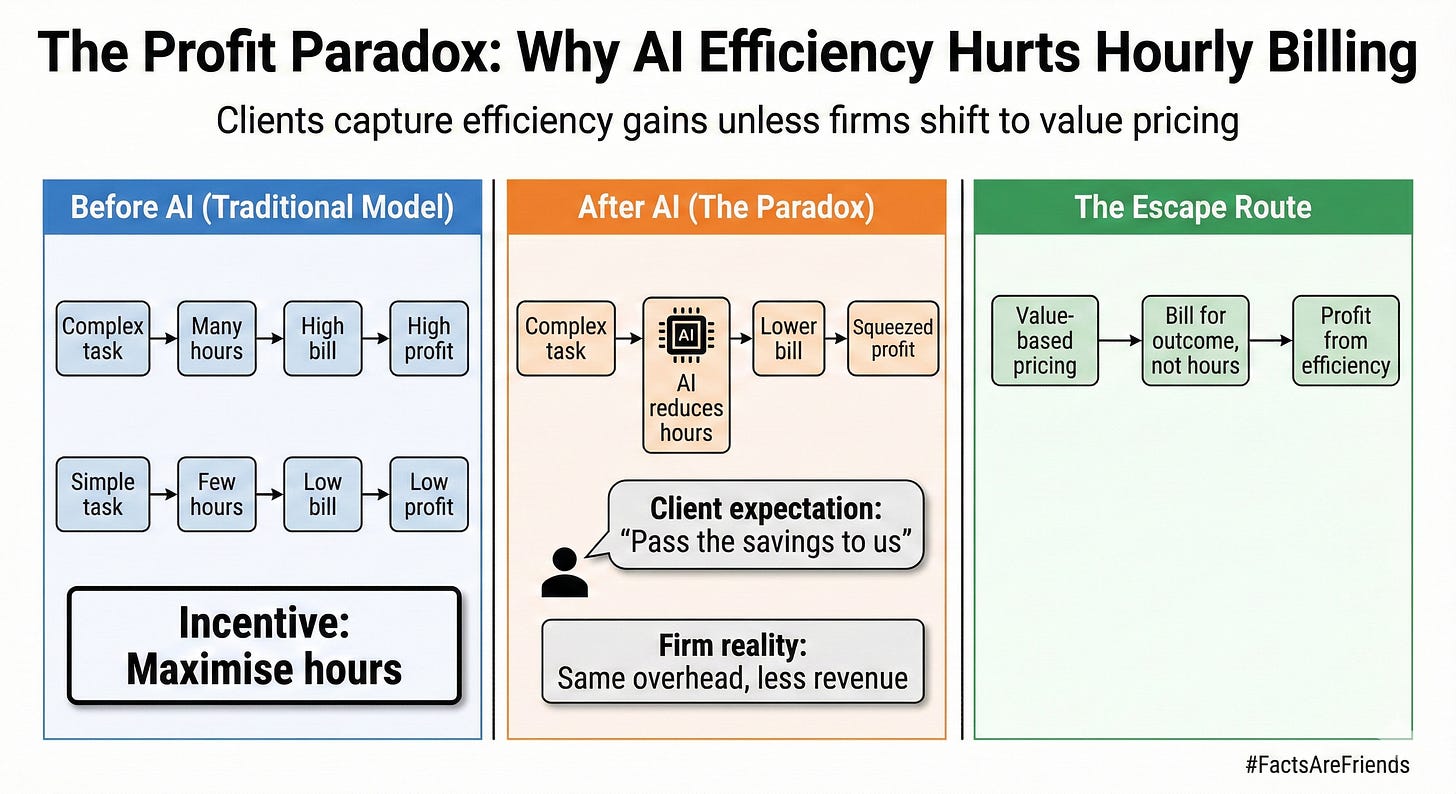
We are living through a fundamental restructuring of how legal services are priced and delivered. To thrive firms must redefine their service offerings around outcomes, not hours worked. They will price based on the value delivered to the client - the successful transaction, the regulatory approval, the risk avoided - rather than the time spent producing documents.
This is precisely the shift that consulting firms made years ago. McKinsey does not bill by the hour. Neither does BCG or Bain. They price based on the complexity and value of the engagement. Their AI investments amplify their margins rather than compressing them, because efficiency gains flow to the firm, not to the client.
Law firms clinging to the billable hour are caught in a vice. AI makes document production cheaper. Clients demand those savings, revenues fall as investment rises.
The only escape is to stop selling hours and start selling outcomes.
Some firms are beginning this transition. Three Points, the AI-first firm launched by ex-Mishcon partners, explicitly positions itself as “moving past hourly rate models towards value-driven legal offerings”. They understand - whether actively or intuitively - that in an AI world, the billable hour is not just inefficient - it is actively self-destructive.
The first casualty: Robin AI’s collapse validates the thesis
In late 2025, Robin AI’s attempt to raise fresh funding faltered and it moved into retrenchment, including reported job cuts and a distressed sale of its managed services arm to Scissero. This was not a successful exit - it was a cautionary tale that validates every concern about legal AI valuations.
Founded in 2019 by Clifford Chance lawyer Richard Robinson, Robin AI raised around $70 million from Temasek, PayPal Ventures and Bloomberg’s family office. They secured Anthropic as their exclusive launch partner for the legal sector. Their client list read like a Magic Circle pitch deck: PepsiCo, PwC, UBS, eBay and Yum! were included as client brands.
In its final (second?) year of operations, Robin AI achieved 4x customer growth and 5x revenue growth. It reached $10 million ARR - genuine traction by any measure. It attempted to raise £38 million. The round failed. HMRC filed a winding-up petition. The company cut one-third of its workforce and sold its managed services division (75 staff) to Scissero for an undisclosed sum widely reported as far below the company’s total funding.
What makes Robin AI’s collapse particularly instructive is what it reveals about the fragility of legal AI business models. They had everything the bulls claim matters: strong growth, premium clients, technology partnerships, experienced founders, well-funded investors. None of it was enough.
The collapse validates concerns about the ‘AI tourist’ phenomenon (customers trying multiple products but not committing to any). Robin AI’s clients were experimenting, not committing. When funding tightened and the company needed clients to commit to long-term contracts, the tourists departed. $10 million ARR was not enough. Growth was not enough. At 80x multiples, platforms need not just to be useful - they need to be indispensable and defensible.
Robin AI was useful. It was not indispensable.
When funding tightened, useful was not enough.
This does not mean all platforms will fail - Harvey and Legora have far deeper resources and broader adoption. But it does mean that valuations built on rapid growth without structural competitive advantage remain vulnerable to capital pressure and strategic dependency risks.
Market consolidation: the starting pistol
Robin AI’s collapse signals what industry analysts predicted: legal tech consolidation is accelerating. The data supports this narrative across multiple dimensions.
New major legal tech startup formations dropped 59% in 2024 - from approximately 200 companies in 2023 to just 80 in 2024. This is not a pause; it is a structural shift. The easy funding that supported experimentation has evaporated. The market is winnowing.
Funding is concentrating in fewer, larger deals to mature companies. European legal tech funding reached €736.5 million in 2025, according to PitchBook data, doubling the 2024 total.
Legora’s $150 million Series C (30 October 2025 at $1.8 billion valuation) and Harvey’s $160 million Series F (4 December 2025 at $8 billion valuation) dwarf the seed and Series A rounds that previously dominated legal tech. Investors are backing proven execution, not promises.
This concentration matters for law firms. The funding arms race creates pressure on platforms to justify ever-higher valuations through rapid expansion - which means capturing not just law firm subscriptions but direct client relationships. The platforms that attract capital are those building tools that enable clients to reduce their reliance on outside counsel. Law firms subscribing to these platforms are funding the infrastructure of their own disintermediation.
Clio’s $1 billion acquisition of vLex in July 2025 demonstrates another consolidation dynamic. The deal combined Clio’s 300,000 practice management users with vLex’s 2.8 million legal research users and one billion searchable documents. vLex’s CEO framed the transaction pointedly:
“vLex’s crown jewel - its proprietary database of over 1 billion legal documents enriched with editorial metadata - provides one of the only long-term defensible competitive moats in legal technology”.
Note the emphasis: one of the ONLY long-term defensible competitive moats. The industry is recognising that most legal tech offerings lack sustainable advantages. Data moats matter. Platform capabilities built on rented infrastructure do not.
Platform competition: the Trojan Horse made explicit
In 2025, the platform race has moved from “lawyer copilots” to client-facing collaboration.
Legora launched Portal on 7 November 2025. Harvey launched Shared Spaces on 4 December 2025.
Earlier, in June 2025, Legora had launched ‘Workflows’ - an agentic AI framework that orchestrates multi-step legal tasks using natural language. The platform can create tabular reviews, invoke web searches for case law, verify citations via legal databases and draft complete sections of reports - all without human intervention beyond the initial instruction.
These launches make the Trojan Horse thesis explicit. The platforms are no longer just helping law firms work faster. They are actively building tools that enable clients to bypass law firms entirely.
Consider the dynamic: a law firm pays Harvey or Legora to build a system that gives clients direct access to the firm’s knowledge and precedents. The firm captures efficiency gains internally - documents drafted faster, due diligence completed quicker. But the platform simultaneously builds infrastructure that lets clients access similar capabilities without engaging the law firm at all.
Harvey’s ‘Shared Spaces’ is not helping law firms serve clients better. It is giving clients the ability to serve themselves. Legora’s ‘Workflows’ enables clients to orchestrate complex multi-step legal work without lawyer involvement. The value flows to clients and platforms. The law firm becomes middleware.
Law firms are paying for them. And they are training clients to expect AI-powered self-service legal guidance.
The platforms are racing to give clients MORE self-service capability, FASTER automation, GREATER independence from law firms. This is not a bug. This is the business model. Law firms are paying subscription fees to platform providers who are actively building tools that eliminate the need for law firms.
At 80x revenue multiples, Harvey and Legora need growth that justifies their valuations. That growth cannot come just from law firms - the market is too small, adoption is finite. The growth must come from expanding to clients directly. The ‘Shared Spaces’, ‘Portal’ and ‘Workflows’ launches make this strategy explicit.
Law firms funding this expansion should ask themselves: at what point does the platform provider decide that client subscriptions are more valuable than law firm subscriptions? What happens when Harvey or Legora concludes that a general counsel with a £50 million legal budget is a better customer than the law firm serving that general counsel?
The platforms cannot say this publicly. But the product roadmaps speak clearly. Client-facing tools are the priority. Law firms are funding their own displacement.
The adoption paradox: dependency masquerading as success
An independent study by RSGI examining 40 Harvey customers found striking results: 100% said their lawyers would be upset or disappointed if Harvey was taken away. Over 90% of Harvey licences were being utilised monthly. 68% reported measurable benefits within three months of implementation.
These are not the metrics of a product that firms are evaluating and discarding. This is genuine adoption. Real value delivery. Demonstrable ROI.
But this strengthens the strategic concern, not weakens it. Law firms who cease to be AI tourists are no longer experimenting with platforms - they are becoming dependent on them. The more value Harvey and Legora deliver, the deeper the dependency becomes. The more lawyers rely on platform-powered workflows, the harder it becomes to switch to proprietary alternatives.
This is the dependency trap. Platforms deliver immediate productivity gains that create long-term strategic vulnerability. Lawyers who would be “upset or disappointed” if Harvey disappeared are lawyers who have integrated platform capabilities into their core workflows. They have outsourced not just tasks, but competence development.
Compare this to firms building proprietary AI. When Cooley’s lawyers use Vanilla, the firm captures learning from every contract negotiated. When Lewis Silkin’s clients use Delphius, the firm strengthens its competitive moat. The dependency runs in the firm’s favour - clients become dependent on the firm’s distinctive AI capabilities.
When Harvey’s clients benefit from Shared Spaces, who captures the learning? When Legora’s Workflows automate due diligence, whose competitive advantage strengthens? The platforms, not the firms.
High adoption rates validate that platforms deliver value. But they also confirm that law firms are willingly building dependencies on infrastructure they do not control, teaching clients to expect capabilities any platform could provide, and outsourcing the development of AI competence to vendors whose business model requires direct client relationships. How long until the first client asks for its data back and moves lock, stock and barrel to another provider (perhaps another law firm, perhaps the Law Tech technology provider or perhaps a foundational model).
Robin AI’s clients showed 4x growth and strong engagement - until funding pressures forced the test of commitment. The tourists departed didn’t book long term rooms. Harvey and Legora’s clients show higher adoption and deeper integration. But the fundamental question remains: are they building capabilities or dependencies?
The primary sources problem: dependency disguised as partnership
Primary law and citator content is concentrated in a small number of large providers, and most legal AI products depend on licensing at least one of them. Every legal AI platform requires access to comprehensive legal databases that they do not own.
Harvey’s June 2025 announcement of a “strategic alliance” with LexisNexis was trumpeted as a breakthrough. The reality is more complex. Industry analysis suggested Harvey’s access to the Lexis data set was more limited than expected - described as integration without the depth that “strategic alliance” might imply.
Harvey has also announced a Wolters Kluwer data licensing deal. Multiple data providers suggests diversification, but also reveals dependency. Harvey does not own the content. It rents access. And the content providers can raise prices, restrict access or - critically - compete directly.
The competitive threat from primary sources providers is already manifest. In December 2025, LexisNexis published thought leadership positioning its Lexis+ AI with Protégé as the superior alternative to “free” or public AI tools, warning inhouse counsel about data security risks whilst citing 284% ROI and reduced outside counsel spend. The marketing message was unmistakable: why pay Harvey or Legora when LexisNexis can provide similar AI capabilities directly, with “zero data retention” and “authoritative legal sources”?
This is the dependency trap made explicit. LexisNexis licenses content to Harvey through their June 2025 “strategic alliance”, provides the foundational legal data that makes Harvey credible, and simultaneously markets competing AI products to the same customer base. Harvey and Legora are tenants in a building whose landlord is actively opening a competing shop downstairs. Perhaps we should read the LexisNexis report as a thank you to the funders who have proven the use of its real estate , and an announcement that they are now planning on going to the tenants direct?
Thomson Reuters already competes through CoCounsel (now integrated with Westlaw). Clio owns vLex and is building AI capabilities directly. The platforms are dependent on foundation providers who can become - and in some cases already are - competitors.
This dependency creates strategic vulnerability.
Harvey and Legora have built businesses on the premise that legal-specific data access creates a moat. But they do not own that data. They license it from companies that can withdraw access, raise prices or compete directly.
The primary sources problem manifests in three ways:
First, cost structure. Legal AI platforms pay substantial licensing fees to content providers. These costs do not decrease with scale - they increase. As Harvey and Legora add customers, their licensing costs rise proportionally. This is the opposite of software economics. There is no marginal cost advantage.
Second, competitive dynamics. Every legal AI platform has broadly similar access to the same primary legal databases through licensing arrangements. The foundation content is a commodity. The only differentiation is the interface and workflows built on top.
Third, strategic control. When content providers decide to compete directly, they have inherent advantages. They own the content. They control distribution. They have existing relationships with law firms and legal departments. The platforms built on top of their data are tenants, not owners.
Clio’s acquisition of vLex for $1 billion demonstrates one response: vertical integration. Clio now owns both the practice management platform AND a primary legal database. This is a defensible combination. Harvey and Legora have neither.
The platforms are caught in an inescapable bind. They need primary legal data to be credible. But accessing that data makes them dependent on providers who can raise costs or compete directly. When those providers already have existing relationships with every law firm and legal department, direct customer access, and control over the content that platforms need, the power dynamic is clear. There is no escape from this dependency.
The counterarguments: what the bulls say
To be fair, there are serious arguments for why this analysis may be too pessimistic.
Early usage data suggests genuine adoption, not tourism. The RSGI study showed 100% customer satisfaction, 90%+ monthly utilisation and 68% reporting measurable benefits within three months. These metrics indicate deep integration into workflows, not superficial experimentation.
However, the counterargument from proprietary AI builders is different. Lewis Silkin’s Delphius demonstrates that firms building their own AI can create client value that platforms cannot replicate. When clients get instant answers to employment law questions across 50 jurisdictions through an AI trained on Lewis Silkin’s specific expertise, they are not just experiencing efficiency - they are experiencing a transformed service model built on proprietary knowledge that Harvey cannot access or replicate.
Ecosystem and distribution moats may matter more than technical moats. Harvey’s expansion into UK law schools - partnering with Oxford, The University of Law, King’s College London and BPP - could create a generation of lawyers trained on Harvey from the start. It feels as though Harvey has learned from Microsoft embedding itself in schools. If Harvey becomes the default tool that law students learn, switching costs compound over careers. But that assumes that junior lawyers have the choice, and that they do not prefer another AI model that is equally tailored and may cost no more than £20 a month. It also assumes that those students will find a job in the law, and that may not be a safe assumption.
Consolidation may create winners. Clio’s acquisition of vLex combines 300,000 practice management users with 2.8 million legal research users and one billion searchable documents. VHS was inferior to Betamax, but won the market. I make no comment on Clio, but note the power of adoption. The LexisNexis-Harvey strategic alliance integrates generative AI with proprietary legal content. One or two platforms may survive and thrive.
The legal market may expand rather than contract. If AI makes legal services cheaper and more accessible, demand may increase. Previously uneconomic legal work becomes viable. The pie grows even as individual slices shrink. Whether this supports the growth of platforms developed for today’s consumers of market services is not entirely clear. Whether the growth in service results in more lawyers, is also unclear.
These are reasonable arguments. But they do not address the fundamental problems revealed by Robin AI’s collapse, the general-purpose AI threat, accessible agent-building tools, and the proprietary AI builders’ success. Even if Harvey and Legora survive - even if law firms love their subscriptions - the strategic questions remain:
How can 80x revenue multiples be justified when general-purpose AI can deliver comparable capabilities?
Why rent when you could spend to create defensible moats?
Why depend on platforms when accessible workflow tools enable DIY creation?
Why teach clients that legal knowledge is abundant if you do not control the AI that provides it?
Why subscribe when you could develop AI competence amongst your lawyers and build your own capabilities?
The Trojan Horse is inside the gates. Robin AI thought it was building a defensible business. It raised around $70 million, achieved strong growth, secured premium clients. None of it was enough. The platforms that survive will be those that answer the strategic questions. The rest will follow Robin AI into distressed sales and consolidation.
Conclusion: castles, rentals or ruins?
We began this series examining Harvey and Legora’s remarkable growth - their rapid fundraising, elite partnerships and expanding customer bases.
We explored how consulting firms built defensive moats whilst law firms rented infrastructure. I made no bones, pulled no punches - I maintained that the valuations were unprecedented and unsustainable. Since I started writing we have seen the collapse of Robin AI, perhaps the first major casualty of unsustainable valuations built on fragile business models.
Now, in late 2025, the picture is clearer.
The platforms are thriving - for now. Harvey and Legora have raised over $1 billion combined at multibillion-dollar valuations. They have expanded to dozens of countries and built genuine customer loyalty. Independent studies show deep adoption: 100% customer satisfaction, 90%+ utilisation rates, measurable productivity gains within months. On report states that lawyers in firms who have deployed would be “upset or disappointed” if the platforms disappeared.
But this success makes the strategic dependency more dangerous, not less. The more value platforms deliver, the deeper law firms’ reliance becomes. High adoption rates confirm not just utility but dependency - law firms integrating capabilities they do not control into workflows they cannot replicate, teaching clients to expect AI-powered service that any platform could provide.
Meanwhile, the three-front war intensifies:
General-purpose AI adds capabilities that legal professionals find useful. When more than half of firms are using or considering ChatGPT, and well-funded generalists with broader markets can compete effectively, why would firms commit to specialist platforms at 80x revenue multiples?
DIY democratisation accelerates. Accessible agent-building tools enable law firms to build sophisticated workflows at dramatically lower cost. The technology barrier has collapsed. A Magic Circle firm could build custom legal automation for less than a single year’s platform subscription - owning the workflows, controlling the training, avoiding vendor dependency.
Proprietary AI builders create defensible moats. Cooley’s Vanilla and Lewis Silkin’s Delphius demonstrate that firms developing AI competence amongst their lawyers can build capabilities platforms cannot replicate. Every contract negotiated deepens the moat. Every client interaction strengthens the competitive advantage. The learning stays with the firm.
Harvey, Legora and other leading models have achieved remarkable things. They moved first into legal AI with conviction and execution. They built products that elite law firms are willing to pay for. They attracted top-tier investors and talent. They may yet prove sceptics like me wrong about their valuations.
But law firms should not confuse the success of legal AI platforms with their own success.
The 80x revenue multiples assume either transformative growth or structural advantages that justify premium valuations indefinitely. The evidence for both is mixed. Robin AI’s collapse in late 2025 - despite around $70 million in funding, 4x customer growth, premium clients and strong partnerships - demonstrates that growth alone does not guarantee survival. The funding arms race between Harvey and Legora, each raising $150M+ rounds, suggests an unsustainable competition for market dominance where investor capital subsidises client acquisition rather than genuine competitive advantages.
Many investors will lose money when consolidation comes. Perhaps most will. But the investors are not the primary concern. They knew the risks when they wrote the cheques.
The lawyers are the concern. They are paying for platforms they do not control. They are uploading expertise that does not train the AI to benefit themselves. They are teaching their clients that legal knowledge is abundant. They are accelerating the commoditisation of their own profession. And they are building dependencies on infrastructure that can be withdrawn, repriced or redirected to serve clients directly.
Sitting in their castles, most law firms are not just inviting the Trojan Horse in - they are paying for it to be delivered. And the platforms, having secured beachheads inside law firm workflows, are now explicitly building tools to capture client relationships directly. The ‘Shared Spaces’, ‘Portal’ and ‘Workflows’ launches make this trajectory unmistakable.
The consulting firms understood this decades ago. They built their own platforms on their own knowledge. They developed AI competence amongst their consultants. They control the AI that captures their expertise. McKinsey’s Lilli, BCG’s internal platforms, Bain’s Centre of Excellence - these are defensive moats that competitors cannot replicate by subscription.
Law firms, with a few exceptions, are taking the opposite approach. Most are choosing dependency over ownership, renting over building, convenience over control.
It is not too late to change course. Training costs are collapsing - the OLMo 3 32B model cost $2.2 million to train, less than a single partner’s annual compensation. Accessible workflow tools make custom systems achievable without deep engineering teams. The technology to build firm-controlled AI is available and affordable. The question is whether law firms have the vision and will to use it - and whether they will develop AI competence amongst their lawyers rather than treating AI as a technology problem to be solved by subscription.
The path forward requires difficult choices:
For firms with ambition and resources: Build proprietary AI. Develop AI competence amongst your lawyers. Transform client service through transparency and predictability. Create defensible moats that deepen with every matter handled. Control the infrastructure that captures your expertise.
For firms choosing platforms: Use them as commodity infrastructure, not strategic advantages. Build proprietary workflows and quality controls on top. Develop AI competence so lawyers understand where platforms add value and where they introduce risk. Never let the platform become indispensable. Retain the ability to switch.
For all firms: Differentiate on what AI cannot automate. Client relationships, industry expertise, negotiation judgment, strategic counsel, courtroom advocacy - these capabilities remain irreplaceable. Everything else becomes a cost centre. Stop selling hours. Start selling outcomes. Transform billing models before clients demand it.
The general-purpose AI threat, accessible agent-building tools, the $2.2 million cost of training advanced models, Robin AI’s collapse despite strong growth, and the proprietary AI builders’ success all point to the same conclusion: the platforms face a three-front war whilst the innovators build moats.
Domain experts will define the next decade of AI progress in law - not the model builders at Harvey and Legora. The firms that thrive will be those that strengthen their core legal capabilities whilst learning to pair them with AI competently. They will be the firms that develop AI competence amongst their people - the ability to translate domain knowledge into AI-powered systems, to understand where AI is useful and where it introduces risk, to operate AI intentionally, safely and efficiently.
The gap has not closed yet. But it will.
If law firms do not change course, they may discover too late that they were not building castles at all. They were renting them - while paying for the siege engines that would tear them down.
The platforms have achieved remarkable adoption and genuine customer loyalty. But that loyalty may represent strategic dependency rather than strategic advantage. Law firms accelerating their own obsolescence, or navigating a pragmatic path to transformation - the answer will become clear in the next 24 months as client expectations, platform strategies and competitive dynamics converge.
This is a genuinely uncertain moment. Reasonable people can and do disagree. But the choice between renting and owning legal AI capabilities is no longer one that law firms can avoid making.
Exploring how AI reshapes society, work, politics and human connection - from my forthcoming book. #FactsAreFriends