 Facts are friends

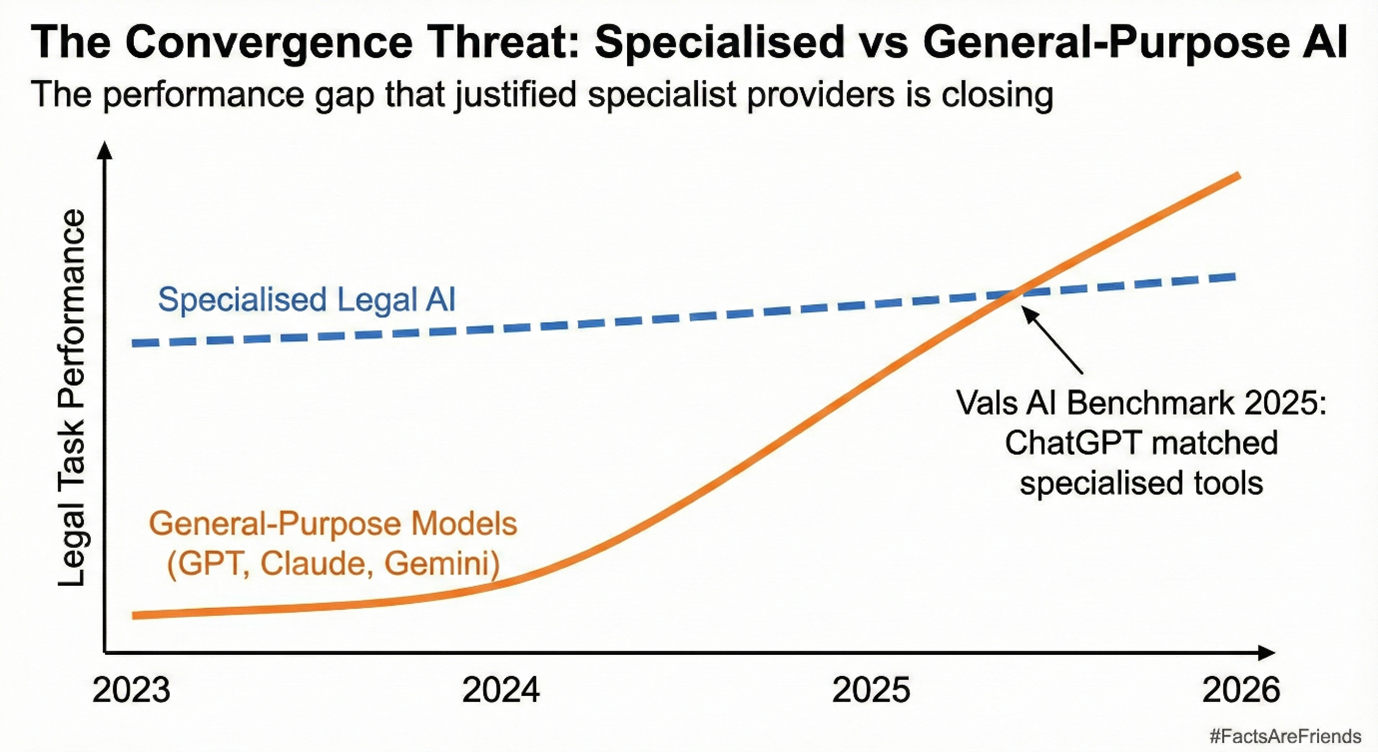
While legal-specific platforms refine their offerings, foundational models are improving at an extraordinary pace.
Multiple industry observers now predict that general-purpose models will outperform legal-specific variants. As the December 2024 Artificial Lawyer predictions noted:
“General-purpose AI models continue to advance at an incredible pace and, contrary to some early opinions, are nearly certain to outperform fine-tuned or specialized legal models. This trend will raise serious questions about the necessity of domain-specific training”.
The evidence is already emerging. The Vals AI legal research benchmark, released in late 2025, evaluated specialised legal AI tools against ChatGPT across accuracy, authoritativeness and appropriateness criteria. Contributing law firms included Reed Smith, Fisher Phillips, McDermott Will & Emery, Ogletree Deakins, Paul Hastings and Paul Weiss.
The results were striking: ChatGPT performed almost as well as the specialised legal AI tools and outperformed the human lawyer baseline across all three criteria.
Every single AI tool beat the human baseline. But the gap between specialised legal AI and general-purpose ChatGPT was marginal.
Perhaps more telling: when legal research was carved out for this separate study, market leaders including Harvey, CoCounsel from Thomson Reuters, Vincent AI from vLex and Lexis+AI chose not to participate. When the biggest players decline transparency in benchmarking, it raises questions about what the results might have shown.
The dominance of general-purpose tools is already evident. The ABA’s 2024 Legal Technology Survey found AI adoption among lawyers nearly tripled year-over-year, from 11% in 2023 to 30% in 2024. Among firms using or considering AI, ChatGPT is the most popular solution at 52%.
Smaller firms show even stronger preference for general-purpose tools - 64% for firms with 2-9 attorneys compared to just 36% for firms with 100+ attorneys. The implication is significant: smaller firms without budgets for Harvey or Legora are going directly to foundational models. They are achieving adequate results for a fraction of the cost. As these models improve, “adequate” becomes “excellent” - and the case for expensive specialist middleware weakens further.
The Commoditisation Acceleration
Several recent developments suggest commoditisation is accelerating faster than anticipated.
OpenAI’s AgentKit enables visual creation of multi-agent workflows without coding. Legal tech companies and law firms can now design, version and deploy agents with substantially reduced technical barriers. If this interface proves as user-friendly as promised, firms might start building their own agentic tools. DIY legal automation could become reality.
Juro’s direct ChatGPT integration cuts out the middleman entirely. Customers can now connect their workspace directly to ChatGPT and ask natural language questions about their contracts. As Juro’s State of In-house report notes, more than 90% of in-house lawyers already use ChatGPT, Gemini or Claude. Instead of building another proprietary interface, Juro is plugging into the tools lawyers already use.
Three Points, launched by two ex-Mishcon de Reya partners, demonstrates the new model. This AI-first law firm integrates Legora and Qanooni platforms from day one - not building proprietary AI, but assembling best-in-class components. As co-founder Tom Murray explains: “As a new firm born in the AI era and unencumbered by legacy systems, we can deliver work faster, be more efficient and collaborate effectively”. They are building a law firm around commodity AI capabilities, not investing millions in proprietary technology. And presumably they have retained flexibility to jump from Legora to any other provider or model at any time.
Three Points is not alone. A new breed of competitor is emerging that renders the traditional law firm model obsolete from inception – these firms are being termed “AI-native”. A phrase which has slipped into the market without a common definition. As I see it, these AI-native firm build workflows, staffing and economics around AI as the primary engine of production, with humans supervising and exercising judgement. They flip the approach of traditional firms - rather than facilitating humans to use AI as an add-on (which is what traditional firms are doing), these AI-native firms use humans to supervise the AI. They do not claim to replace all lawyers, but to redesign the bottom of the “pyramid”. At least that I show they are starting. Over time, their drive to efficiency will cause the redundancy of many more lawyers.
Here are some examples.
Eudia, backed by $105 million in venture funding, launched “Eudia Counsel“ in September 2025 - what it calls the world’s first AI-augmented law firm. Operating under Arizona’s Alternative Business Structure rules, Eudia serves Fortune 500 clients including DHL, Duracell, Stripe and Airbnb. Its CEO Omar Haroun states the mission bluntly: “Most legal departments have lost control of their budgets and their knowledge“. Critically, Eudia’s platform builds a proprietary “Brain“ for each client - capturing strategic context, legal preferences and institutional knowledge that compounds with every engagement. Unlike Harvey and Legora, Eudia is capturing and retaining client-specific knowledge.
Covenant, founded by former WilmerHale partner Jen Berrent and ex-CVC head of legal Richard Perris, raised $4 million to build what they call a “hybrid AI law firm“. The key insight: leverage comes from technology, not associates. As Berrent describes it, Law Firm 2.0 means “the deconstruction of the services a law firm provides and the reconstruction of those to create a law firm that uses new approaches and leans on technology“.
Crosby raised $20 million in Series A funding with Sequoia and Cooley investing - another hybrid AI law firm placing AI at the centre of service delivery.
JustPoint has raised $95 million to use AI for mass tort case discovery, operating its own Arizona-based law firm. It has brought 13,000 claims across six mass torts with an average settlement of $355,000 per claimant.
In November 2025 Blackstone invested $50m in Norm Ai, bringing total funding to $140m in two years.
The pattern is unmistakable. New entrants are building legal businesses around AI capabilities from day one. They have no legacy systems to maintain, no partnership structures to navigate, no billable hour culture to overcome. They price on value, not time. They leverage technology, not associates.
Traditional law firms face a choice: transform or be outcompeted by organisations that were never constrained by the old model.
And if the AI-ntaive firms do not eat the traditional firms’ lunch, then don’t forget that the foundational models are not showing any sign of leaving the legal space alone. But, as we shall see, the real threat (to the traditional and AI-native firms, as well as the Legal Tech platform providers currently in the ascendency) is from a different angle altogether.
The Real Losers
Law firms are hiring Chief AI Officers. Investing millions in Harvey and Legora. Building custom workflows and playbooks. These people and strategies are expensive. Are these “ahead of the curve“ firms leading or bleeding?
The answer depends on who captures value from legal AI. And the uncomfortable truth is that it does not look set to be the law firms themselves.
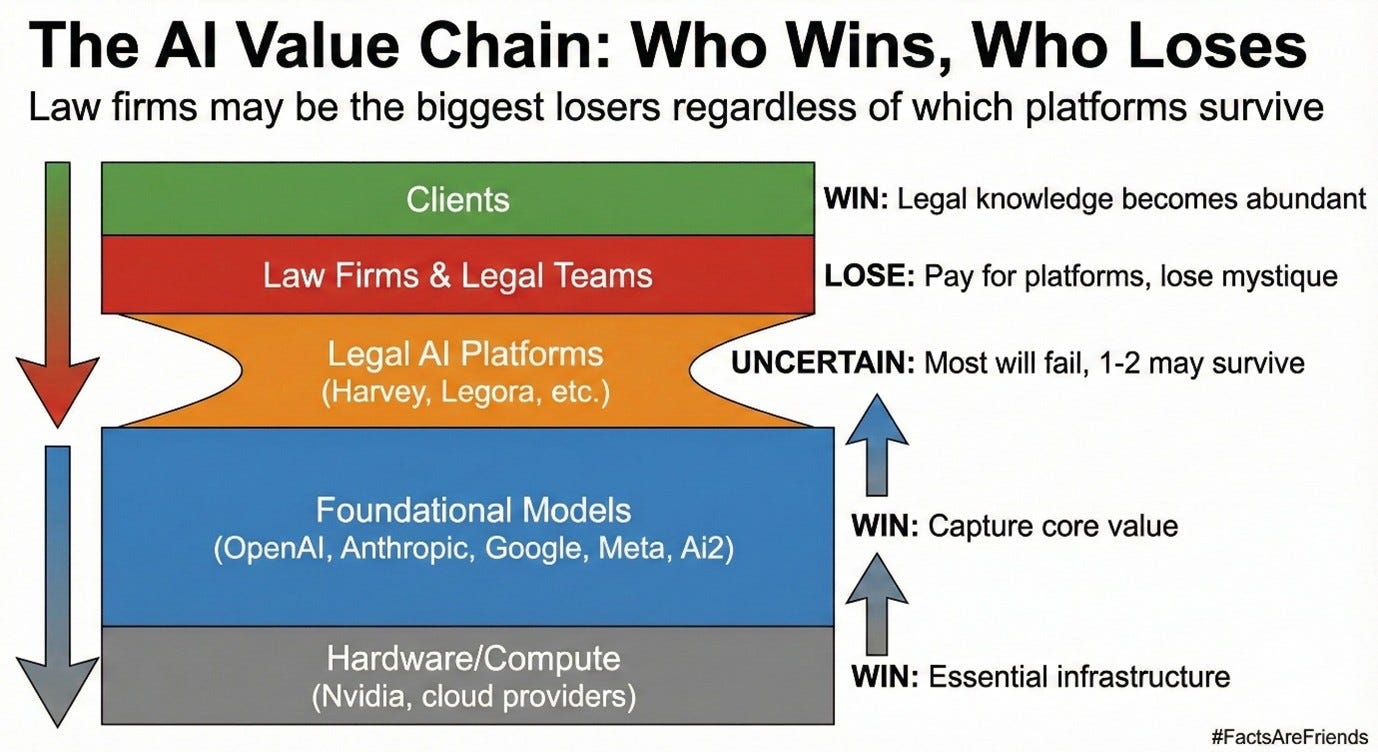
Here is the value chain:
Foundational model providers (OpenAI, Anthropic, Google, Meta, Ai2) capture the fundamental capability improvements. Every advancement in reasoning, context handling and knowledge integration benefits all downstream applications.
Legal AI platforms (Harvey, Legora) add value through legal-specific fine-tuning, workflow integration, compliance features and customer relationships. But they are dependent on foundational model providers for their core capabilities.
Law firms pay for subscriptions, upload their expertise and train their lawyers to use these tools.
Clients learn that legal analysis can be delivered faster and cheaper. They adjust their expectations permanently.
The foundational model providers win regardless. The legal AI platforms may or may not survive - at 80x multiples, it is likely that most investors will lose money when consolidation comes and only one or two platforms remain. Law firms will have paid for tools that they do not control and cannot take with them.
And clients? Clients learn that legal knowledge is abundant. They will find ways to access it directly. The question is not whether this happens, but when.
The Profit Paradox
Law firms expected AI to be a goldmine. The data now suggests it may be a drain.
In 2023, 69% of top UK law firms believed AI would increase revenue and margins. By November 2025, that figure had collapsed to just 31%. The PWC Law Firm Survey tells the same story: 67% of Top 10 firms now anticipate negative revenue or margin impacts from AI - up from just 17% in 2024.
Clients seeing the inefficiency don’t want to pay for it. They expect the cost savings from AI to be reflected in their bills. This creates a structural trap. Law firms invest in AI to become more efficient. Efficiency means the same work takes fewer hours. Fewer hours means lower bills - unless rates increase proportionally. But clients, knowing that AI has reduced the firm’s costs, resist rate increases. The efficiency gains flow to clients, not to firms.
The client dynamics reinforce this pressure. General Counsels now review cost reduction KPIs daily. Dutch auctions for legal work are increasing. Clients expect not just efficiency but visibility into how technology drives that efficiency. They want lawyers who understand the financial advantages derived from AI - and who pass those advantages through.
The relationship dynamics are shifting toward what industry observers describe as “entirely controlled by clients“. In this environment, any law firm that achieves AI efficiency but maintains traditional billing simply transfers that efficiency to profit margin - and clients notice.
The billable hour, long the foundation of law firm economics, has created a misalignment of interests that AI now exposes ruthlessly. When a firm bills by the hour, any tool that reduces hours reduces revenue. The better the AI, the worse the economics - unless the business model changes.
The data is unambiguous. The majority of law firms that once saw AI as an opportunity now see it as a threat to their margins. They are right - but only if they refuse to change. AI is forcing a correction that has been overdue for decades. The future lies not in billing for time, but in demonstrating and pricing value.
The Real Threat: not Harvey, but Accenture
As I wrote this essay and considered the lawyers’ mental masturbation of whether Harvey is sufficiently accurate for legal research, it occurred to me that a different threat is emerging from an unexpected direction.
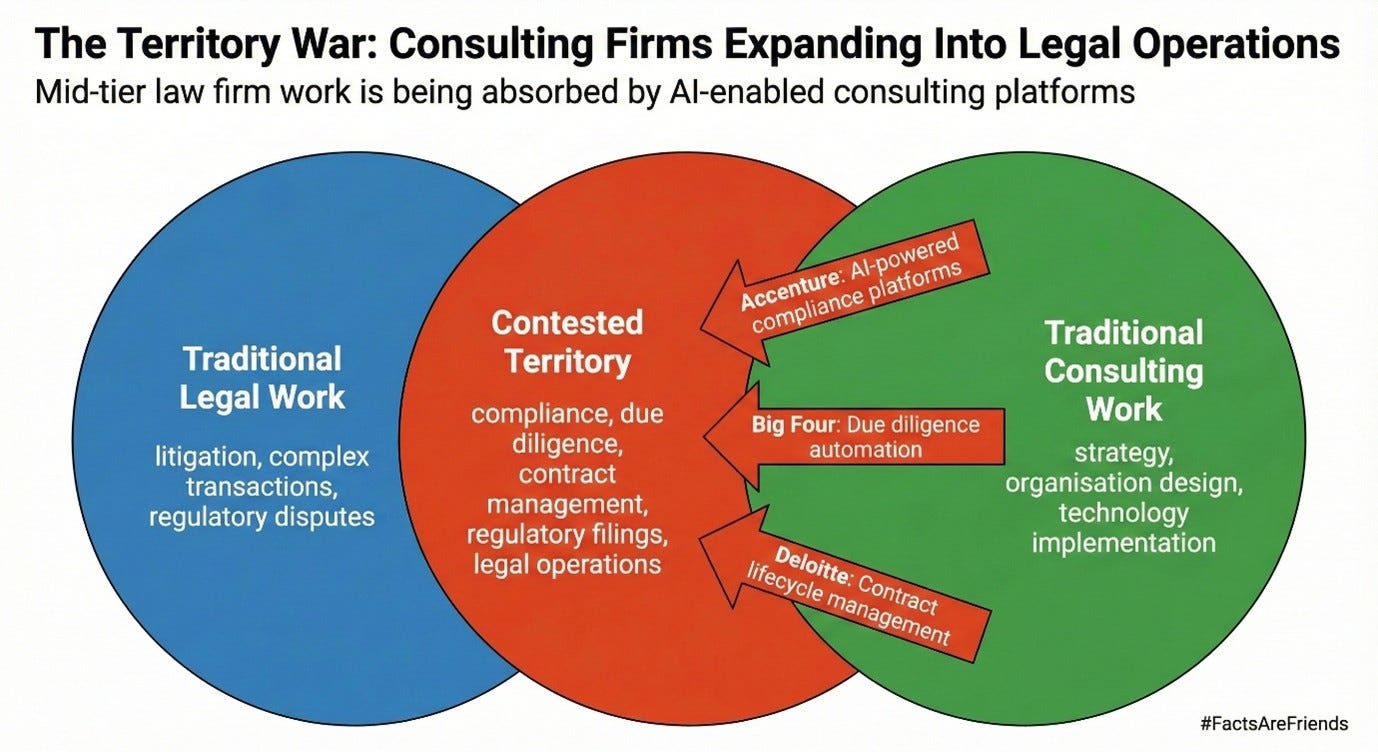
Accenture, Deloitte, PwC, EY and KPMG are not building legal AI to help lawyers draft better documents. They are building AI agents that perform entire legal operations functions - bypassing the need for a law firm to “advise” at all.
An interesting trajectory appears if you look for it:
Regulatory compliance: Previously, a company facing new regulations would engage a law firm to advise on requirements, draft policies and review implementation. Now, the Big Four are building AI-powered compliance platforms that continuously monitor regulatory changes, automatically update policies, flag gaps and generate audit-ready documentation. The law firm’s role shrinks from trusted adviser to occasional validator.
Due diligence: M&A due diligence once generated millions in law firm fees - associates reviewing thousands of documents, partners synthesising findings. Accenture and the Big Four now offer AI-powered due diligence platforms that review contracts at scale, flag risks automatically and produce standardised reports. The legal review becomes a commodity add-on to their broader transaction services.
Contract lifecycle management: From negotiation through execution to renewal, contracts once required continuous legal involvement. AI-powered CLM platforms - many built or acquired by consulting firms - now manage entire contract portfolios, automatically identifying renewal dates, flagging non-standard terms and suggesting negotiation positions based on market benchmarks.
The consulting firms are executing a strategic pivot from “Strategy” to “Operations.” They are eating the bread-and-butter work that sustained mid-tier law firms for decades: compliance programmes, due diligence reviews, contract management, regulatory filings.
BCG generated $2.7 billion in AI revenue in two years. Accenture plans to reach 80,000 data and AI professionals by 2026. Bain equipped 13,000 consultants with ChatGPT Enterprise. These firms are deploying AI at a scale that dwarfs legal AI investment.
Lawyers are relaxed that Harvey is not stealing their drafting. They should be worried about Accenture stealing their clients’ entire legal operations departments.
The threat to lawyers is not that AI will write contracts instead of associates. The threat is that clients will conclude they do not need a law firm for compliance, for due diligence, for contract management - because their consulting partner already handles it, faster and cheaper, with AI baked in.
Harvey competes with lawyers for legal work. Accenture competes with law firms for client relationships. One is a tool that might reduce fees. The other is an alternative that might eliminate the engagement entirely.
When a General Counsel faces budget pressure, they do not choose between Harvey and an associate. They choose between engaging a law firm at all - or letting their existing Accenture relationship handle it through an AI-powered platform that produces acceptable results at a fraction of the cost.
The consulting firms saw this coming. That is why McKinsey built Lilli on proprietary knowledge. That is why BCG invested billions in AI capabilities. That is why Bain partnered with OpenAI to build a Centre of Excellence.
They are not protecting their document production. They are protecting their client relationships and expanding their scope of work - into territory that law firms assumed was theirs.