 Facts are friends
Like many people, I feel the pull of safety in clear rules, trading the vulnerability of trust for the false security of rigid codes.
This was brought into sharp focus by a talk James gave at Saltisford Church recently.
It is all about perspective
James used an old Guardian advertisement to illustrate a profound truth about faith.
The advert showed a young man in rough clothing who appears to be violently pushing a businessman. Then the camera pulls back and reveals that he is actually saving him from falling debris. The voiceover says:
“An event seen from one point of view gives one impression.
Seen from another point of view, it gives quite a different impression.
But it’s only when you get the whole picture you can fully understand what’s going on.”
James used this to illuminate a simple but demanding idea: we make judgments based on the limited perspective we have.
We see the young man pushing the businessman and are confident we understand. We do not. We have judged without seeing the full picture.
Faith invites us to recognise that we do not see the whole picture, but requires us to trust that God sees what we cannot, knows what we cannot and works in ways we cannot control. If we accept faith, we surrender ultimate control. That is a tough call.
Code and commandments
James spoke about the Pharisees who condemned Jesus.
The Pharisees were the “Magic Circle” partners of first-century Judea – elite practitioners with intricate knowledge, high status and a belief in the system they had built. They had codified 613 commandments, creating a detailed operating system for righteousness. They believed that executing the code that they had curated provided perfect safety. They prioritised the Torah (or at least their interpretation of it, which I think of as the “Law”) above all else.
The Pharisees’ fault was not law-keeping; their fault was making their Law (their interpretation of the Torah) the substitute for faith.
Torah means “instruction” or “guidance” as much as it means “law”. It was always meant to provide wisdom for navigating situations it did not explicitly address. The Pharisees, as experts, believed they could extend and codify that guidance to cover every conceivable scenario: they created their own Law, based on the Torah. Their aim was protective: if they created comprehensive rules, ordinary people could not get it wrong.
But in building that system, they lost sight of God’s crucial instructions to focus on motivation and attitude, not just behaviour.
Love, compassion, mercy - these are matters of the heart. They cannot be measured from the outside. I can observe whether someone attends church or follows dietary laws. I cannot observe whether they love. God can.
When we assess from outside - when we police compliance rather than nurture hearts - we substitute visible behaviour for invisible transformation. We become gatekeepers rather than shepherds. We can check boxes and apply rules mechanically, but doing so assumes the rules are right for every situation and that we can know the full picture. It treats our interpretation as absolute, rather than seeking God’s heart and purpose.
Some of us today may fall into this trap. We become preoccupied with rules, boundaries and institutional identity, signalling virtue through correct behaviour while missing the real purpose. We live by what we see as the letter of the law preferring that over the spirit of the law.
Clinging to rule-based certainty drives a wedge in our hearts between us and God. God remains faithful, but we draw away.
Jesus taught us to love, and we fail when we prioritise our interpretation of any other Law over love.
The craving for certainty
The uncomfortable truth is that people like certainty. Uncertainty creates fear and anxiety. In our chaotic world, clear rules feel like safety. In a complex moral environment, boundaries feel like guidance. We want confidence and assurance that we are getting things “right”.
But there is a crucial distinction here, and it matters.
Healthy Christian conviction is trust rooted in Christ – confidence in the resurrection, the incarnation, the Gospel and loving God. These are relational and lived convictions, reflecting the call to live in love.
Fear-driven certainty in religion works differently. Instead of trusting, it seeks control. Rather than walking faithfully within ambiguity, it tries to eliminate it entirely. It builds systems of “shame” and “should” to banish vulnerability, attempting to use fear to beat fear. Living in fear is living without love; it is lonely and unsatisfying.
Of course, it is simplistic to assume we fall in one or other camp. Many (most) of us straddle both these convictions and fears, sometimes at the same time - we want to trust in God whilst feeling the human need to remain in control. I have little doubt that many Pharisees lived in love, but that love was tempered by their need to control their understanding of the Torah. It was that fear-driven desire for certainty that shaped their response to Jesus.
The Pharisees aimed, almost certainly with good intentions (perhaps tinged with a desire to retain their status), to provide clarity where God had left space for people to make their own application of His wisdom to their own specific circumstances. They insisted on their interpretation of the rules substituting trust and faith in God, and it was their reliance on that substitution that led them astray. .
Faith, as James explained, is about living in the space of uncertainty with trust, hope and relationship. Faith allows love, compassion and forgiveness to prevail over rules, dogma and tradition.
Our need for certainty leads to our, human, judgement. And our judgement displaces love and introduces shame. In contrast we are taught that “Perfect love drives out fear” (1 John 4:18). Living in love does not shame ourselves or others, but honours and promotes.
The blind man and the incomplete picture
James used Chapter 9 of John’s Gospel, to reveal the danger of certainty. Jesus heals a man born blind. But because it happens on the Sabbath (and the Torah prohibited work on the Sabbath), the Pharisees saw only one perspective: a breach of their code. Having codified the Torah to help others they were blind to any interpretation that challenged their own. They saw Jesus’ act as dishonouring God, and sought only to impose the rules that they understood God had imposed in giving the Torah.
They interrogate the healed man. They summon his parents. They treat the miracle as a threat to their understanding of God’s system. Their certainty blinds them to what God is doing.
The man’s response is simple:
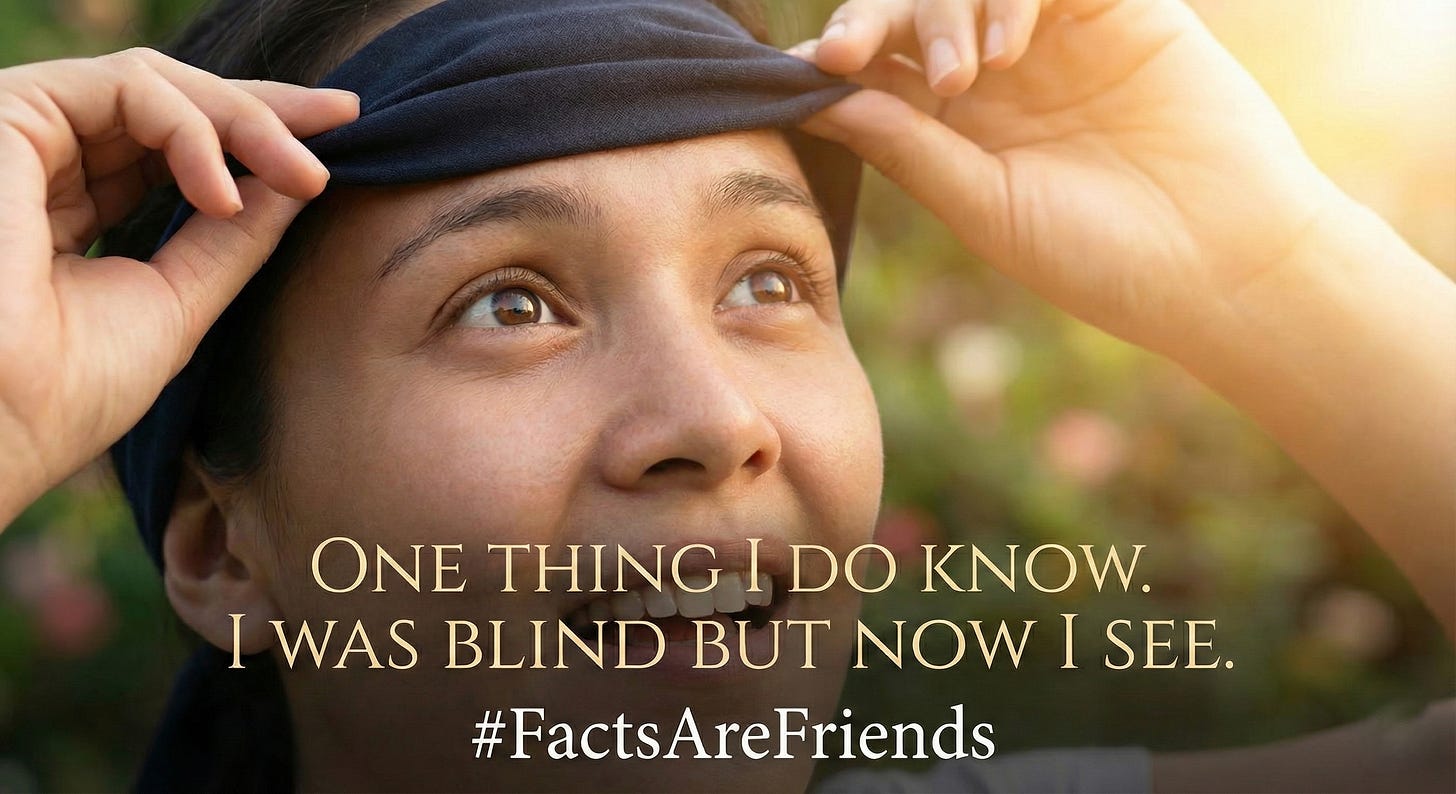
“One thing I do know. I was blind but now I see!” (John 9:25).
He admits what he does not know whilst holding firmly to what he does. He trusts his encounter with Jesus. He accepts partial understanding. He is content to live with faith rather than crave certainty.
The Pharisees cannot do this. Their fear of being wrong, their pride in their system and their reliance on rigid categories prevent them from recognising what is in front of them.
They judged with condemnation because they believed judgment was their job. It was not.
Our patterns
Do our lives today echo the Pharisees’ pattern? Do we cling to systems that offer psychological safety? Have you experienced fellowship where individuals:
split over worship styles or musical preferences,
rely on different translations of the Bible as markers of belonging (I enjoy the Message, others insist it is an interpretation not a translation - I feel judged, they feel justified),
form small groups around “political alignment” (dogma), rather than spiritual growth?
None of these are malicious. They are simply the places where preference becomes identity, and identity becomes boundary. And sometimes boundary becomes judgment. And our judgment may lead to division and shame but not love.
The problem is not conviction. Christian faith has core convictions. The problem is the craving to eliminate ambiguity, believing that we have the capacity to know the right answer and to legislate for every circumstance. In our desire to honour God with logic we design systems that maintain control. Honouring God is so much simpler: it is loving.
Fear-driven certainty may lead to rules being elevated above compassion or theological correctness being valued above tangible transformation. Sometimes change which is in a person’s life is overshadowed because it does not fit within the perceived rules. The facts are there, but the rules do not accommodate them.
This is the fear-driven pattern: craving control, resisting uncertainty, substituting certainty for trust.
Love and limitation
We all share some love, but not always. We may notice our own spiritual criticism, but we may also celebrate our genuine love. Many Christians display love, humility and deep trust. They show that faith thrives in truly trusting God (certainty in Him not our interpretation of his rules). When we live in love we live out the call to compassion.
And when we critique others (whether in analysing them or criticising them) we are implementing our own systems, exercising our own shibboleths: seeking to satisfy our own needs to be “right”. This Pharisaic impulse is human. The desire for certainty cuts across every group; appears whenever fear tempts us to cling to control.
The distinction between certainty and faith cuts to the heart of how we live as Christians. In faith we recognise that we may never see the whole picture, but we trust in God without seeking to colour in the grey areas.
What Jesus requires
Jesus invited the Pharisees to trade their certainty for faith. To recognise that they did not have the whole picture. To understand that their detailed legal code could not substitute for relationship with Him.
He asked them – and asks us – to let love displace fear: to stop doing God’s job of judgment and focus on our job of love.
When asked about the greatest commandment, Jesus did not point to doctrinal precision. He said: love God and love your neighbour (Matthew 22:37-39). Everything else hangs on these.
The question for us
The better question is personal: where is this impulse in me? Where do I crave certainty when Jesus calls me to faith? Where does fear lead me to pride in my understanding? When do I judge based on one angle, forgetting I do not see the whole picture?
The Pharisees tried to honour God. Their intentions were doubtless good. But in their hunger for certainty, in their fear of uncertainty, in their pride in their system, they missed the core call: to love God, to love others and to trust Him with judgment.
Can we say, with the healed man’s honesty, “One thing I do know. I was blind but now I see”?
Can we choose faith over certainty, love over fear, compassion over judgment?
Because in the end, what drives out fear is not certainty. It is love.
Hear James’ talk (The man born blind tells the Pharisees - 23 November, 2025).
Read the story of the blind man being healed.