 Facts are friends
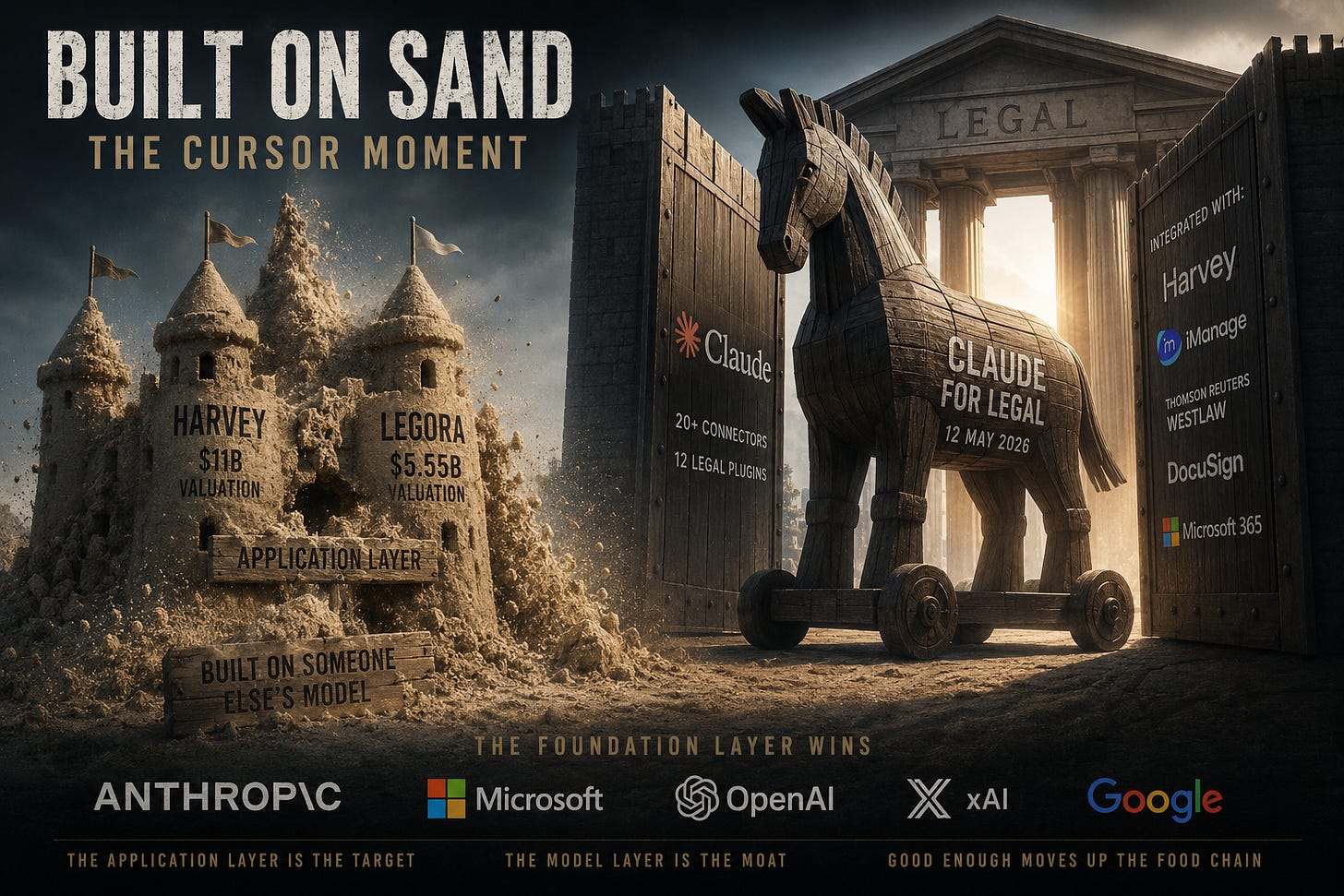
#FactsAreFriends | #TrojanHorseDebate | #BuiltOnSand
Last month, SpaceX secured the right to acquire Cursor - the AI coding assistant built by Anysphere - for $60 billion. A company valued at $2.5 billion in early 2025 became a $60 billion acquisition target in fifteen months.
The tech press called it a triumph. Cursor’s founders were celebrated. And in one sense, rightly so.
But watch carefully. The same story is about to play out in legal. And the second time around, perhaps fewer people will be celebrating?
The Cursor parallel - and what it really means
Cursor was an extraordinary product. It took the AI coding market by storm, accumulated $2 billion of ARR at a pace that has no precedent in enterprise software history, and counted over half the Fortune 500 as customers. Its valuation rose from $2.5 billion in early 2025 to nearly $30 billion by the end of that year.
Then Anthropic launched Claude Code.
This is the part of the Cursor story that most of the coverage has airbrushed. Claude Code launched in May 2025 - quietly, as a research preview - built on the same foundation models that Cursor was itself dependent on and paying Anthropic to access. The asymmetry was brutal from the outset. Cursor paid retail for Anthropic’s model inference. Anthropic got wholesale. As one venture capitalist told Fortune: “Anthropic is trying to drown out Cursor”.
The market responded with speed that surprised even its architects. Claude Code awareness rose from 31% in April-June 2025 to 57% by January 2026. By late 2025, it had overtaken both Cursor and GitHub Copilot as the most-used AI coding tool among professional software engineers. It had overtaken GitHub Copilot - on the market since 2021 - within just eight months. The “Cursor is dead” narrative began circulating on social media in February 2026. As Zach Lloyd, CEO of coding competitor Warp, observed: “The IDE is dead. That’s just not how software is being built now”.
Cursor was not, in fact, dead. But it was cornered.
To escape its dependency on Anthropic’s models, Cursor began building its own - the Composer model, launched November 2025. Training and maintaining frontier-level models are astronomically expensive endeavours, requiring technical talent that is hard to find outside OpenAI and Anthropic. Cursor was now spending heavily to compete with the very infrastructure provider it had been built on top of.
It was in this context - squeezed on pricing by its own foundation model provider, losing satisfaction rankings to Claude Code, and burning capital to build model independence it could not easily afford - that Cursor sought strategic alignment with SpaceX and xAI. In April 2026, xAI announced a deal giving it the right to acquire Cursor for $60 billion, or to pay $10 billion for joint development work. The $10 billion is guaranteed regardless of whether the full acquisition proceeds - a detail that tells you everything about the negotiating position Cursor brought to the table.
The $60 billion headline number is real. But it is not the whole story. Without xAI’s intervention - without compute, capital and a strategic parent able to match Anthropic’s model economics - Cursor’s independent trajectory was deeply uncertain. The SpaceX deal did not crown a winner. It rescued a platform that the foundation model beneath it had been systematically under pricing.
This is the Cursor parallel. Not the triumph. The trap - and the rescue.
Now look at Harvey and Legora, and ask yourself how different their position really is.
Harvey and Legora’s position
Harvey raised $200 million in March 2026 at an $11 billion valuation. Legora raised $550 million at $5.55 billion, backed by Accel, Benchmark, Bessemer, General Catalyst and Y Combinator. Together they carry combined enterprise valuations north of $16 billion. By any conventional measure, these are serious businesses with serious investors behind them.
Their shareholders are not necessarily facing a catastrophe. If either platform is acquired - and the logic of the Cursor parallel suggests that is the more likely outcome than independent survival - the question is simply whether full value is paid. The Cursor deal demonstrates that where a foundation model provider has strategic reasons to own the application layer, it will pay a premium to do so. Harvey’s domain-trained feedback loops, its thousands of law firm relationships, its benchmarking architecture: these are assets. Legora’s enterprise security infrastructure, its legal engineering team of former practicing lawyers, its workflow deployment capability: these are assets too. They do not disappear because the model underneath has moved.
A well-priced acquisition of either platform could be a very good outcome for their shareholders.
That is not the problem.
12 May 2026
On 12 May 2026, Anthropic launched Claude for Legal.
Twenty MCP connectors. Twelve practice-area plugins. Coverage from commercial counsel to M&A diligence, from employment to privacy, from litigation associate to bar prep. Integration with DocuSign, iManage, Thomson Reuters’ Westlaw and Microsoft 365. A litigation associate plugin handling deposition prep, chronology building and brief drafting. A corporate counsel plugin for M&A closing checklists and board functions. A law student plugin for case briefing, outline building and bar prep. We have not seen it working in earnest yet, but the runes are strong. Going by what Anthropic has previously heralded and then delivered, they will not have oversold themselves with this.
This is a classic Anthropic move. They have a great large language model. What they’ve really learned to do is embrace the other technology that LLMs are less good at displacing. It embraces those technologies and incorporates them so as to deliver a true solution rather than just hope.
It seems what was announced on May 12, 2026, was not a research preview, but a product launch.
And Anthropic said, without diplomatic softening, that legal is now the top power-user job function inside its Cowork platform.
The Trojan Horse has not merely entered the city. It has opened.
Harvey and Legora have both confirmed they are built on Claude’s underlying models. They are, as I have argued throughout this series, paying rent to their landlord to compete with their landlord. On 12 May 2026, the landlord posted a new sign on the door.
What the CEOs said
Both Winston Weinberg, CEO of Harvey, and Max Junestrand, CEO of Legora, responded publicly on LinkedIn on the day of the announcement. Their posts are worth reading with care - not for what they assert, but for what the assertions reveal.
Weinberg described the Claude for Legal launch as something that “validates what we have long believed”. He pointed to Harvey’s feedback loop - thousands of law firm partnerships, task-level benchmarking, domain-specific training signals - as the source of durable differentiation. The argument is that Harvey improves Claude at the task level, and that general models cannot replicate that accumulated signal.
Junestrand was similarly measured. He acknowledged that “LLMs are necessary to power this work, but insufficient on their own”, and pointed to enterprise-grade security, ethical walls, confidentiality architecture, auditability and a large team of legal engineers - former practicing lawyers - as the layer that turns a horizontal model into a production-ready vertical system.
These are not empty arguments. The feedback loop is real. Legal engineering is real. EU data residency compliance and AI Act conformity assessment are real regulatory requirements that do not disappear because Anthropic has launched a plugin.
But read the structure of both responses carefully.
Both CEOs welcomed the launch. Both framed it as validation rather than threat. Both pivoted immediately to the layer above the model - domain training, enterprise security, human expertise - as the source of value that Claude for Legal cannot replicate.
This is the defensive pivot of a platform that knows it is dependent on its supplier and is making the best possible case for why that dependency does not define its fate.
Paul Giguere, a former Harvey employee, was more direct: “The first mover advantage Harvey once had is gone”.
Dillon Harindiran, CEO of Counsel, was more direct still. Having built his own context layer and run direct comparisons, he stated that Claude with full contextual awareness outperforms Harvey - and that paying customers have confirmed it.
Matt O’Brien, CEO of SnowCrash Labs, put it in four words on Junestrand’s thread: “Anthropic is becoming a competitor”.
He is right. And I said so.
For those familiar with my essays, you will know that I recently published the Data Giants Dilemma. That essay heralded that RELX or Thomson Reuters would be embedded within a foundational model.
Well, now we see it’s happened.
The feedback loop problem
Weinberg’s feedback loop argument deserves a direct answer, because it is the most sophisticated defence Harvey has offered.
The argument runs as follows: Harvey has accumulated years of task-level signal from thousands of law firms. Those signals improve model performance at the legal task level. That accumulated knowledge is proprietary and not replicable by a general-purpose model provider entering the market.
There is something in this. Domain-specific fine-tuning matters. Legal benchmarking on tasks that actually arise in practice is more valuable than generic capability evaluations.
But the argument has a structural flaw.
When Harvey uses those signals to improve Claude at the task level, who owns the improved model? Anthropic does. The training relationship runs upward, not downward. Harvey is, in this formulation, a very sophisticated data provider feeding signal to the foundation model it depends on. The better Harvey makes Claude for legal tasks, the more capable Claude for Legal becomes. The feedback loop, on close inspection, runs in both directions - and one of those directions is not in Harvey’s favour.
As noted elsewhere, in the same way that Harvey and Logora were Trojan horses in the lawyer’s citadel, Anthropik’s models were in theirs.
This is the embedded judgement problem I have written about previously. The conditions that made specialist legal AI platforms valuable - deep transactional immersion, accumulated signal, workflow integration - are precisely the conditions that also make them useful teachers for the foundation model that will eventually displace them.
The real losers
Harvey’s and Legora’s shareholders, as I have said, may yet do well. Some may do better than others. There will be a peak time to exit, and a trough after that, which allows for a long period of regret. Others within the broader ecosystem may not fare so well.
The mid-tier players - the document review tools, the contract analytics platforms, the workflow automation products - have spent three years and tens of millions of dollars getting into the legal AI market. They entered a market they believed was defined by legal workflow expertise and enterprise integration. They built products on top of foundation models they did not own, serving customers who were simultaneously being targeted by those same foundation models.
12 May 2026 makes their position very difficult to defend. When Claude itself offers commercial counsel review, M&A diligence support and litigation chronology building - out of the box, to every paying Cowork customer - the market for standalone tools doing precisely those things does not contract gradually. It collapses.
My belief is that legal will be offered as a utility packaged alongside the tokens we buy from Anthropic. Then Microsoft or XAI will deliver the same. The scarcity will disappear, and the value piece previously secured by the lawyers will be reduced.
Stephen Dowling SC, a Senior Counsel and founder of TrialView, put the competitive question cleanly in the thread: “What will win? The AI that provides ‘good enough’ across a wide spectrum or the AI that delivers exceptional results in a narrow but lucrative field?”
It is the right question. And regular readers of this series will know my answer.
Good enough is not staying where it is. Good enough is moving up the food chain. And on 12 May 2026, good enough arrived in the mid-market wearing a suit and carrying a briefcase.
The wildcard
None of this should lead anyone to assume the outcome is settled.
Microsoft is not sleeping. Copilot is already embedded in Word, Outlook and Excel - exactly where legal professionals spend their working lives. Microsoft has announced a legal-specific AI agent for Word with redlining capabilities. The integration between Microsoft’s existing enterprise dominance and an AI legal layer is, in distribution terms, formidable. Every law firm’s favourite vendor already has the keys to the front door.
OpenAI has the brand, the reach and the resources to enter legal directly, as it has entered coding with Codex. xAI - emboldened by its Cursor play and sitting on a million H100-equivalent chips at Colossus - is not going to watch a $160 billion global legal market pass without interest. Google’s Gemini, deeply embedded in enterprise infrastructure, is watching the same market.
xAI has been quietly building a colossal legal library and hiring lawyers as though it were going out of fashion, certainly more than any standard business would need.
The legal AI market is not moving towards an Anthropic monopoly. It is moving towards a foundation-model oligopoly, in which the application-layer specialists will be squeezed from above by infrastructure providers and from below by vibe-coders who need no intermediary at all.
The question for Harvey and Legora is not whether this is coming. The question is which foundation model - Anthropic, Microsoft, OpenAI, xAI or another - decides their platform is worth acquiring rather than displacing. And whether that decision arrives before or after the renewal cycle tells the story the current valuations are papering over.
The thesis holds
Throughout this series I have argued that the valuations of the legal AI platforms rest on assumptions that do not survive scrutiny: no network effects, declining switching costs, commoditising workflows, and a structural dependency on foundation models that could - and eventually would - enter the market directly.
On 12 May 2026, “eventually” became “now”.
The CEOs of both Harvey and Legora responded to that day with dignity and with the best available arguments for their platforms’ durability. I do not doubt the quality of their execution. Legora’s platform is real. Harvey’s feedback loop is real. The legal engineering teams on both sides are real.
But execution quality and valuation sustainability are different questions. And it is the second question - not the first - that a $16 billion combined valuation requires answering.
For their shareholders, the question is no longer whether the platforms’ independence is sustainable. The question is whether they exit at full value before the market reaches the same conclusion their cap tables already imply.
That is a question for their advisers.
The broader question - who bears the real cost when the foundation model arrives in the market it was powering from below - was always the more important one.
We have our answer.
Quentin Solt is a senior commercial solicitor, co-founder of Eurovestech and a strategic adviser on legal technology and AI. He writes on Substack at FactsAreFriends.
#FactsAreFriends #BuiltOnSand #TrojanHorseDebate #LegalTech #AI #Harvey #Legora #Anthropic
Sources
Section 1 - The Cursor parallel
SpaceX/xAI secured the right to acquire Cursor for $60 billion
Wikipedia (Anysphere): https://en.wikipedia.org/wiki/Anysphere
Fortune: https://fortune.com/2026/04/22/spacex-strikes-60-billion-deal-cursor/
Yahoo Finance: https://finance.yahoo.com/markets/article/spacex-strikes-60-billion-deal-for-the-right-to-buy-ai-coding-startup-cursor-143350832.html
CNBC: https://www.cnbc.com/2026/04/19/cursor-ai-2-billion-funding-round.html
Cursor valued at $2.5bn early 2025, ~$30bn by end 2025
Fortune (Cursor crossroads, 21 March 2026): https://fortune.com/2026/03/21/cursor-ceo-michael-truell-ai-coding-claude-anthropic-venture-capital/
Cursor $2bn ARR by February 2026
The Next Web: https://thenextweb.com/news/cursor-anysphere-2-billion-funding-50-billion-valuation-ai-coding
Tech Insider: https://tech-insider.org/cursor-60-billion-valuation-anysphere-ai-coding-2026/
Over half the Fortune 500 as customers
The Next Web (above): https://thenextweb.com/news/cursor-anysphere-2-billion-funding-50-billion-valuation-ai-coding
The $10bn guaranteed regardless of full acquisition
Tech Insider (above): https://tech-insider.org/cursor-60-billion-valuation-anysphere-ai-coding-2026/
Wikipedia/Anysphere (above)
Section 2 - Claude Code and the pricing trap
Claude Code launched May 2025 on the same foundation models Cursor depended on
Fortune (Cursor crossroads): https://fortune.com/2026/03/21/cursor-ceo-michael-truell-ai-coding-claude-anthropic-venture-capital/
Claude Code Statistics 2026: https://www.gradually.ai/en/claude-code-statistics/
Claude Code awareness rose from 31% (Apr-Jun 2025) to 57% (Jan 2026)
uvik.net (JetBrains data): https://uvik.net/blog/claude-code-vs-cursor-vs-copilot-vs-codex-2026/
Claude Code overtook Cursor and GitHub Copilot by late 2025
Tech Insider: https://tech-insider.org/cursor-60-billion-valuation-anysphere-ai-coding-2026/
Claude Code Statistics: https://www.gradually.ai/en/claude-code-statistics/
Claude Code overtook GitHub Copilot (on market since 2021) within eight months
Claude Code Statistics: https://www.gradually.ai/en/claude-code-statistics/
“Anthropic is trying to drown out Cursor” (VC quoted in Fortune)
Fortune (Cursor crossroads): https://fortune.com/2026/03/21/cursor-ceo-michael-truell-ai-coding-claude-anthropic-venture-capital/
Cursor pays retail; Anthropic gets wholesale
Fortune (Cursor crossroads): https://fortune.com/2026/03/21/cursor-ceo-michael-truell-ai-coding-claude-anthropic-venture-capital/
“The IDE is dead” - Zach Lloyd, Warp
Fortune (Cursor crossroads): https://fortune.com/2026/03/21/cursor-ceo-michael-truell-ai-coding-claude-anthropic-venture-capital/
“Cursor is dead” narrative, February 2026
Fortune (Cursor crossroads): https://fortune.com/2026/03/21/cursor-ceo-michael-truell-ai-coding-claude-anthropic-venture-capital/
Cursor launched Composer model (November 2025) to reduce Anthropic dependency
Tech Insider: https://tech-insider.org/cursor-60-billion-valuation-anysphere-ai-coding-2026/
Fortune (Cursor crossroads): https://fortune.com/2026/03/21/cursor-ceo-michael-truell-ai-coding-claude-anthropic-venture-capital/
“Training and maintaining models of your own are astronomically expensive...”
Fortune (Cursor crossroads): https://fortune.com/2026/03/21/cursor-ceo-michael-truell-ai-coding-claude-anthropic-venture-capital/
Claude Code $2.5bn annualised revenue
Claude Code Statistics: https://www.gradually.ai/en/claude-code-statistics/
Section 3 - Harvey and Legora’s position
Harvey: $200m raise at $11bn valuation, March 2026; co-led by GIC and Sequoia; total capital over $1bn
Harvey press release: https://www.harvey.ai/blog/harvey-raises-at-dollar11-billion-valuation-to-scale-agents-across-law-firms-and-enterprises
TechCrunch: https://techcrunch.com/2026/03/25/harvey-confirms-11b-valuation-sequoia-triples-down/
Harvey investors: Andreessen Horowitz, Coatue, Conviction Partners, Elad Gil, Evantic, Kleiner Perkins
PRNewswire (above)
Legora: $550m Series D at $5.55bn valuation, 10 March 2026; led by Accel
Legora press release: https://legora.com/newsroom/legora-raises-550-million-series-d-to-fuel-us-growth
TechCrunch: https://techcrunch.com/2026/03/10/legora-reaches-5-55-billion-valuation-as-ai-legaltech-boom-endures/
CNBC: https://www.cnbc.com/2026/03/10/swedish-ai-legaltech-legora-hits-5-billion-valuation.html
Legora investors: Benchmark, Bessemer, General Catalyst, ICONIQ, Redpoint, Y Combinator (plus new investors)
Legora press release (above)
Legora tripled in valuation in five months
Tech Insider: https://tech-insider.org/legora-550-million-series-d-5-5-billion-valuation-harvey-ai-2026/
Harvey and Legora confirmed built on Claude’s underlying models
TechCrunch (Claude for Legal, 12 May 2026): https://techcrunch.com/2026/05/12/the-ai-legal-services-industry-is-heating-up-anthropic-is-getting-in-on-the-action/
Fortune (12 May 2026): https://fortune.com/2026/05/12/anthropic-legal-plug-in-release-claude-cowork-big-law/
Lawyard: https://www.lawyard.org/lawyard-spotlight/what-legoras-550m-raise-at-5-55bn-means-for-the-legaltech-industry/ (Legora “predominantly powered by Anthropic’s Claude”)
Section 4 - 12 May 2026: Claude for Legal
Full launch details (20 MCP connectors, 12 plugins, practice areas, integrations)
Artificial Lawyer: https://www.artificiallawyer.com/2026/05/12/claude-for-legal-launches-may-reshape-the-legal-tech-world/
LawSites/LawNext: https://www.lawnext.com/2026/05/anthropic-goes-all-in-on-legal-releasing-more-than-20-connectors-and-12-practice-area-plugins-for-claude.html
Fortune: https://fortune.com/2026/05/12/anthropic-legal-plug-in-release-claude-cowork-big-law/
Legal is top power-user job function in Cowork
Fortune (above): https://fortune.com/2026/05/12/anthropic-legal-plug-in-release-claude-cowork-big-law/
Anthropic’s earlier February 2026 legal plugin
Artificial Lawyer: https://www.artificiallawyer.com/2026/02/02/anthropic-moves-into-legal-tech/
Section 5 - What the CEOs said
Winston Weinberg (Harvey CEO) LinkedIn post, 12 May 2026
LinkedIn post
Max Junestrand (Legora CEO) LinkedIn post, 12 May 2026
LinkedIn post
Paul Giguere (ex-Harvey): “The first mover advantage Harvey once had is gone”
LinkedIn comment, visible in documents shared in this conversation (Weinberg thread).
Dillon Harindiran (CEO, Counsel): Claude outperforms Harvey with full contextual awareness
LinkedIn comment, visible in documents shared in this conversation (Weinberg thread).
Matt O’Brien (CEO, SnowCrash Labs): “Anthropic is becoming a competitor”
LinkedIn comment, visible in documents shared in this conversation (Junestrand thread).
Jacek Miczek (LEGAION): verification architecture, EU AI Act, data residency as regulatory moats
LinkedIn comment, visible in documents shared in this conversation (Antti Innanen thread).
Alexander Irschenberger: “In reality, both are Claude agents”
LinkedIn comment, visible in documents shared in this conversation (Antti Innanen thread).
Non-Billable (industry coverage of CEO responses)
Section 6 - Microsoft
Microsoft Legal Agent for Word launched 30 April 2026
Microsoft Tech Community (official announcement): https://techcommunity.microsoft.com/blog/microsoft365copilotblog/word-legal-agent-in-frontier/4516218
Artificial Lawyer: https://www.artificiallawyer.com/2026/04/30/microsoft-launches-its-own-legal-agent-for-word/
Legal IT Insider: https://legaltechnology.com/2026/05/01/microsoft-turns-up-to-its-own-fight-with-new-word-legal-agent/
Law.com: https://www.law.com/legaltechnews/2026/04/30/microsoft-launches-legal-agent-in-word/