 Facts are friends
The question that won’t go away
The debate about how to ensure that he disenfranchised and newly redundant are not marginalised and how new AI-generated wealth is distributed has moved from the academic fringe to the centre of UK policy discussion in a matter of weeks.
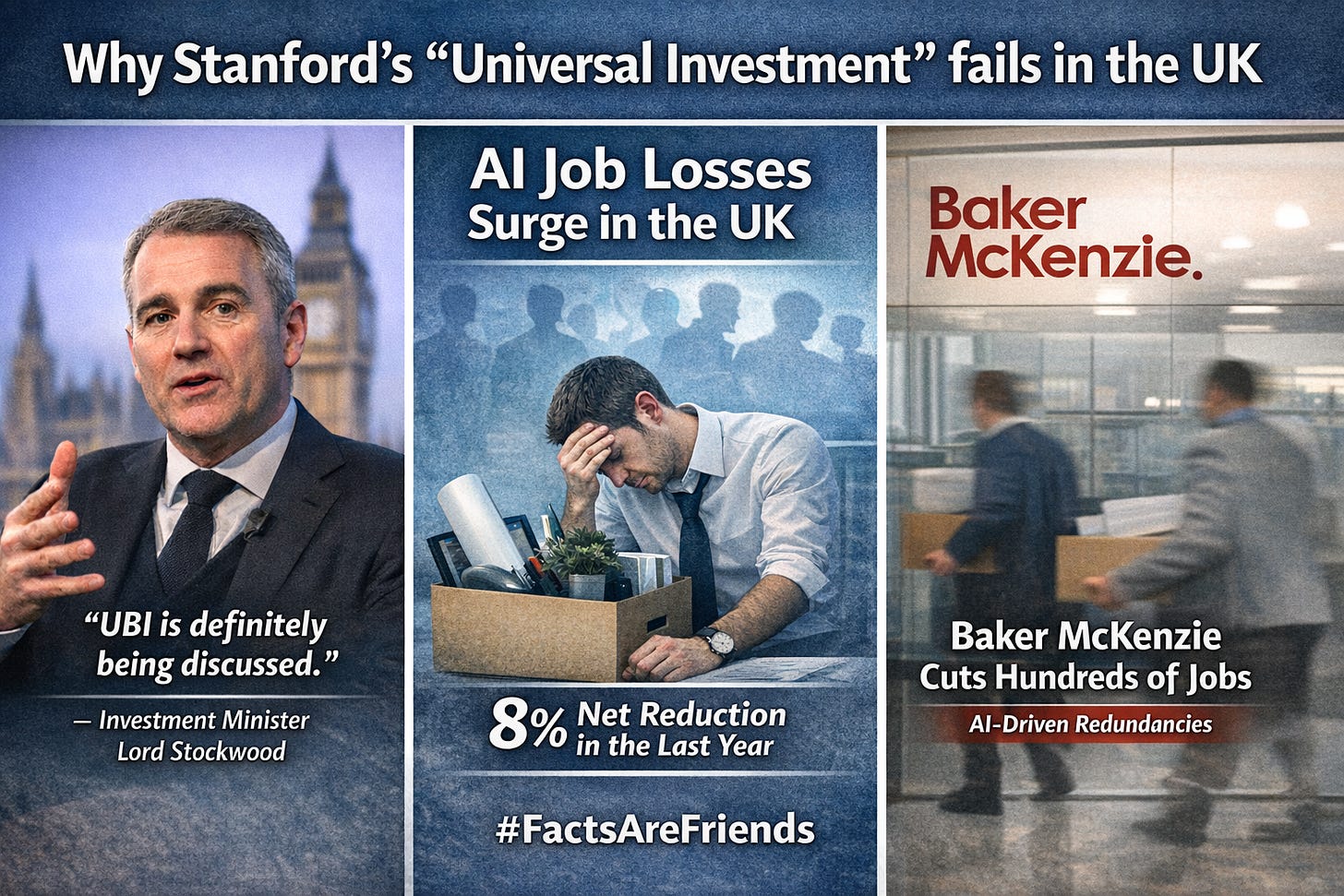
UK Investment Minister Lord Stockwood told the Financial Times this week that Universal Basic Income is “definitely” being discussed in government as AI displacement accelerates.¹ Technology Secretary Liz Kendall acknowledged that “some jobs will go”, pointing to early-career roles in finance and legal services.² I think that that may prove to be a massive understatement, but it is at the very least an acknowledgement of an awareness.
Morgan Stanley research shows British companies have suffered 8% net job losses from AI adoption over the past year - the steepest decline among major economies surveyed and twice the international average.³ Baker McKenzie, one of the world’s largest law firms, announced hundreds of AI-driven redundancies across its global business services team on the same day.⁴
The speed of convergence is striking. A year ago, UBI was still treated as a fringe proposition in mainstream UK politics. Today, a Labour investment minister is discussing it openly and the DWP is testing AI chatbots to replace welfare advisors.⁵ How AI will reshape the economic settlement between citizens and the state is daily emerging as a pressing question.
Into that gap comes an intriguing proposal from Stanford. Spoiler - I do not buy it, but I think it gives food for thought.
Stanford’s “Universal Investment”
In February 2026, Stanford HAI published research by Professor Alex “Sandy” Pentland - a Centre Fellow at Stanford HAI, Toshiba Professor at MIT and one of the most cited computational scientists in the world - proposing what he calls “Universal Investment”.⁶
The mechanism is straightforward: every new company deposits 10% of its founding shares in a sovereign wealth fund, modelled on Alaska’s Permanent Fund which distributes oil revenues to all citizens. The report claims that had this been in place for the last 30 years in the US, the fund would now be worth over $9 trillion - enough to pay every American citizen $3,000 a year, similar to Alaska’s fund in its best years.
Pentland argues that because shares are “worthless” at the point of incorporation, giving up 10% costs founders nothing and isn’t worth paying lawyers and lobbyists to avoid - particularly if the contribution provides future tax certainty.
The proposal has a certain (I think superficial) elegance. It apparently avoids the political toxicity of tax increases. It aligns citizens’ interests with economic growth rather than redistribution. And it scales naturally as AI enables what Pentland describes as “a world of distributed, less centralised companies and startups” - pointing to San Francisco’s working-age population of 600,000 supporting 15,000 venture-funded startups and 90,000 SMEs.
I’ve looked at it in the context of the UK. For me the elegance doesn’t survive the crossing.
The founder fallacy: shares are never worthless
The intellectual foundation of Universal Investment rests on the claim that founding shares have no value. This is technically true in accounting terms. It is psychologically and economically false.
Founders do not value their shares at nil. They value them at their hope value - the future they believe they are building and the entire reason they are starting the company in the first place. Hope value is what persuades people to leave secure employment, remortgage houses and work without salary for months or years. It is the most powerful motivator in the start-up economy.
Requisitioning 10% of that hope value at inception, then layering corporation tax, income tax and capital gains tax on top as the company grows, means the state is taking more from entrepreneurship, not less. At some point that burden stifles the innovation the fund depends on for its returns.
Pentland suggests that 10% of nothing isn’t worth fighting. Any corporate lawyer will tell you otherwise. Founders and their advisers are acutely sensitive to equity dilution from day one. The cap table is the first thing investors scrutinise. A mandatory 10% allocation to a sovereign wealth fund before a single pound of investment is raised changes the arithmetic of every funding round that follows.
Capital reacts faster than legislation
As a lawyer who has spent thirty years advising on corporate structures, I can predict with some confidence what happens next.
If the shares are dilutable, advisers will find structures to ensure the sovereign wealth fund’s holding is progressively reduced through successive funding rounds. Anti-dilution provisions are bread and butter for corporate lawyers. The fund’s 10% becomes 5%, then 3%, then economically irrelevant.
If the legislation makes the shares undilutable, the problem inverts. Investors and founders face a permanent 10% equity drag that cannot be managed or negotiated away. That makes ventures in jurisdictions with the levy structurally less attractive than those without it. Capital is mobile. Founders are mobile. AI makes both yet more mobile.
Then there are the unintended consequences. If the UK imposes a 10% founding equity levy and Dublin, Amsterdam or Delaware do not, entrepreneurs will simply incorporate elsewhere. The shares go offshore - and so does the corporation tax, the employer’s National Insurance, the business rates and the local economic activity that would otherwise have stayed here. You set out to capture 10% of future wealth and end up losing 100% of the existing tax base. Plus we lose the income tax on the staff not employed and the revenues on what those staff do not spend. Governments have learned this lesson before with corporate tax competition. It is surprising to see it overlooked here.
The liquidity problem no one wants to own
Even if every UK company dutifully deposited its 10% and stayed put, the sovereign wealth fund faces a fundamental operational problem: private company shares are illiquid. They generate no income unless the company pays dividends, which most startups and growth companies do not.
A fund holding millions of minority stakes in private companies has paper wealth but no cash to distribute to citizens. Converting that paper wealth into distributable income means selling shares - and every sale becomes a political decision. Sell early-stage holdings and you miss the upside. Hold too long and you are blamed when valuations fall. Sell a stake in a company that subsequently fails and you face accusations of insider knowledge. Sell a stake in a company that subsequently succeeds spectacularly and you face accusations of incompetence.
Alaska’s Permanent Fund works because it holds liquid assets - publicly traded securities and bonds funded by oil royalties. Universal Investment would hold the opposite: illiquid, non-income-producing minority stakes in private companies, many of which will fail entirely. The analogy to Alaska is appealing but structurally misleading.
And the UK context makes this harder still. UK pension funds have increasingly abandoned domestic equities in favour of overseas markets and bonds. If the institutions that should be championing British enterprise have already walked away, building a sovereign wealth fund on the back of British founding shares is building on sand.
A simpler path: tax the transaction, not the dream
The right question is how citizens share in AI-generated prosperity. Universal Investment offers one answer. I believe there is a better one.
Transaction-based taxation - extending proven VAT infrastructure to capture the digital economy - avoids every problem outlined above. It applies at point of sale, regardless of where the provider is based, so it cannot be shifted offshore. It generates immediate, liquid revenue rather than illiquid equity stakes. It requires no political decisions about when to buy or sell. It does not distort founder incentives or drive incorporation overseas. And it scales automatically as AI drives more economic activity through digital channels.
In my forthcoming book, AI, Abundance and the Future of Work, I propose a Digital Economy Participation Tax built on this principle. The mechanism uses existing VAT collection infrastructure - systems that already process over £150 billion annually with proven compliance. Rates are graduated by necessity: lower on essential digital services, higher on premium and luxury digital consumption. The tax captures AI-generated prosperity at the point where it enters the real economy, unavoidably and efficiently.
The advantages over equity requisition are significant. Transaction taxes are broad-based and stable, less volatile than corporate profits or equity valuations. They are progressive in impact, with higher rates on luxury consumption. They are work-neutral, creating no disincentive to employment or productivity. And they can be internationally coordinated, building on existing frameworks like the UK’s 2% Digital Services Tax, France’s 3% digital platform levy and Austria’s 5% digital transaction tax, to prevent harmful jurisdictional competition.
This is not a radical departure from proven fiscal policy. It is an adaptation of systems that already work, extended to capture an economy that increasingly operates through digital transactions. The fuller implementation framework, including phased rollout and international coordination challenges, is set out in the book.
Participation without distortion
Pentland is asking exactly the right question at exactly the right time. As AI reshapes the relationship between capital, labour and the state, we need mechanisms that give citizens a genuine stake in the prosperity that technology creates. UBI funded through conventional taxation creates endless political battles over redistribution. Shared participation in economic growth is a more durable foundation.
Where I part company with the Stanford proposal is on mechanism. Equity requisition sounds frictionless but founders, lawyers and capital markets will ensure it is anything but. Transaction-based taxation is less intellectually exciting but it actually works - it collects revenue unavoidably, distributes it immediately and leaves the startup ecosystem undistorted.
For the UK specifically, the priority should be building the domestic innovation ecosystem and ensuring that AI-generated economic activity is taxed where it occurs, not chasing equity stakes in companies that will incorporate elsewhere to avoid handing them over.
Right question. Interesting suggestion. For the UK, a different answer.
Exploring how AI reshapes society, work, politics and human connection - from my forthcoming book. #FactsAreFriends
Notes
[1] Lord Stockwood interview, Financial Times, reported by Fortune, 1 February 2026: https://fortune.com/2026/02/01/elon-musk-optional-work-fantasy-universal-basic-income-uk-minister-jason-stockwood/
[2] Lord Stockwood confirms UBI “definitely” being discussed, GB News, 30 January 2026: https://www.gbnews.com/money/universal-basic-income-labour-ai-jobs
[3] Morgan Stanley study on UK AI-driven job losses, Engineering & Technology Magazine, 27 January 2026: https://eandt.theiet.org/2026/01/27/ai-driven-job-losses-hitting-uk-harder-other-big-economies
[4] Baker McKenzie business services cuts citing AI, Legal Cheek, 6 February 2026: https://www.legalcheek.com/2026/02/baker-mckenzie-to-cut-business-services-roles-as-ai-use-grows/
[5] DWP AI chatbot proposals, The Register, 6 February 2026: https://www.theregister.com/2026/02/06/dwp_chatbot_testing/
[6] Alex Pentland, “Big Changes in the World: Davos 2026”, Stanford HAI / Digital Economy Lab: https://digitaleconomy.stanford.edu/news/big-changes-in-the-world-davos-2026/